






Definition & Meaning
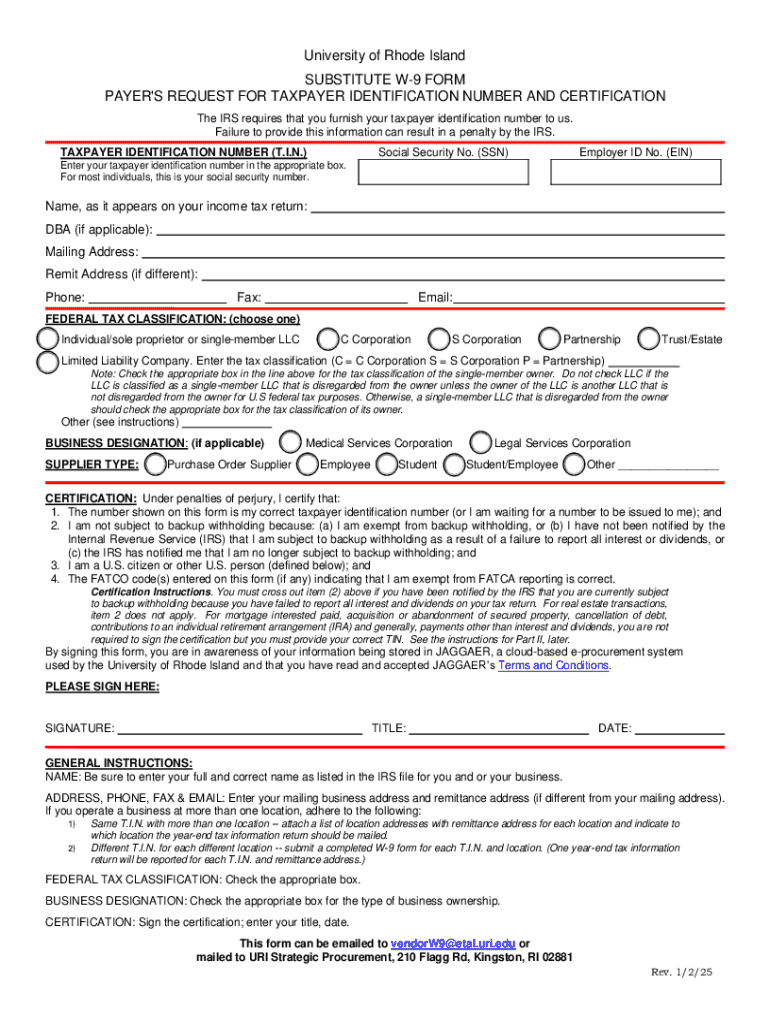
The Payer's Request for Taxpayer Identification Number and Certification is an essential form in the U.S. tax system. Commonly referred to as the W-9 form, it facilitates the process of collecting essential tax information from individuals and entities. This form enables the requester, often a business or financial institution, to obtain the correct taxpayer identification number (TIN) of a payee for reporting income paid. The W-9 form is pivotal in ensuring compliance with Internal Revenue Service (IRS) regulations and avoiding penalties related to incorrect or unreported income.
Key Components of the W-9 Form
-
Taxpayer Identification Number (TIN): This is a critical part of the form, where the payee provides either their Social Security Number (SSN) or Employer Identification Number (EIN).
-
Certification: By signing the W-9, the taxpayer certifies that their TIN is correct and that they are not subject to backup withholding.
-
Business Name and Classification: The form asks for the taxpayer's business name and type, such as individual, corporation, or partnership, to accurately classify them for tax purposes.
Purpose of the W-9 Form
The W-9 is mainly used for informational returns, such as 1099 forms, where the payer reports income other than wages, tips, and salaries. Its proper use ensures that all taxable revenue is reported correctly and helps the IRS track income and ensure compliance.
Steps to Complete the PAYER'S REQUEST FOR TAXPAYER IDENTIFICATION NUMBER AND CERTIFICATION
Completing a W-9 form accurately is crucial for both payers and payees to comply with tax regulations. It involves several straightforward yet essential steps.
-
Provide Your Name and Business Entity Type:
- Fill in your legal name as it appears on your tax return.
- If applicable, enter your business name or disregarded entity name.
-
Select Your Federal Tax Classification:
- Choose the appropriate option: individual, sole proprietor, corporation, partnership, etc.
-
Enter Your Address:
- Use your business or home address depending on your tax return type.
-
Provide TIN:
- Enter your SSN or EIN accurately, ensuring it matches IRS records.
-
Sign and Date the Certification:
- By signing, you confirm that all information is accurate and that you are not subject to backup withholding unless noted.
Avoiding Common Errors
-
Double-check Numbers: Ensure that the TIN is entered correctly to avoid processing issues.
-
Proper Classification: Make sure to select the correct classification to prevent IRS mismatches.
-
Sign the Form: An unsigned form is considered incomplete and can lead to delays or penalties.
Who Typically Uses the PAYER'S REQUEST FOR TAXPAYER IDENTIFICATION NUMBER AND CERTIFICATION
The W-9 form is a common requirement for various entities and individuals in the U.S. tax landscape. It is primarily used by:
-
Freelancers and Independent Contractors: Required to submit W-9 forms to every company or client that pays them more than $600 in a tax year.
-
Businesses and Corporations: Companies request W-9s from vendors or contractors to report payments made for services or goods.
-
Financial Institutions: Banks require W-9 forms to report interest, dividends, or other income received over the year.


Legal Use of the PAYER'S REQUEST FOR TAXPAYER IDENTIFICATION NUMBER AND CERTIFICATION
Ensuring legal compliance with the W-9 form is critical for both payers and payees.
Regulatory Requirements
-
IRS Regulations: The W-9 form aligns with section 3406 of the Internal Revenue Code, dictating when a taxpayer's identification should be collected and verified.
-
Backup Withholding: Taxpayers who fail to provide a correct TIN may be subject to backup withholding of 24% on reportable payments.
Penalties for Non-Compliance
-
Fines: There are potential fines for providing false information or for failing to furnish a TIN timely.
-
Tax Liabilities: Incorrect completion can lead to additional tax liabilities and legal issues.
Important Terms Related to PAYER'S REQUEST FOR TAXPAYER IDENTIFICATION NUMBER AND CERTIFICATION
Understanding key terminology associated with the W-9 form ensures comprehension and accurate execution.
-
TIN: Taxpayer Identification Number, either an SSN for individuals or an EIN for entities.
-
Backup Withholding: A type of tax withholding when a taxpayer ID is incorrect or missing.
-
Certification: The taxpayer's assertion that the information provided is correct and they are not subject to withholding.
Examples of Key Terms in Use
- TIN Use Case: A sole proprietor provides an SSN on a W-9 to a company hiring them for freelance work.
- Backup Withholding Scenario: A subcontractor submits a W-9 with an incorrect EIN and is notified they will be subject to 24% backup withholding until corrected.
Steps to Obtain and Submit the PAYER'S REQUEST FOR TAXPAYER IDENTIFICATION NUMBER AND CERTIFICATION
Obtaining and submitting the W-9 form effectively involves straightforward steps:
-
Accessing the Form:
- Available on the IRS website or can be requested directly from the payer needing the form.
-
Filling Out the Form:
- Complete as instructed, ensuring all details are correct.
-
Submitting to the Requester:
- Return via mail, in-person delivery, or securely online if the requester permits electronic submission.
Best Practices for Submission
-
Privacy and Security: When submitting electronically, ensure the transfer method is secure to protect sensitive information.
-
Record Keeping: Retain a copy of the completed form for personal records and future verification.
Key Elements of the PAYER'S REQUEST FOR TAXPAYER IDENTIFICATION NUMBER AND CERTIFICATION
Central to the form are elements that must be accurately completed to ensure compliance:
Personal and Business Details
- Name: Legal name matching tax returns.
- TIN: Accurate SSN or EIN.
Certification Statement
- Backup Withholding Exemption: Certify status regarding withholding, with options for exemptions if applicable.
Address
- Current Address: Using the most up-to-date mailing or business address for the tax year.
Ensuring these core components are accurate avoids complications and streamlines tax reporting processes across all involved parties.