







Definition and Purpose
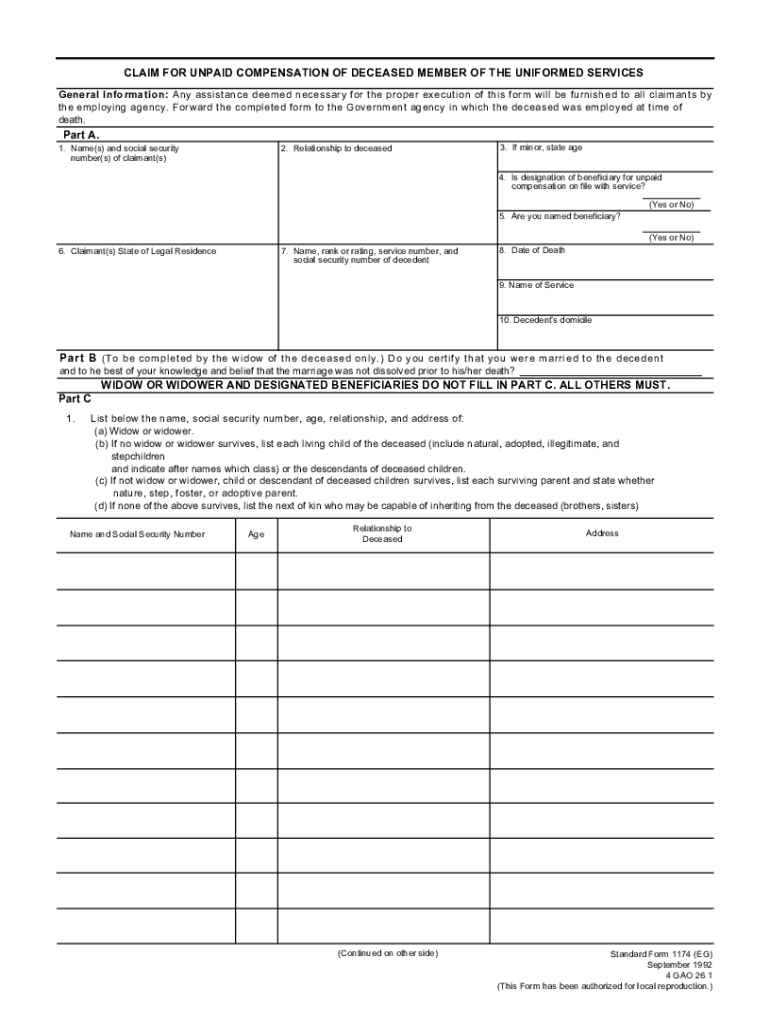
The "Claim for Unpaid Compensation of Deceased Member of the Uniformed Services" is a legal form designed to enable beneficiaries to request payment for any remaining unpaid compensation owed to a deceased member of the uniformed services. This form plays a crucial role in ensuring that the financial entitlements of deceased service members are rightfully distributed to their designated heirs or beneficiaries. It covers accrued salary, allowances, and other compensatory benefits that remain unpaid at the time of the service member’s death.
Examples and Practical Scenarios
- If a service member passes away before receiving their final paycheck, the designated beneficiary can use this form to claim the owed amount.
- It is also applicable when claiming bonuses or allowances that were approved but not yet disbursed before the service member’s demise.
Eligibility Criteria
The eligibility to file the "Claim for Unpaid Compensation of Deceased Member of the Uniformed Services" depends on the beneficiary’s relationship to the deceased and the designation made by the service member. Beneficiaries often include the spouse, children, or legal representatives.


Criteria Breakdown
- Primary Beneficiaries: Typically, legal spouses or children listed in the will or designations made by the deceased.
- Legal Representatives: If no beneficiaries are designated, executors of the estate may file the claim.
- Dependency Status Consideration: The dependency status may influence eligibility, particularly if children or non-spousal family members are involved.
Steps to Complete the Claim Form
- Gather Required Documentation: Collect all necessary documents, including the death certificate, proof of relationship, and service records of the deceased.
- Identify Beneficiaries: Ensure clarity on who is legally recognized as a beneficiary as per the service member’s records.
- Fill Out the Form: Complete the sections detailing personal information, service details of the deceased, and the payment information for the beneficiary.
- Attach Supporting Documents: These may include marriage certificates, birth certificates for children, and any legal documentation confirming executorship if applicable.
- Submit the Form: Follow the specified submission method, which may include mailing the form to a designated military finance office or filing it online if available.
Edge Cases and Variations
- Multiple beneficiaries need coordination to avoid duplicate claims.
- Legal disputes may require additional documentation like court orders to confirm beneficiary status.
Required Documents
Certain key documents are typically necessary for processing the claim successfully. The absence of any required document can delay the claim processing.
- Death Certificate: Official proof of the deceased's death.
- Proof of Relationship: Marriage or birth certificates, or legal guardianship papers.
- Military Service Records: To verify the deceased's active or retired status.
- Legal Documents for Executors: If claiming on behalf of the estate.
Form Submission Methods
The submission process accommodates various preferences and logistical needs, catering to digital and physical forms.
- Online Submission: Available through certain military online portals, offering convenience and faster processing.
- Mail-In Option: Some beneficiaries might prefer or require mailing the completed form and documents to a specified military finance address.
- In-Person Submission: Direct submission at military finance offices may be necessary in certain jurisdictions.
Legal Use and Compliance
Filing the claim correctly is essential for ensuring compliance and preventing any legal complications. Beneficiaries must adhere to U.S. regulations governing the distribution of military compensation.
- ESIGN Act Compliance: For electronic signatures on online submissions.
- State-Specific Regulations: Vary by locality, especially concerning probate law and estate claims.
Key Elements of the Claim Form
Each section of the form is structured to capture important information accurately. Understanding each component is essential for successful completion.
- Personal Information Section: Captures the deceased's and claimant's personal details.
- Service Information Section: Details about the deceased’s military service, units, and active duty history.
- Payment Information: Specifies how and to whom the unpaid compensation should be disbursed, requiring bank details or alternative payment instructions.
Filing Deadlines and Important Dates
Adhering to timeline requirements ensures that claims are processed efficiently and beneficiaries receive entitled payments without delay. Deadlines are often aligned with the date of death.
- Initial Filing Deadline: Typically within six months of the service member’s death.
- Extensions: May be available upon request and subject to approval, depending on specific circumstances.




