






Definition and Meaning of the Relationship Contract Agreement
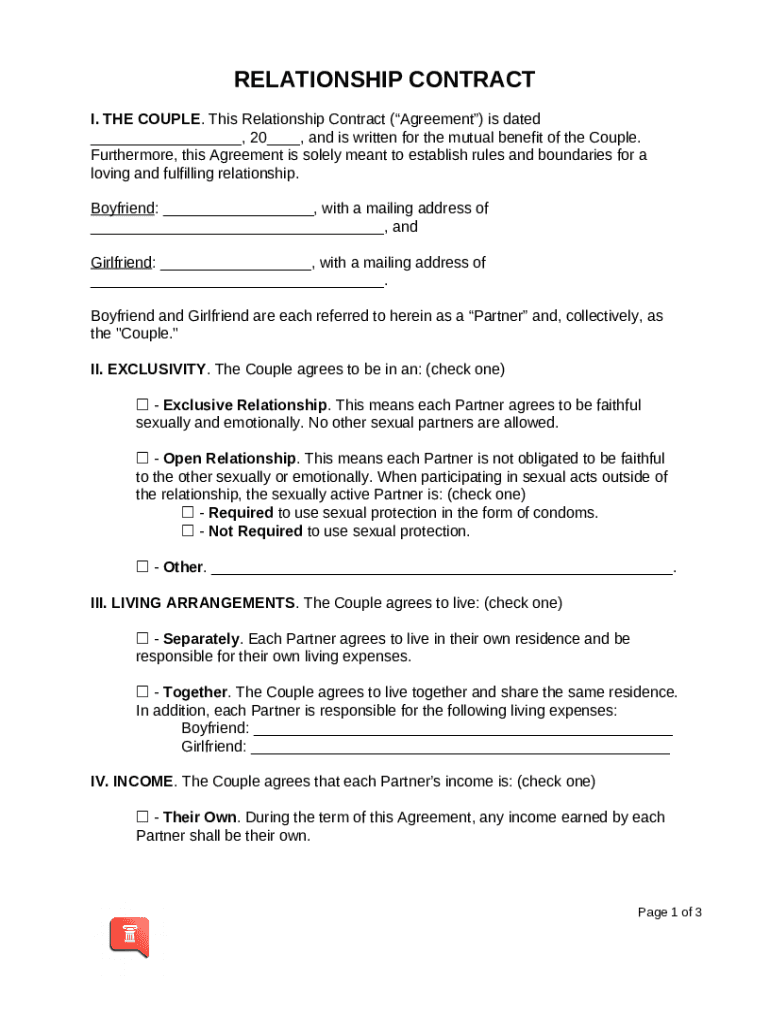
A Relationship Contract Agreement is a formal document that outlines the expectations, responsibilities, and commitments between two individuals in a relationship. Unlike typical contracts, this agreement focuses on the personal and relational aspects rather than legal or business obligations. It aims to ensure mutual understanding and clarity about the relationship's dynamics, enhancing communication and addressing concerns before they escalate.
Relationship Contract Agreements can take various forms and may include sections on financial responsibilities, living arrangements, personal goals, communication methods, and dispute resolution mechanisms. They are tailored to the couple's unique needs and desires, providing a structured framework to navigate their relationship effectively.
How to Use the Relationship Contract Agreement
To effectively use a Relationship Contract Agreement, both parties should actively participate in its creation:
-
Discussion and Drafting: Begin with open conversations about the terms and conditions that are important to both parties. Consider personal values, individual needs, and joint goals.
-
Customization: Adapt the agreement to reflect the specifics of your relationship. Include clauses on practical aspects such as shared expenses, division of chores, and emotional support.
-
Review and Revise: Periodically revisit and update the agreement as the relationship evolves. Ensure it remains relevant and serves the intended purpose of maintaining harmony and understanding.
-
Implementation: Integrate the terms into daily interactions, using the agreement as a guide to manage conflicts and make decisions collaboratively.
Steps to Complete the Relationship Contract Agreement
Completing a Relationship Contract Agreement involves several important steps:
-
Identify Key Areas: Pinpoint the most critical areas of your relationship that require clear agreements, such as finance, time management, intimacy, and conflict resolution.
-
Articulate Expectations: Clearly describe what each person expects from the other in these areas. This might include daily communication habits, shared responsibilities, or vacation planning.
-
Draft Agreement: Write the initial draft detailing all agreed-upon terms. Use clear and precise language to avoid any ambiguity or misinterpretation.
-
Seek Mutual Agreement: Ensure both parties fully understand and agree to the terms. Revise any section that doesn't satisfactorily address one party's concerns.
-
Formalize the Agreement: Once both parties are satisfied, formalize the document by signing and dating it. This symbolizes commitment to the outlined responsibilities.
Key Elements of the Relationship Contract Agreement
The core of a Relationship Contract Agreement revolves around several key elements:
-
Commitment Pledge: A mutual acknowledgment of commitment to the relationship and respect for the agreement's terms.
-
Financial Arrangements: Define how expenses will be shared, including bills, savings, and investments.
-
Conflict Resolution: Establish procedures for addressing disputes, such as regular check-in meetings or counseling sessions.
-
Personal Growth: Encourage support for each other's personal development goals, be it education, hobbies, or career aspirations.
-
Boundaries and Privacy: Set clear boundaries regarding personal space and privacy, respecting individual needs for solitude and independence.
Who Typically Uses the Relationship Contract Agreement
Relationship Contract Agreements are used by a wide range of people:
-
Couples at the Beginning of a Relationship: Establish a strong foundation and prevent misunderstandings.
-
Long-Term Couples: Use to reassess and rejuvenate the relationship by addressing current dynamics and future goals.
-
Co-habitating Couples: Manage domestic responsibilities and shared expenses in a structured manner.
-
Couples with Unique Circumstances: Those in long-distance or non-traditional relationships might use these agreements to navigate specific challenges.


Legal Use of the Relationship Contract Agreement
While not legally binding, a Relationship Contract Agreement serves as a documented understanding that may hold moral weight. In some cases, especially where certain provisions overlap with legal concerns (e.g., financial support), the agreement may be referenced in court proceedings to clarify the intent and understanding of the parties at the time of the agreement. Always consider consulting a legal professional to ensure alignment with local laws and regulations when drafting clauses with potential legal implications.
State-Specific Rules for the Relationship Contract Agreement
Since Relationship Contract Agreements are more personal than legal, they are generally not subject to state regulations. However, the legal enforceability of certain clauses—particularly those related to financial commitments—may depend on state-specific laws. In states like California, for instance, cohabitation agreements (which overlap with some elements of relationship contracts) could be examined under contract law. Individuals should research their state's laws or seek legal counsel to understand how specific agreement components may be viewed legally.
Examples of Using the Relationship Contract Agreement
The application of a Relationship Contract Agreement can vary significantly based on personal circumstances:
-
Young Professional Couples: Define career support strategies and work-life balance to avoid stress affecting the relationship.
-
Retiree Couples: Ensure alignment on retirement goals, leisure activities, and healthcare planning.
-
Re-married Couples: Clearly set expectations regarding financial responsibilities and integration of family dynamics.
By providing structured communication strategies, the Relationship Contract Agreement helps navigate the complexities of modern relationships with transparency and trust.