
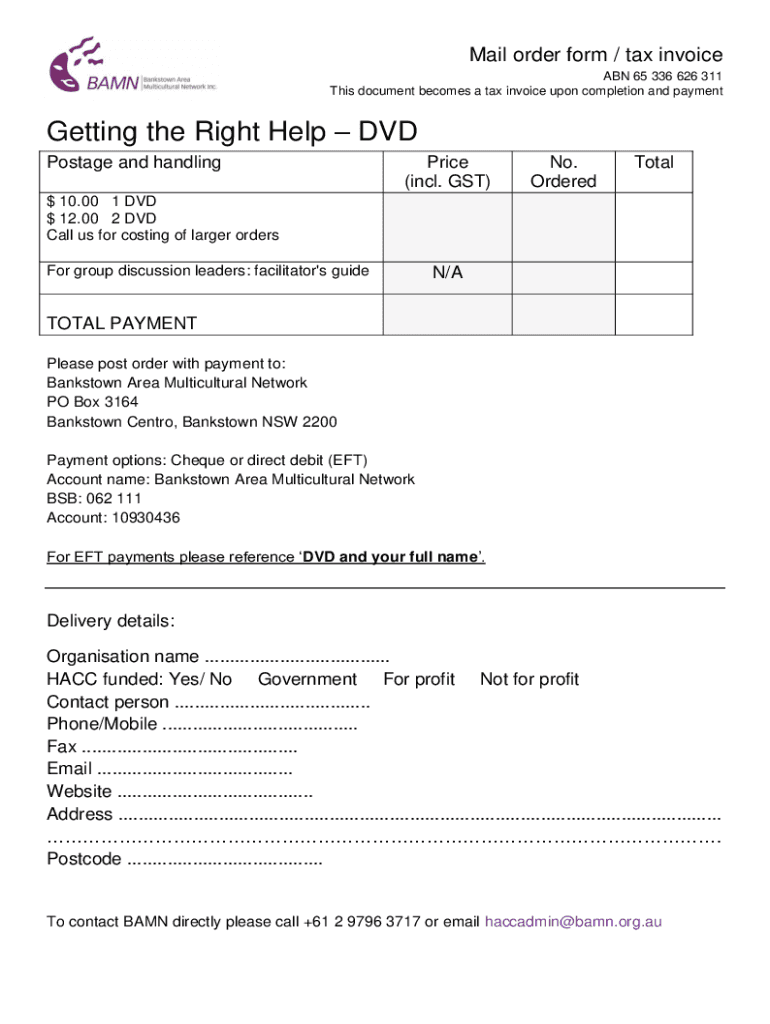







Definition & Meaning
A "Mail Order Form Tax Invoice" is a hybrid document serving two primary purposes. It acts as an order form for purchasing goods or services via mail order and as a tax invoice providing essential billing information. Often needed by businesses and individuals to streamline transactions, this document outlines the goods or services purchased, prices, taxes applied, and the total amount due. As both an order form and an invoice, it provides clarity on sales transactions that require accurate tracking for both vendor and customer.
Distinct Characteristics
- Order Form Elements: Include fields for product descriptions, quantity, and pricing.
- Tax Invoice Elements: Outline applicable taxes (e.g., sales tax), total amount payable, and vendor details.
- Dual Purpose: Both records sales transactions for the buyer and serves as tax documentation for the seller.
How to Use the Mail Order Form Tax Invoice
Utilizing the Mail Order Form Tax Invoice efficiently enables smooth transaction handling and proper record-keeping.
Step-by-Step Usage
-
Filling Out Order Information:
- List the items or services you wish to order.
- Provide quantities and itemized pricing for each product.
-
Tax Calculation:
- Enter any applicable taxes, specifying the type and rate (e.g., GST).
- Confirm the total payable amount, including taxes.
-
Customer and Vendor Details:
- Enter buyer and seller information, including contact details.
- Ensure accuracy to prevent processing delays.
-
Submission:
- Mail the form with any necessary payment information or enclosures.
- Retain a copy for personal records.
-
Verification and Confirmation:
- Upon receipt and processing, await confirmation or clarification from the vendor.
Steps to Complete the Mail Order Form Tax Invoice
Completing the Mail Order Form Tax Invoice involves several systematic steps to ensure accuracy and compliance.
Detailed Steps
-
Header Information:
- Include the document title and issue date.
- Assign a unique invoice or order number for tracking.
-
Product or Service Details:
- Clearly describe each item or service.
- Include individual prices and total before tax.
-
Tax and Total Calculation:
- Calculate taxes based on applicable laws.
- Verify the total payable figure, incorporating all components.
-
Payment Instructions:
- Outline acceptable payment methods and terms.
- Include any deadlines for payment completion.
Important Terms Related to Mail Order Form Tax Invoice
Understanding key terminology facilitates better comprehension of the Mail Order Form Tax Invoice.
Key Terms Explained
- Invoice Number: A unique identifier for tracking and reference.
- GST/VAT: Taxes applied to goods and services, often itemized separately.
- Net Amount: The total before taxes.
- Grand Total: The all-inclusive amount owed, encompassing all fees and taxes.
Key Elements of the Mail Order Form Tax Invoice
The document incorporates crucial components to fulfil its function effectively.
Essential Elements
- Buyer and Seller Information: Names, addresses, and contact details.
- Itemized List of Products or Services: Clear description and quantity.
- Pricing Details: Item price, any discounts, and tax amounts.
- Total Payment Due: Sum of all items, taxes included, with payment instructions.
Legal Use of the Mail Order Form Tax Invoice
Both buyers and sellers must adhere to specific regulations when using the form.
Compliance and Legal Considerations
- Accuracy: Ensure all entries are precise to prevent disputes.
- Record-Keeping: Maintain copies for future reference, audits, and legal purposes.
- Legal Requirements: Align with state or federal sales tax laws to avoid penalties.
Form Submission Methods (Online / Mail / In-Person)
Various methods exist for submitting the form, each with its own advantages.
Methods Overview
-
Mail Submission:
- Traditional postal service, ideal where digital means are not available.
- Requires sufficient mailing lead time for processing.
-
Electronic Submission:
- Efficient for digital-savvy users, offering quicker processing and confirmation.
- Utilize PDF conversion and email or platform-specific uploads.
-
In-Person Submission:
- Direct handover to the vendor, offering immediate confirmation but requiring physical presence.
Who Typically Uses the Mail Order Form Tax Invoice
Identifying primary users provides insight into its typical application.


Primary Users
- Small Businesses: Often used to manage sales and tax documentation.
- Self-Employed Professionals: Important for individual transactions requiring formal invoicing.
- Online Retailers: Useful for order fulfilment and record-keeping in mail orders.
By implementing these detailed insights and guidelines, users of the Mail Order Form Tax Invoice can effectively manage transactions, ensuring all legal and tax considerations are met efficiently.




