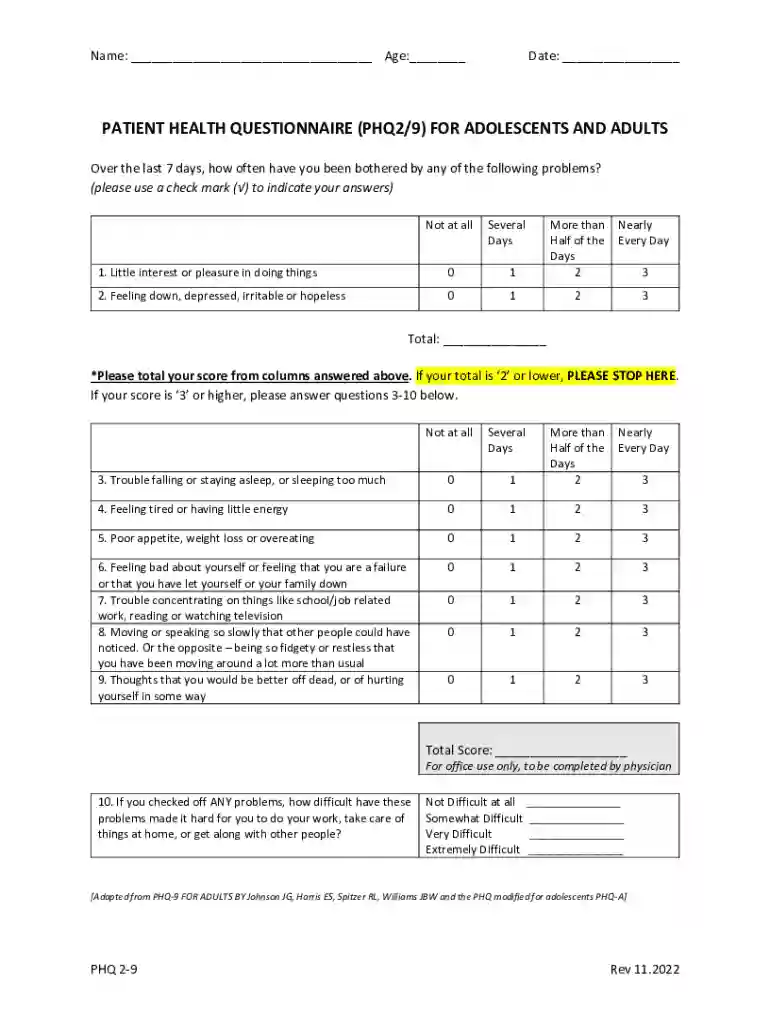
Definition & Meaning
The Patient Health Questionnaire (PHQ-2/9) is a tool used for screening, diagnosing, monitoring, and measuring the severity of depression in adolescents and adults. The PHQ-2 is a preliminary evaluation, consisting of the first two questions from the PHQ-9, to quickly assess whether further investigation is warranted. The PHQ-9 expands on this by providing a more in-depth examination of depression symptoms to determine their severity.
Key Characteristics
- PHQ-2 Focus: Concentrates on the frequency of depressed mood and anhedonia over the past two weeks.
- PHQ-9 Coverage: Expands to include additional symptoms such as sleep disturbances, fatigue, changes in appetite, feelings of worthlessness, and concentration difficulties.
How to Use the Patient Health Questionnaire PHQ2 9
Using the PHQ-2/9 involves assessing participants with a standardized set of questions to identify depression levels. The user should follow these steps:
- Administer the PHQ-2: Begin by asking the participant the first two questions to evaluate the presence of depressive symptoms.
- Interpret PHQ-2 Results: A score of three or more suggests the need for the complete PHQ-9 assessment.
- Administer the PHQ-9: Use this when PHQ-2 results indicate potential depression. It consists of a broader question set that covers various depressive symptoms.
Practical Example
A primary care physician might use the PHQ-2/9 during a regular check-up to screen adolescents and adults for depression, integrating it into the patient's electronic health records for continuous monitoring.
Steps to Complete the Patient Health Questionnaire PHQ2 9
- Provide Questionnaire: Ensure that the questionnaire is accessible, whether digitally or on paper.
- Instruct Patients: Clarify the importance of honest and introspective reflection when answering questions.
- Score the Questionnaire: Use the scoring system (0-3 for each question) to calculate total scores.
- Review Results: Evaluate scores against thresholds to determine the severity and need for further intervention or referral to a mental health professional.
Flow of Completion
- PHQ-2: Scores range from 0 to 6; scores of 3 or above require further assessment.
- PHQ-9: Total scores help determine the depression severity level: minimal, mild, moderate, moderately severe, or severe depression.
Why Use the Patient Health Questionnaire PHQ2 9
The PHQ-2/9 is widely used for its effectiveness in identifying individuals who suffer from depression, allowing for timely interventions. Key reasons for its use include:
- Efficiency: Quick to administer, especially PHQ-2, making it ideal for settings with time constraints.
- Research Validity: Supported by numerous studies, providing validated results.
- Comprehensive Detection: Captures a wide range of depressive symptoms to guide clinicians in developing appropriate treatment plans.
Who Typically Uses the Patient Health Questionnaire PHQ2 9
The PHQ-2/9 is utilized by various professionals and settings, including:

- Primary Care Providers: For initial depression screening in regular check-ups.
- Mental Health Specialists: As part of psychiatric evaluations.
- Researchers: In clinical studies focused on depression and related conditions.
Key Elements of the Patient Health Questionnaire PHQ2 9
PHQ-2 Elements
- Focus Areas: Mood and pleasure in activities.
- Purpose: Identifying candidates for further screening.
PHQ-9 Elements
- Comprehensive Symptoms: Cover topics like sleep changes, self-esteem issues, and suicidal thoughts.
- Severity Scoring: Ranges from minimal to severe depression classifications.
Legal Use of the Patient Health Questionnaire PHQ2 9
The use of the PHQ-2/9 in clinical settings must adhere to legal requirements regarding patient confidentiality and informed consent. Professionals should ensure:
- HIPAA Compliance: Protect patient data in digital and paper formats.
- Consent Documentation: Secure patient consent prior to questionnaire administration.
Digital vs. Paper Version
Digital and paper formats of the PHQ-2/9 offer flexibility depending on the context:
Digital Version
- Convenience: Easily integrates into electronic health records and promotes telehealth adoption.
- Efficiency: Automated scoring reduces the potential for human error.
Paper Version
- Accessibility: Useful in settings without digital resources.
- Tangible Record: Provides a physical copy for patient files where electronic documentation is unavailable.
Both formats maintain the integrity of the screening process while offering flexibility to meet different practice needs.