
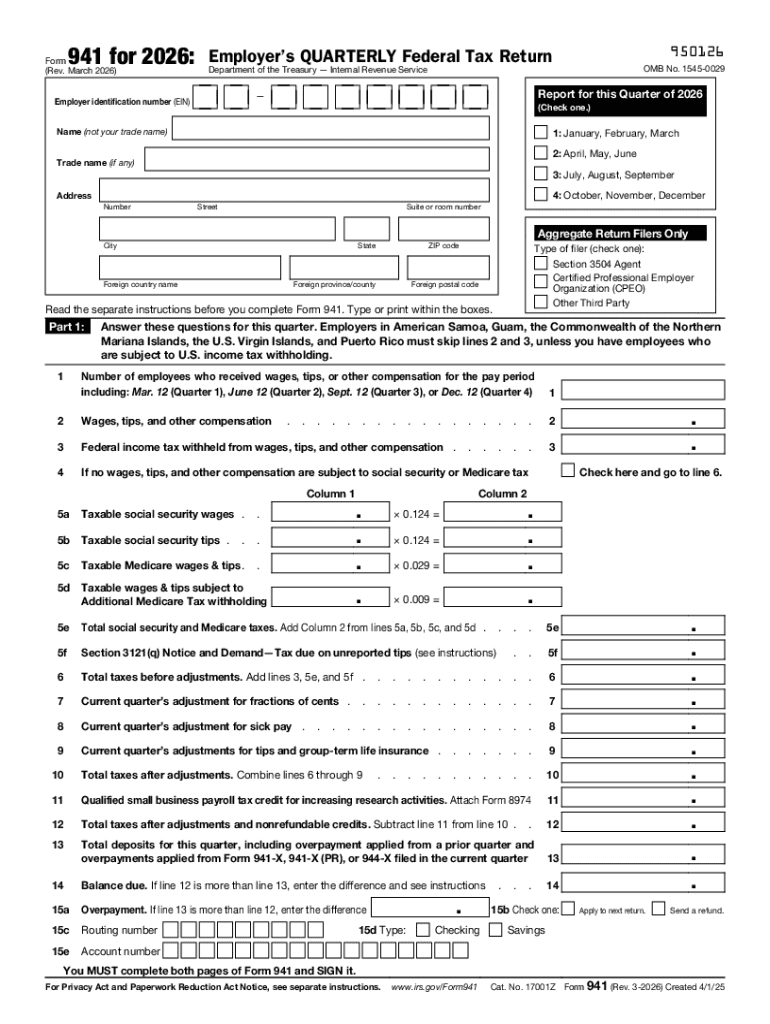







Definition & Overview of Form 941 (Rev March 2026)
Form 941, also known as the Employer's Quarterly Federal Tax Return, is a critical document used for reporting employment taxes. The March 2026 revision of Form 941 is designed to facilitate employers in accurately reporting wages paid to employees, the taxes withheld, and the employer's share of Social Security and Medicare taxes. This form is essential for maintaining compliance with IRS regulations and ensuring accurate tax records.
- Purpose: To report income taxes, Social Security tax, and Medicare tax withheld from employees' paychecks, along with the employer's contribution to Social Security and Medicare taxes.
- Tax Reporting: Summarizes quarterly tax liabilities and deposits made, helping employers reconcile their payroll reports with IRS records.
- Revision Specifics: The Rev March 2026 update reflects the latest tax law changes and any adjustments in tax reporting requirements.
How to Use the Form 941 (Rev March 2026)
Employers must follow a structured process to complete and file Form 941 accurately. This section outlines the step-by-step approach to using Form 941 effectively:
- Collect Employee Information: Gather all necessary data, including employee wages, tips, federal income tax withheld, and total compensation.
- Calculate Tax Liabilities: Determine the amounts for Social Security, Medicare, and withheld income taxes.
- Complete Each Part:
- Part 1: Report the number of employees and wages paid.
- Part 2: Provide total taxable wages and calculate federal tax liabilities.
- Part 3: Reconcile with payments made and tax liabilities.
- Double-check Entries: Ensure all calculations and reported amounts are accurate.
- Submit Form: Choose the appropriate method for filing, online or by mail.
Steps to Complete the Form 941 (Rev March 2026)
Completion of Form 941 involves a series of detailed steps ensuring compliance with tax requirements:
- Step 1: Payroll Reconciliation: Align payroll records with the amounts reported on the form.
- Step 2: Input Employee Data: Enter employee details, including Social Security numbers and total wages.
- Step 3: Tax Calculations: Compute the taxes owed for Social Security and Medicare, considering current rates.
- Step 4: Reporting: Fill out Parts 1 through 4, ensuring accuracy in reported figures.
- Step 5: Signature and Date: Certify the form with an authorized signature and the current date.
- Step 6: Filing: Choose between electronic filing or mail submission, ensuring adherence to IRS deadlines.
Why You Need Form 941 (Rev March 2026)
Using Form 941 is crucial for several reasons, primarily focusing on compliance, reporting accuracy, and financial management:
- Regulatory Compliance: Essential for meeting IRS requirements, avoiding penalties, and ensuring appropriate tax payments are made.
- Financial Accuracy: Aids in maintaining accurate employee compensation records and tax withholdings.
- Audit Preparation: Helps businesses prepare for potential audits by ensuring all reported data aligns with payroll records.
- Cash Flow Management: Predict and plan for tax liabilities, aiding in better financial decision-making.
Who Typically Uses Form 941 (Rev March 2026)
The form is predominantly used by the following entities:
- Small to Medium-sized Businesses: Engage in regular payroll operations and federal tax withholdings.
- Corporations and Large Enterprises: Must report significant payrolls and tax contributions accurately.
- Non-Profit Organizations: Required to report on employee compensation and taxes withheld.
- Government Entities: Federal, state, and local governments responsible for tax reporting on behalf of their employees.
Key Elements of Form 941 (Rev March 2026)
Understanding the core components of Form 941 is vital for accurate completion:
- Employer Information: Includes the business name, address, and employer identification number (EIN).
- Wages and Compensation: Detailed reporting of total wages paid to employees.
- Tax Liabilities: Comprehensive breakdown of Social Security, Medicare, and federal income taxes owed.
- Deposits and Payments: Summary of tax deposits made and any remaining balances due.
IRS Guidelines for Form 941 (Rev March 2026)
Adhering to IRS guidelines ensures proper compliance and minimizes risks of errors:
- Timely Filing: Forms must be submitted quarterly, generally by the last day of the month following the end of the quarter.
- Record Keeping: Maintain copies of filed forms and all supporting documentation for at least four years.
- Penalty Avoidance: Understand potential penalties and interest for late filings or underpayments.
Filing Deadlines & Important Dates
To ensure compliance, keeping track of important dates is essential:
- Quarterly Deadlines: Forms must be filed by April 30, July 31, October 31, and January 31.
- Deposit Schedules: Follow the IRS deposit schedule to ensure timely payments of withheld taxes.
- Yearly Reconciliation: At the year's end, reconcile Form 941 with Forms W-2 and W-3 to ensure accuracy.




