
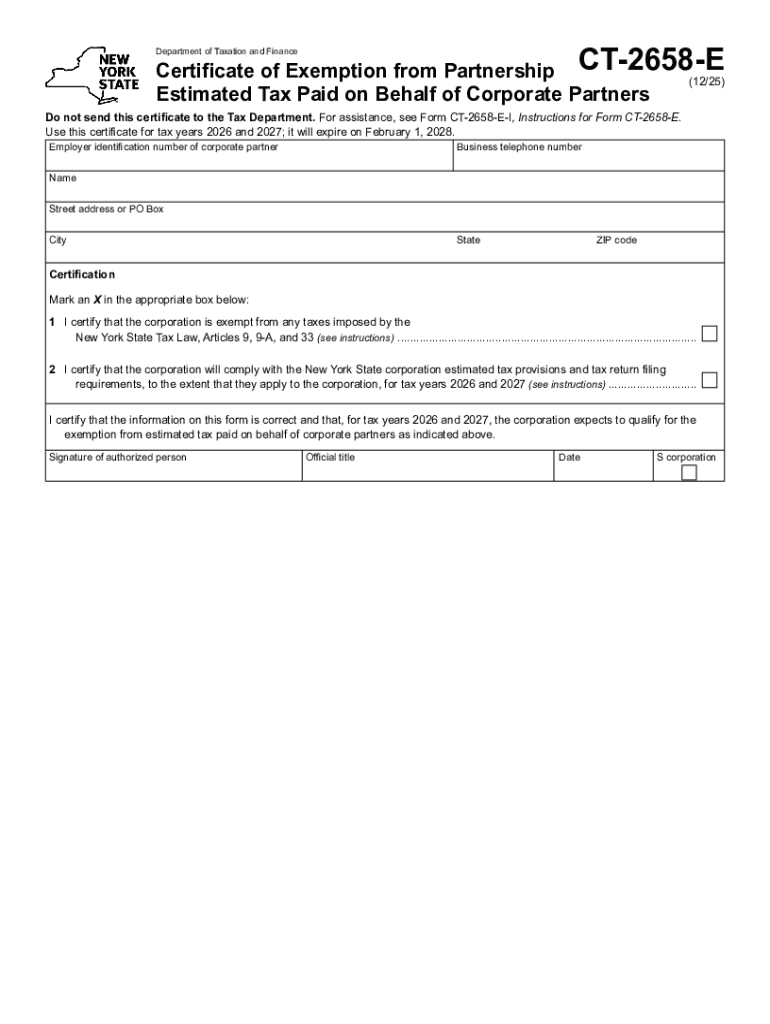







Definition of Form CT-2658-E Certificate of Exemption
Form CT-2658-E, known as the Certificate of Exemption from Partnership Estimated Tax Paid on Behalf of Corporate Partners, is a document used primarily within the context of U.S. taxation. It serves to exempt certain corporate partners in a partnership from the obligation to pay estimated taxes on their behalf. This form is crucial for corporate partners who are part of partnerships that distribute income and want to avoid the default estimated tax withholding.
How to Use Form CT-2658-E
Utilizing Form CT-2658-E effectively involves several steps to ensure compliance and benefit from tax exemptions. Corporate partners must first determine their eligibility for exemption by reviewing their financial and tax circumstances. Upon confirming eligibility, the form can be filled out and submitted to the relevant partnership to notify them of the exemption. This crucial step allows the partnership to refrain from withholding estimated taxes, thereby aligning with the corporate partner's tax strategy.
- Identify pertinent tax responsibilities concerning partnership distributions.
- Verify adequate documentation and corporate status to validate exemption.
- Ensure timely submission to avoid unnecessary tax withholdings.
Steps to Complete the Form CT-2658-E
Completing Form CT-2658-E requires attention to detail and understanding of the required information:
- Gather Necessary Information: Collect financial statements, tax identification numbers, and partnership agreements.
- Fill Out the Form: Input the corporate partner's details, including name, address, and identification details.
- Declaration of Exemption: Clearly state the basis for being exempt from estimated tax withholding.
- Signature Verification: An authorized representative must sign to affirm the validity of the information provided.
Eligibility Criteria for Form CT-2658-E
Eligibility is a critical factor for corporate partners seeking an exemption. Generally, corporations that have not been subject to certain federal taxation rules may qualify:
- Must be a corporate entity engaged in partnership.
- The corporate partner should have no federal tax liability in the previous year.
- Must operate within jurisdictions recognizing this exemption status.


Key Elements of the Form
This form comprises essential sections, including the corporate partner's identification details, declaration of exemption, and applicable tax year. Each section serves to affirm the partner's exemption claim and ensure appropriate processing:
- Identification Information: Required for validating corporate entity.
- Exemption Declaration: States the justification for claiming exemption.
- Tax Year Indication: Determines the specific period of exemption.
Business Entity Types That Use Form CT-2658-E
Corporate partners in various business structures can benefit from this form:
- Corporations: Specifically designed for entities within partnership arrangements.
- Partnerships: To manage compliance and financial obligations effectively.
Filing Deadlines and Important Dates
Timely submission of Form CT-2658-E is critical. Corporations must adhere to deadlines that coincide with the tax year to ensure the exemption is recognized:
- Submission typically required before partnerships must file their own estimated taxes.
- Late submissions can result in complications or defaults to withholding.
Penalties for Non-Compliance
Failing to submit Form CT-2658-E or filing incorrectly can lead to significant consequences:
- The partnership might default to withholding estimated taxes, impacting cash flow.
- Potential for penalties and interest on unpaid taxes due to improper exemption claims.
Software Compatibility with Tax Tools
For those utilizing accounting software, understanding compatibility can streamline the process:
- Tools like TurboTax and QuickBooks may offer modules to autofill form details.
- Ensures accuracy and reduces manual entry errors associated with tax filing.
Business Types Benefiting from the Exemption
Certain business types stand to gain more from the exemption:
- Large Corporations: With complex tax structures and significant partnership engagements.
- Multi-State Operations: Where tax liabilities vary across jurisdictions.
Practical Examples of Form Utilization
Numerous scenarios illustrate the practical use of Form CT-2658-E:
- A corporation with multiple subsidiary partnerships can prevent each contingent from withholding taxes separately.
- Partnerships leveraging diverse geographical operations utilize the exemption to manage consolidated tax plans effectively.
By following these guidelines and understanding specifics related to Form CT-2658-E, corporate entities can strategically manage their tax obligations within partnerships.




