
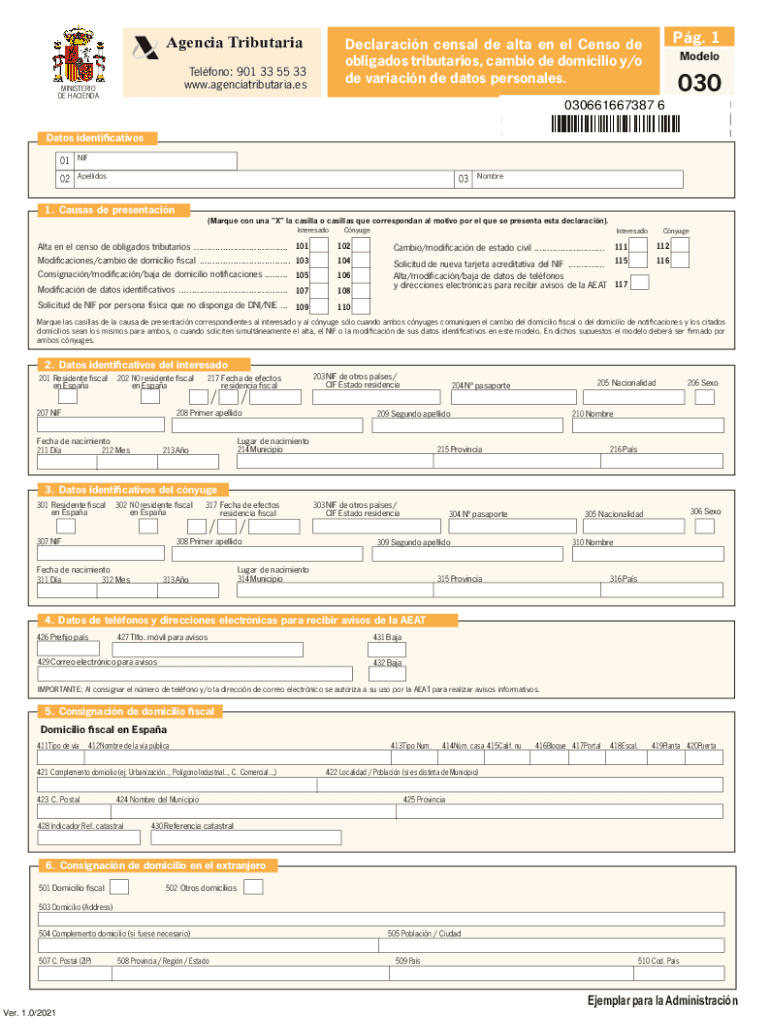







Definition & Meaning
The Spanish Tax Form 030 is an important document used for filing specific tax-related information with the Agencia Tributaria (Spanish Tax Agency). It serves several purposes, including declaring tax status, updating personal information, like an address change, or making amendments to other personal data previously provided. The form ensures that the Agencia Tributaria maintains accurate and up-to-date records for individuals or entities.
Key Functions
- Census Registration: It's used to register or deregister from various tax obligations.
- Updating Personal Data: Individuals can notify changes in personal details, which is crucial for maintaining correct tax records.
- Amendments: Enables amendments to previous submissions and ensures data accuracy.
How to Use the Spanish Tax Form 030
Form 030 serves multiple purposes, making it essential to understand its correct usage to comply with Spanish tax laws effectively.
Common Actions
- Registering for Tax Obligations: When beginning a new business or activity.
- Updating Information: Such as address changes or changes in family status that could affect tax liabilities.
- Deregistration: For ending a taxable activity or notifying the cessation of a specific duty.
Practical Examples
- Moving to a new residence and needing to update tax information to reflect the change.
- Marriage or a change in marital status, which might necessitate updates in the tax profile.
How to Obtain the Spanish Tax Form 030
Acquiring the Spanish Tax Form 030 is straightforward and can be completed through several methods.
Accessing the Form
- Online Download: Visit the official Agencia Tributaria website to download a digital version.
- Physical Collection: Obtain a physical form from local tax offices in Spain.
- Postal Request: Request the form by post if personal collection is not viable.
Assistance Options
- Local tax consultants can provide guidance and support in retrieving and filling out the form.
- The Agencia Tributaria often provides hotlines or chat support for inquiries about form availability.
Steps to Complete the Spanish Tax Form 030
Filling out the form correctly is critical for compliance and ensuring personal or business data is correctly represented.
Completion Process
- Personal Details: Provide your full name, National Identification Number (NIN), and contact details.
- Type of Request: Clearly indicate whether you're registering, updating, or deregistering.
- Specific Details: Fill in the specific information required for your request, such as new address information if updating.
- Sign and Date: Ensure the form is signed and dated appropriately to validate the request.
Recommendations
- Double-check all entries for accuracy.
- In cases of complicated changes or updates, consult with a tax professional.
Why Use the Spanish Tax Form 030
There are several compelling reasons to use Form 030, making it an essential tool in tax compliance and management.
Benefits of the Form
- Legal Compliance: Ensures you're legally registered with the tax authorities and comply with all necessary requirements.
- Accurate Tax Data: Helps maintain correct records, which is critical for accurate tax calculation and reporting.
- Efficient Communication: Keeps personal or business information updated, facilitating smooth interactions with tax authorities.
Important Terms Related to Spanish Tax Form 030
Comprehensive understanding of related terminology is beneficial for effectively navigating the form.
Key Terms
- Agencia Tributaria: The official Spanish tax authority responsible for tax collection and enforcement.
- NIN (National Identification Number): A unique number assigned to Spanish residents for tax and legal purposes.
- Census: Refers to registration or enumeration in the tax context specific to Spain.
Contextual Clarifications
- Individual Registration: Relates to registering or updating personal tax information.
- Business Census: Involves declaring business activities or changes thereof.
Form Submission Methods
Submitting Form 030 accurately and timely is crucial for effectiveness.
Submission Options
- Online Submission: Utilize the Agencia Tributaria’s electronic platforms for digital submission, offering convenience and reduced processing times.
- In-Person at Tax Offices: Presenting the form directly at local tax offices might be preferred for direct communication.
- Postal Submission: Mail the completed form to the relevant tax office address if electronic or in-person options are not possible.
Pros and Cons
- Online: Fast and efficient but requires digital access and authorization.
- In-Person: Personal interaction and immediate confirmation but more time-consuming.
- Postal: Suitable for those distant from offices or without digital capability but slower processing time.
Penalties for Non-Compliance
Non-compliance with Spanish tax regulations via Form 030 can lead to various penalties and issues.
Consequences
- Fines: Monetary penalties incurred from failure to register or update necessary information.
- Legal Action: In severe cases, continued non-compliance might result in legal proceedings.
- Operational Delays: Delays in processing permissions or entitlements that are contingent on updated tax information.
Avoidance Strategies
- Ensure timely updates and changes to tax information.
- Seek professional consultation for complex taxation matters.




