







Definition and Meaning
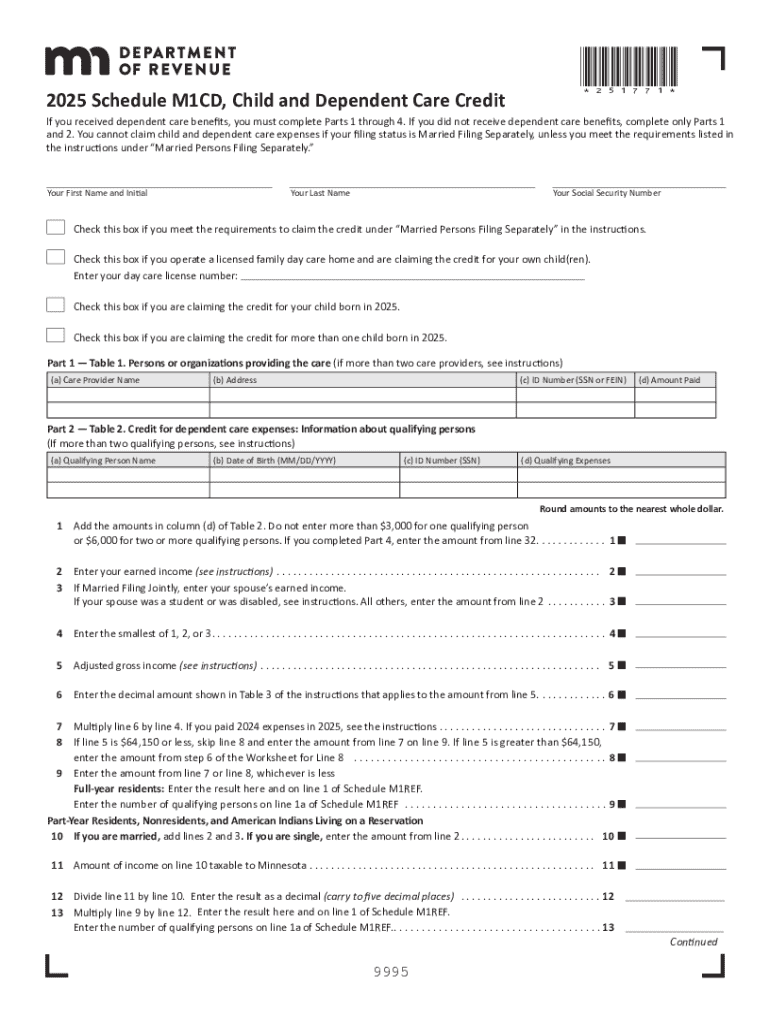
The 2025 Schedule M1CD, Child and Dependent Care Credit, is a U.S. tax form that allows taxpayers to claim a credit for expenses incurred for the care of children or dependents. This credit aims to support working individuals who need to pay for child or dependent care services to remain employed. It can significantly reduce the amount of tax owed by offsetting a portion of the care costs, making it a crucial tool for families managing expenses related to dependent care.
Eligibility Criteria
To qualify for the Child and Dependent Care Credit, taxpayers must meet specific criteria. The credit is available to individuals with one or more dependent children under 13 years of age or for dependents who are physically or mentally incapable of caring for themselves. The care expenses must be essential for the taxpayer to work or look for work. Additionally, taxpayers must have earned income, and the care provider cannot be a spouse or a dependent.


Examples of Eligible Expenditures
- Payments to daycare centers or nursery schools
- Fees paid to babysitters or nannies
- Costs associated with daycare camps
How to Use the 2025 M1CD, Child and Dependent Care Credit
To utilize the 2025 M1CD form effectively, taxpayers should gather detailed records of their care expenses throughout the year. It's essential to calculate the total qualifying expenses and understand the percentage of costs eligible for the credit. By completing the form accurately, taxpayers can maximize their potential credit and ensure they are in compliance with IRS guidelines.
Steps to Complete the 2025 M1CD
- Gather documentation such as receipts from care providers.
- Calculate total expenses incurred for child and dependent care.
- Verify the eligibility criteria, ensuring all dependents qualify.
- Complete Parts 1 through 4 if dependent care benefits are received; otherwise, complete only the required sections.
- Submit the form along with the federal tax return.
Important Terms
Understanding key terms is vital for accurately filling out the Schedule M1CD. Terms like "qualified dependent," "earned income," and "care provider" have specific definitions and implications for eligibility and credit calculation.
- Qualified Dependent: A child under 13 or a dependent who cannot care for themselves.
- Earned Income: Wages, salaries, tips, or other taxable employee pay.
IRS Guidelines
The IRS provides specific instructions and regulations regarding the Child and Dependent Care Credit. Taxpayers must ensure that all expenses claimed are substantiated with proper documentation. The IRS sets a cap on eligible expenses, and understanding these limits is critical for accurate reporting.
Filing Deadlines and Important Dates
Taxpayers should be mindful of filing deadlines to ensure compliance. Typically, the Child and Dependent Care Credit must be claimed by the annual tax filing deadline, which is usually April 15. Staying organized and filing on time prevents penalties and maximizes the chance of receiving the full credit.
Required Documents
To successfully file for the Child and Dependent Care Credit, taxpayers should prepare several documents:
- Receipts from all care providers
- The taxpayer identification number of the care provider(s)
- Forms W-2 or other documentation of earned income
- Any documentation pertaining to employer-provided dependent care benefits
Form Submission Methods
Taxpayers have multiple options for submitting Schedule M1CD:
- Online: Via tax preparation software or the IRS e-filing system.
- Mail: By sending a paper return to the IRS.
- In-Person: At IRS centers, although e-filing is encouraged for rapid processing.
Penalties for Non-Compliance
Failure to comply with IRS guidelines or inaccurately reporting expenses can lead to penalties. Such penalties may include interest on taxes owed, fines for underreporting income, or disqualification from claiming the credit in future years. It's crucial to maintain accurate records and adhere to IRS regulations to avoid these consequences.
By exploring these aspects of the 2025 Schedule M1CD, Child and Dependent Care Credit, taxpayers can better navigate their tax responsibilities while maximizing the financial support available for dependent care expenses.




