






Definition & Meaning
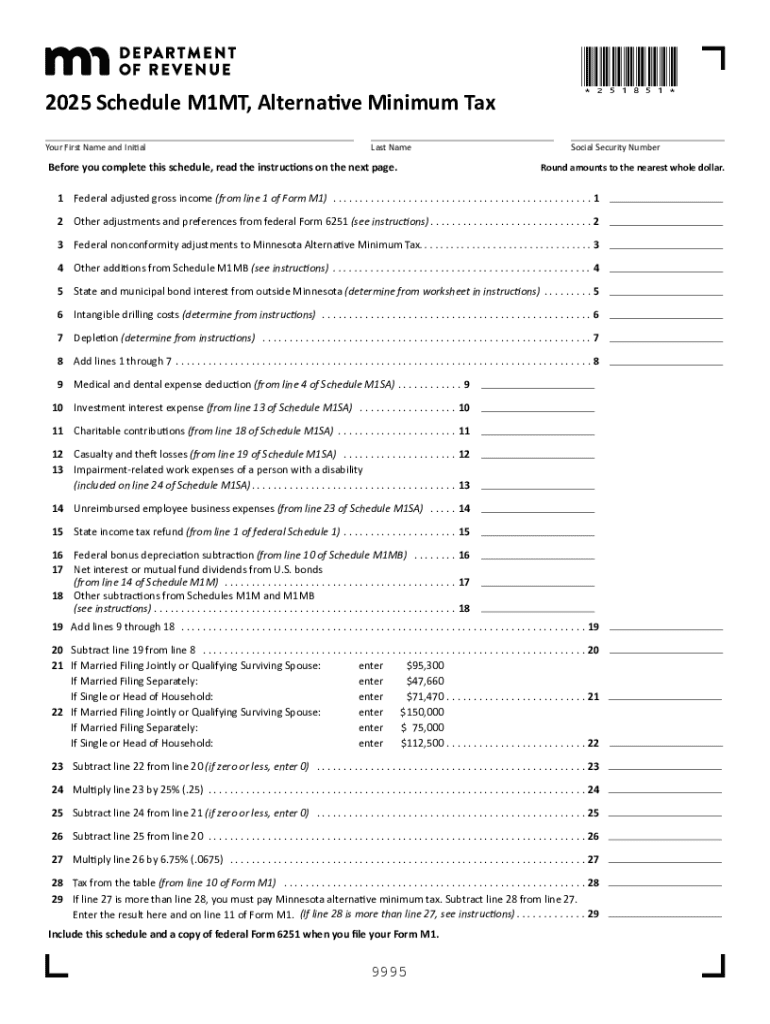
The "2025 M1MT, Alternative Minimum Tax" form is intended to calculate the Alternative Minimum Tax (AMT), which applies to certain taxpayers in addition to the regular income tax. The AMT was designed to ensure that high-income individuals, corporations, trusts, and estates pay a minimum level of tax. By completing the M1MT form, taxpayers can determine their AMT liability if it exceeds the regular tax amount. The form typically includes adjustments to regular income and deductions and calculates the alternative minimum tax income (AMTI).
How to Use the 2025 M1MT, Alternative Minimum Tax
Using the 2025 M1MT form involves multiple steps geared towards assessing whether you owe AMT:
-
Gather Necessary Information: Before you begin, collect all required documents such as W-2s, 1099s, and any financial records that may affect your tax liability.
-
Complete the Regular Tax Calculation: Calculate your regular tax liability to establish a baseline against which the AMT will be compared.
-
Adjust Income and Deductions: Utilize the M1MT to adjust your income and deductions. Certain tax-exempt interest or itemized deductions typical in regular tax calculations might not apply here.
-
Determine AMTI: Calculate your Alternative Minimum Taxable Income using the specified adjustments and preferences outlined in the form instructions.
-
Calculate AMT: Apply the AMT rate to your AMTI to determine your potential AMT liability.
-
Compare with Regular Tax: Assess if your AMT exceeds the regular tax liability. If it does, you'll need to pay the higher amount.
Steps to Complete the 2025 M1MT, Alternative Minimum Tax
Completing the form requires detailed steps:
-
Fill Personal Information: Enter basic details including your name, Social Security Number, and filing status.
-
Enter Adjustments and Preferences: Work through sections that require entering adjustments from regular taxable income, like depreciation differences or tax-exempt interest.
-
Calculate AMTI: Take the adjusted total and subtract the exemption amount stipulated in the form instructions to arrive at your AMTI.
-
Compute AMT: Apply the appropriate tax rate to your AMTI.
-
Finalize and File: Verify your calculations, sign the form, and submit it along with your main tax return.
Important Terms Related to 2025 M1MT, Alternative Minimum Tax
Understanding specific terms is crucial for successfully completing the form:
-
Alternative Minimum Taxable Income (AMTI): Income modified by specific adjustments required for calculating the AMT.
-
Exemption Amount: A specific deduction used to reduce AMTI in determining whether you owe AMT.
-
Adjustments and Preferences: Items and computations that differ under AMT rules compared to regular tax laws such as certain deductible expenses and tax credits.
Filing Deadlines / Important Dates
Align your filing schedule with these important tax deadlines:
- April 15: Typically the deadline for filing federal tax returns including the 2025 M1MT.
- October 15: If you file an extension, ensure your tax return submission includes the completed M1MT form by this date.
To avoid penalties, it's crucial to keep track of these dates and submit the form along with or prior to your tax return.
Required Documents
Accurate completion of the M1MT requires several documents:
- W-2 Forms: Details on wages and contributions.
- Form 1099: Information on income from dividends, interest, or self-employment.
- Schedule A: If itemized deductions affect your regular tax, adjustments may be relevant for AMT purposes.
- Previous Year’s Tax Returns: Useful for comparative purposes and for ensuring any carryovers are correctly reported.
Penalties for Non-Compliance
Ignoring AMT liabilities can result in penalties, including:
- Late Payment Penalty: Charges due to tax amounts not paid by the original due date, whether an extension was filed or not.
- Interest on Unpaid Tax: Accumulates from the original due date until the tax is paid in full.
- Accuracy-Related Penalty: Issued if the underpayment stemmed from negligence or disregard of rules and regulations.
Ensure timely, accurate filing to avoid these repercussions.
IRS Guidelines
Adhering to official guidelines can prevent errors:
- Review IRS Publications: Understand the AMT rules, covered in IRS publications specific to individual taxpayers or relevant to business entities.
- Software Use: Information on software compatibility with programs like TurboTax or QuickBooks can assist with calculations and ease the process.
- Amendments: Guidelines are available for filing amendments in case errors in initial filings are identified.
Consulting these resources can mitigate risks associated with AMT filing complexities.