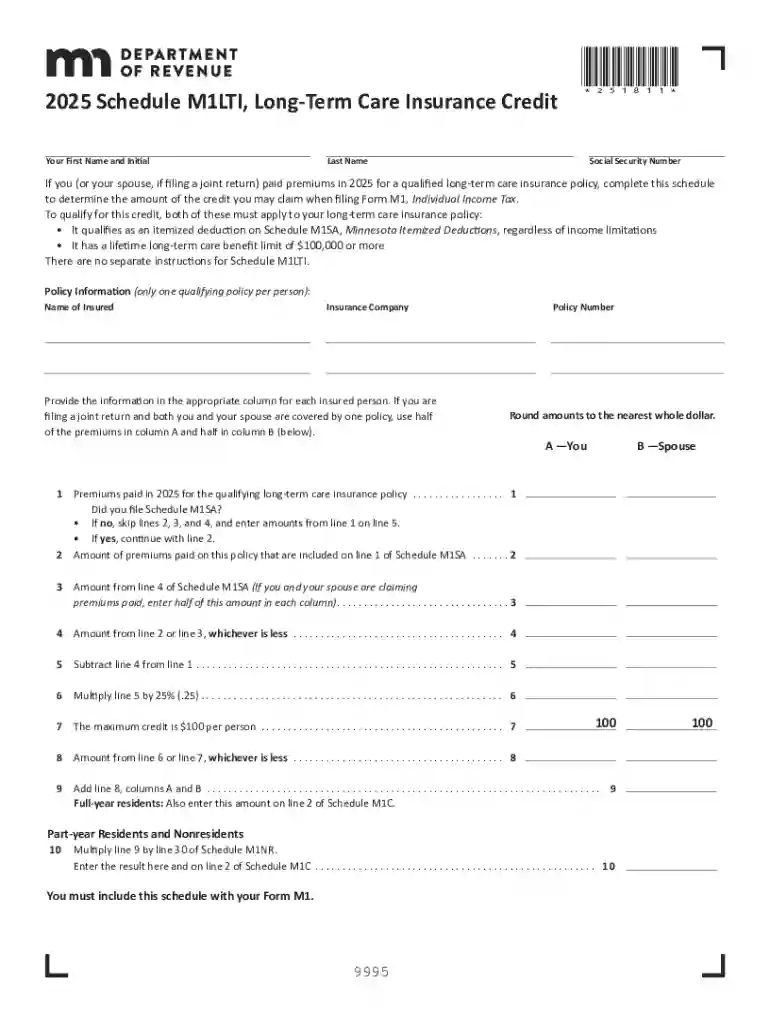
2025 M1LTI, Long-Term Care Insurance Credit Long-Term Care Insurance Credit-2026

Get Form
2025 M1LTI, Long-Term Care Insurance Credit Long-Term Care Insurance Credit Preview on Page 1

Here's how it works

01. Edit your form online
Type text, add images, blackout confidential details, add comments, highlights and more.

02. Sign it in a few clicks
Draw your signature, type it, upload its image, or use your mobile device as a signature pad.

03. Share your form with others
Send it via email, link, or fax. You can also download it, export it or print it out.

Definition & Meaning

The 2025 Schedule M1LTI, Long-Term Care Insurance Credit, is a tax form utilized to claim a credit for premiums paid towards long-term care insurance policies. This credit is specifically designed for taxpayers who have incurred expenses for such insurance either for themselves or their spouse, reflecting the emphasis on supporting long-term care planning through tax incentives. The primary purpose of the Schedule M1LTI is to lower the overall tax burden by providing a financial offset against insurance premiums paid during the taxable year.

Context and Background

  • Purpose: Designed to encourage individuals to secure long-term care insurance, this form incentivizes the proactive management of future healthcare needs.
  • Eligibility: Typically benefits individuals or couples who have taken steps to safeguard against the substantial costs associated with long-term care services.

How to Use the Form

Filing the Schedule M1LTI requires careful attention to detail and adherence to IRS guidelines to ensure eligibility and accuracy.

Steps Involved

  1. Gather Documentation: Before filling out the form, collect all necessary documentation, including receipts of insurance premium payments.
  2. Complete Personal Information: Input personal details, including the taxpayer's and spouse's names and social security numbers.
  3. Calculate the Credit: Follow the specific calculation instructions to determine the amount of credit. This involves inputting the amount of premiums paid.
  4. Attach to Tax Return: Once completed, attach the Schedule M1LTI to your regular income tax return form.

Common Mistakes

  • Failing to confirm the eligibility of the insurance policy for the credit.
  • Omitting required attachments, such as proof of payment.
  • Incorrectly calculating the deductible amount, which may lead to errors in tax liability.

Steps to Complete the Form

Completing the Schedule M1LTI requires methodical input of data and calculations:

  1. Verify Eligibility: Confirm that the long-term care insurance policy qualifies under IRS guidelines.
  2. Input Relevant Details: Write down all applicable details accurately as specified on the form.
  3. Calculate Allowable Credit: Follow the worksheet provided to ensure precise credit calculation.
  4. Check for Accuracy: Review entries for any discrepancies or omissions.
  5. Attach Supporting Documents: Attach copies of the insurance premium invoices or statements.
  6. File with Tax Return: Ensure the form is filed with the overall tax return submission.

Practical Example

Consider a taxpayer who paid $2,000 in premiums for their long-term care insurance policy. Using the Schedule M1LTI, they must verify if the full premium qualifies and compute the permissible credit to reduce their tax payable.

Important Terms Related to the Form

The vocabulary associated with the 2025 Schedule M1LTI requires familiarity to navigate the filing process effectively:

  • Premiums: Payments made for the long-term care insurance policy.
  • Credit: A dollar-for-dollar reduction in tax liability.
  • Eligible Policy: Insurance that meets IRS criteria for the credit.

Key Definitions

  • Long-Term Care Services: Assistance with performing daily activities due to chronic illness, disability, or aging.
  • Taxpayer: The individual or joint filers submitting the tax return that includes Schedule M1LTI.

Eligibility Criteria

Eligibility for the long-term care insurance credit centers around specific requirements:

decoration image ratings of Dochub

Basic Eligibility

  • Only available to individuals who have paid premiums for qualified long-term care insurance.
  • Policies must conform to IRS eligibility standards.

Additional Considerations

  • Taxpayers must retain documentation illustrating payment of premiums within the tax year.
  • Only the primary taxpayer or their spouse can claim the credit.

Required Documents

Essential documents for substantiating claims on Schedule M1LTI include:

  1. Insurance Premium Receipts: Proof of payment for long-term care insurance coverage.
  2. Policy Statements: Documentation outlining the policy’s compliance with IRS eligibility criteria.

Organizational Tips

  • Maintain a file containing all relevant forms and receipts for easy reference.
  • Use digital copies for added security and accessibility during tax preparation.

Form Submission Methods (Online / Mail / In-Person)

Taxpayers have multiple options for submitting the Schedule M1LTI:

  • Online Submission: File electronically through the IRS e-file system, enhancing speed and reducing error likelihood.
  • Mail: Physical mailing of the form as part of a comprehensive tax return package.
  • In-Person: Submission through a tax preparer or IRS office.

IRS Guidelines

Adhering to IRS guidelines ensures a smooth filing process:

  • Follow Instructions: Adhere meticulously to the step-by-step guide provided by the IRS for completing the Schedule M1LTI.
  • Timely Filing: Submit the form within prescribed deadlines to avoid penalties or disqualifications.

Common Errors

  • Misreporting premium amounts or incorrectly applying the credit.
  • Failing to attach proof of eligibility or payment, leading to credit denial.

These blocks collectively offer a comprehensive walkthrough of the 2025 Schedule M1LTI, Long-Term Care Insurance Credit, tailored to assist users in understanding and utilizing the form effectively.

be ready to get more

Complete this form in 5 minutes or less

Get form

Security and compliance

At DocHub, your data security is our priority. We follow HIPAA, SOC2, GDPR, and other standards, so you can work on your documents with confidence.

Learn more
ccpa2
pci-dss
gdpr-compliance
hipaa
soc-compliance
be ready to get more

Complete this form in 5 minutes or less

Get form