
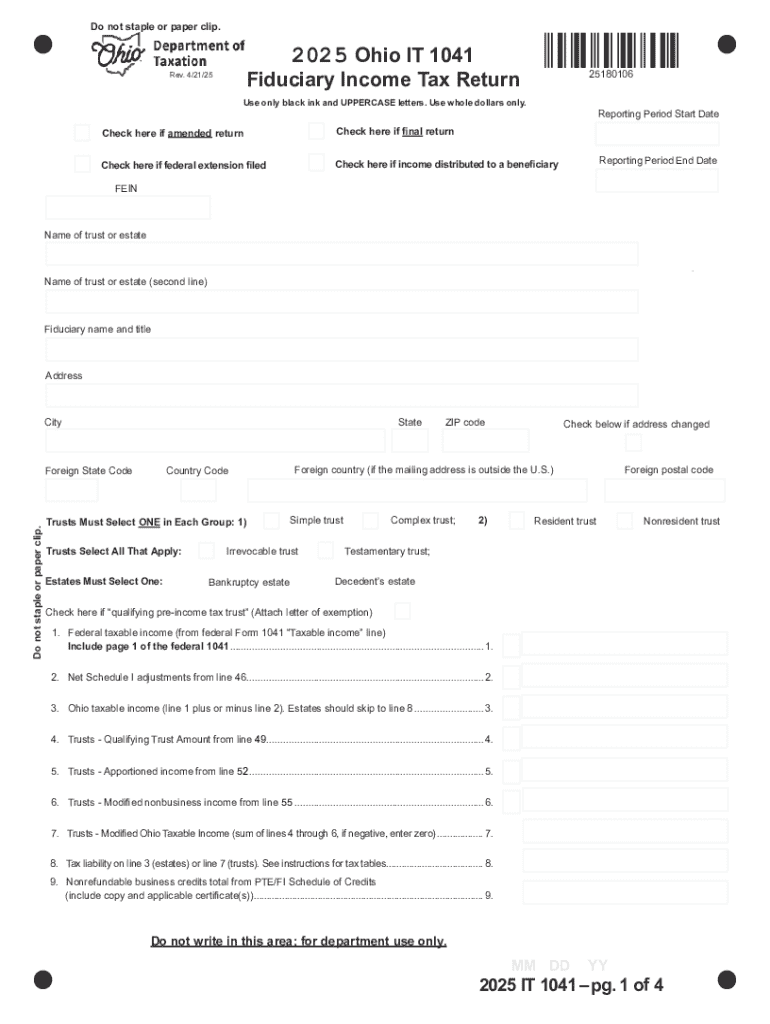







Definition and Meaning
The 2025 Ohio IT 1041 Fiduciary Income Tax Return is a critical document employed for reporting the income, deductions, and some credits related to an estate or trust. This form is specifically tailored for fiduciaries, such as executors or trustees, responsible for tax-related obligations in the state of Ohio. The primary purpose is to ensure that the fiduciary accurately reflects the income earned by the trust or estate during the tax period.
Key Features
- Fiduciary Responsibilities: It captures the financial activities of estates or trusts, ensuring that fiduciaries comply with tax regulations.
- Income Reporting: All types of income, including interest, dividends, and capital gains, need to be meticulously documented.
- Tax Obligations: The form computes the amount of taxes owed or refunds due on the income reported.
How to Use the 2025 Ohio IT 1041 Fiduciary Income Tax Return
Using the 2025 Ohio IT 1041 efficiently involves several careful steps to ensure compliance and accuracy. Proper completion is essential for avoiding penalties and ensuring legitimate claims for credits and deductions.
Step-by-Step Guide
- Gather Required Documents: Collect all necessary financial records, including income statements, deduction documents, and prior year tax returns.
- Prepare Financial Statements: Accurate preparation of income statements is essential for recording the estate's or trust’s financial activities.
- Complete the Form Sections: Enter all pertinent details, including fiduciary information, income details, deductions, and credits.
- Review and Double-Check: Verify the accuracy of every entry to avoid mistakes that might lead to penalties or audits.
Practical Example
- Fiduciary Scenario: If a fiduciary is managing a trust with investment income, they must accurately report all dividends or interest received using this form.
How to Obtain the 2025 Ohio IT 1041 Fiduciary Income Tax Return
Getting your hands on the proper version of the form is the first step to ensuring compliance and proper filing.
Methods of Acquisition
- Online Access: Download the latest version directly from the Ohio Department of Taxation website.
- Mail Requests: Request a physical copy by contacting the Ohio Department of Taxation and providing your mailing information.
- Professional Assistance: Obtain the form through a tax professional or certified accountant.
Steps to Complete the 2025 Ohio IT 1041 Fiduciary Income Tax Return
Completing the form thoroughly is important to fulfill fiduciary duties accurately. It involves understanding various sections of the form and how to input data correctly.
Detailed Instructions
- Enter Fiduciary Information: Include the name, address, and identification number of the representative administrative party.
- Report All Income Sources: Thoroughly detail all income received by the estate or trust, segmented into correct categories.
- Deductions and Credits: Accurately apply any qualifying deductions or credits to minimize tax liabilities.
- Final Review and Signoff: Ensure all details are final and sign the document to authenticate the information provided.
Important Terms Related to the 2025 Ohio IT 1041 Fiduciary Income Tax Return
A comprehensive understanding of specific terms ensures correct completion and compliance with regulations set by the Ohio Department of Taxation.
Glossary of Key Terms
- Fiduciary: An individual or institution managing assets for a third party and responsible for the trust’s or estate's compliance.
- Deductions: Expenses incurred that can be subtracted from gross income to reduce taxable income.
- Credits: Specific provisions that may reduce the tax owed.
Key Elements of the 2025 Ohio IT 1041 Fiduciary Income Tax Return
Understanding the major components that comprise the form enables accurate and efficient filing.
Core Sections
- Fiduciary Details: Administrative data regarding the entity responsible for filing.
- Income Declarations: Detailed breakdown of all income types.
- Tax Deductions and Credits: Sections dedicated to computations that impact the estate's or trust's tax obligations.
Filing Deadlines and Important Dates
Adhering to specific deadlines is crucial in the submission of the return to mitigate the risk of incurring late fees or penalties.
Timelines to Consider
- Annual Filing Date: The form must be filed by April 15 annually, aligning with federal tax schedules.
- Extension Requests: Should a deadline extension be necessary, applications must be submitted before the original due date to avoid penalties.
Required Documents for Completing the Form
Gathering essential documents beforehand ensures that every piece of information necessary for filing the return is available.
Document Checklist
- Prior Tax Returns: To ensure consistency and verify information.
- Income Statements: Includes all financial reports reflecting income received over the tax period.
- Legal Documents: Any agreements or court orders pertinent to the estate or trust.
Form Submission Methods: Online, Mail, or In-Person
Various submission channels offer flexibility and convenience based on the fiduciary’s preferences or needs.
Submission Options
- Online Filing: A convenient method with streamlined steps on the Ohio Department of Taxation website or through authorized e-file providers.
- Mail Submission: Complete and mail the form to the specified address provided by the Ohio Department of Taxation.
- In-Person Assistance: Available at regional tax offices for those who prefer face-to-face interaction.
Penalties for Non-Compliance
Understanding the implications of non-compliance highlights the importance of precise and timely filings.
Potential Consequences
- Late Filing Penalty: A fixed fee applies for missing the deadline without valid extensions.
- Accuracy-Related Penalty: Imposed if substantial errors or falsifications occur within the form entries.
- Interest on Unpaid Taxes: Additional charges on overdue taxes until the full payment is settled.


