
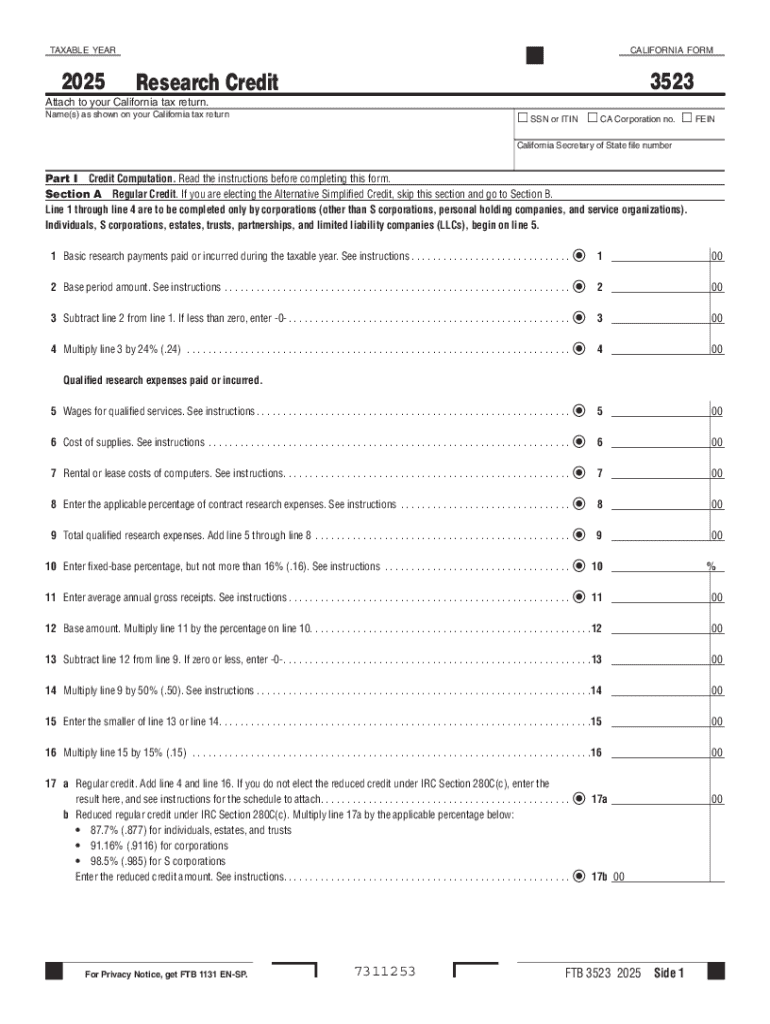







Definition and Purpose of the California Research Credit Form 3523
The California Research Credit Form 3523 is a tax form used primarily by businesses and corporations engaged in research and development within the state of California. This form is essential for claiming research credits that reduce the taxable income of qualifying entities, reflecting their innovative activities. The intent is to incentivize research endeavors that contribute to technological advancements and economic growth in California.
Key Elements of the California Research Credit Form 3523
- Qualified Research Expenses (QREs): Defines the eligible expenses that can be included, which generally cover wages, supplies, and contract research costs.
- Base Amount Calculation: Involves determining the base amount against which QREs are measured, using either the regular calculation method or the simplified method.
- Incremental vs. Alternative Simplified Credit (ASC): Option for businesses to choose between different calculation methods according to suitability and qualification.
Steps to Complete the California Research Credit Form 3523
Completing the California Research Credit Form 3523 requires careful adherence to the instructions and precise calculation based on eligible expenses and projects.
-
Gather Required Information:
- Compile detailed records of all research expenses, employee time allocations, and associated activities.
- Ensure that expenses align with eligibility criteria.
-
Calculate the Credit:
- Use provided instructions to compute either the incremental credit or the alternative simplified credit.
- Ensure accuracy in calculations to prevent errors in tax filings.
-
Complete Each Section:
- Fill in necessary information, including identification details like Social Security Number (SSN), Individual Taxpayer Identification Number (ITIN), or Federal Employer Identification Number (FEIN).
- Precisely document all relevant expenses and outcomes.
-
Review and Attach to Tax Return:
- Verify all entries for accuracy.
- Attach the completed form to your California state tax return.
Detailed Breakdown of Relevant Sections:
- Part I: Establishes eligibility for the credit, entailing specific requirements and preliminarily segregates costs.
- Part II: Inquiry into credit limitations and potential adjustments depending on filing status and previous credits claimed.
Eligibility Criteria for California Research Credit Form 3523
Entities seeking the California Research Credit need to meet certain criteria that validate their entitlement to claim research expenses.
- Business Type: Typically used by corporations, not-for-profits, and other legal entities engaged in innovation.
- Qualified Research Activities (QRAs): Must possess elements of scientific exploration and discovery rather than routine data collection or market research.
- Expense Documentation: Verified financial and activity logs must substantiate the expenses claimed under QREs.


Examples of Qualifying Activities:
- Development of prototypes or processes
- Experimental techniques aimed at process improvement
- Software and technological innovation projects
State-Specific Rules for the California Research Credit Form 3523
California has enacted specific regulations and guidelines that govern research credit claims, distinct from federal procedures.
- Adaptation of Federal Guidelines: While based on federal standards, California imposes unique additional requirements and thresholds.
- Documentation Standards: Higher scrutiny and documentation standards to ensure proportional statewide benefits.
- Coordination with Federal Filings: Often requires coordination of state and federal research credit claims to avoid duplication or inconsistencies.
Compliance and Penalty Considerations
- Auditing and Verification: Regular checks to ensure adherence to claimed credits, with potential for audits.
- Penalties for Non-compliance: Monetary penalties and interest charges may be levied for incorrect filings or fraudulent claims.
How to Obtain the California Research Credit Form 3523
Acquiring the California Research Credit Form 3523 involves several straightforward steps, ensuring businesses can apply for research credits seamlessly.
- Direct Download: Available through the California Franchise Tax Board’s official website. Accessible as a downloadable PDF for direct use.
- Software Tools: Compatibility with popular financial software such as TurboTax, facilitating automatic synchronization with tax reporting data.
- Contacting the Franchise Tax Board: For additional guidance or paper copies, businesses can reach out via phone or online communication.
Alternative Access Points:
- Tax Professionals: Often provide forms during tax preparation services.
- State Tax Offices: Regional offices may provide physical copies or computer access for downloading.
Important Terms Related to the California Research Credit Form 3523
Numerous terminologies are associated with this form, important for understanding nuances and proper filing.
- Gross Receipts: Total receipts without adjustment for expenses, relevant for baseline calculations.
- Excess QREs: The amount by which QREs exceed the base period amount, critical for calculating incremental credits.
- Consistency Rule: Ensures consistent treatment of expenses across different tax years.
Clarifications and Explanations:
- Fixed-Base Percentage: Calculated based on historical expenses, setting a baseline for determining credit eligibility.
- Specific Identification Method: A specific requirement for identifying and separating QREs, to avoid allocation of non-eligible expenses.
Filing Deadlines and Important Dates
Understanding deadlines ensures timely submission and avoids any penalties associated with late filing.
- Annual Filing Deadline: Aligns with the California state tax return date, typically April 15.
- Extension Opportunities: While automatic extensions may apply, any owed taxes should be paid by the original deadline to avoid interest.
- Audit Response Time: Post-filing, businesses should be prepared to provide documentation and response to audits in a timely manner.
Importance of Timely Filing:
- Avoidance of Penalties: Ensures avoidance of late fees and interest charges.
- Budgeting for Tax Payments: Allows time for setting aside funds to cover any additional tax liabilities that may arise.




