
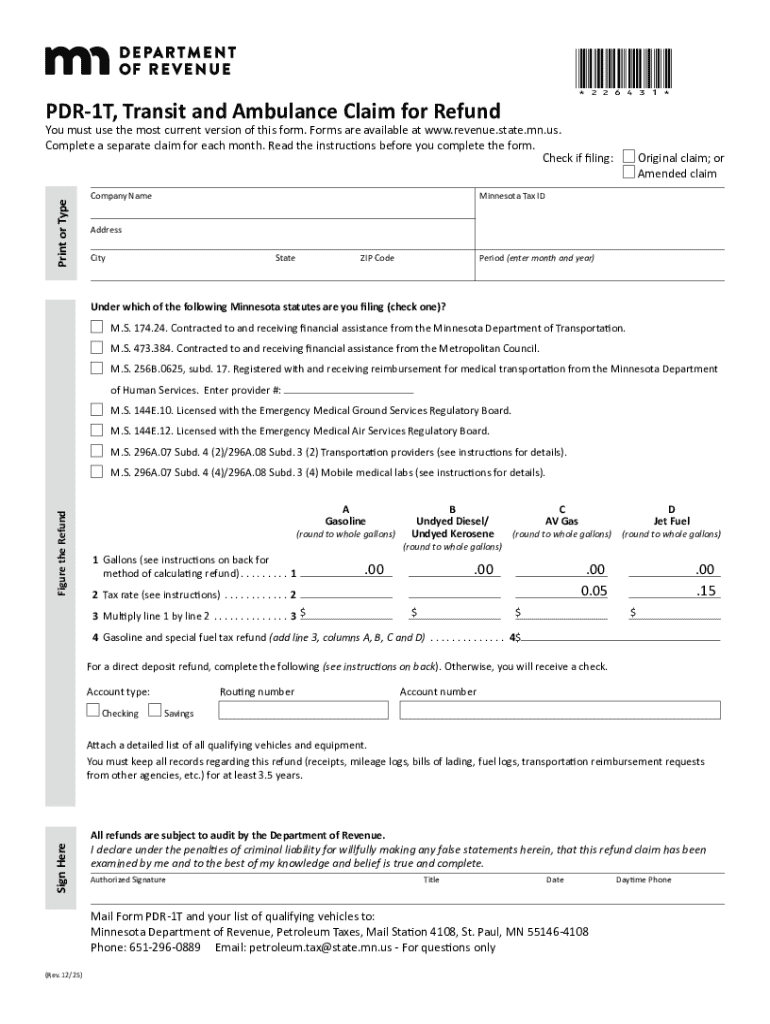







Definition & Overview of the Minnesota Transit and Ambulance Claim for Refund
The Minnesota Transit and Ambulance Claim for Refund is a specialized form used by businesses and individuals within Minnesota to seek reimbursement for overpaid taxes related to transit or ambulance services. This form is essential for ensuring compliance with Minnesota's taxation policies and receiving a refund for any undue payments made under these specific service categories.
-
Purpose: The primary purpose of this form is to allow claimants to accurately document and submit a request for refunds related to tax overpayments in the context of provided transit or ambulance services.
-
Utilization: Widely used by entities and individuals engaged in providing transit or ambulance services, this form ensures that taxes paid beyond what is due can be formally claimed back from state revenue departments.
How to Use the Minnesota Transit and Ambulance Claim for Refund
Using the Minnesota Transit and Ambulance Claim for Refund involves several steps to ensure that claims are submitted accurately and efficiently.
-
Gather Required Information: Collect details such as tax payment records, service logs, and any previous correspondence with the Minnesota Department of Revenue.
-
Form Completion: Accurately fill out each section of the form, ensuring all figures and details match your service records and documentation.
-
Submission Process: Submit the completed form as per the submission methods authorized by the Minnesota Department of Revenue, which can include online platforms, mailing systems, or in-person submissions.
Common Mistakes to Avoid
- Incorrect Figures: Double-check all numerical entries to ensure correctness and compliance.
- Outdated Forms: Ensure that the most recent version of the form is used, which can be obtained from official state websites.
Steps to Complete the Minnesota Transit and Ambulance Claim for Refund
Follow these detailed steps to complete the Minnesota Transit and Ambulance Claim for Refund accurately.
-
Download or Obtain the Form: Access the latest version of the form from the Minnesota Department of Revenue’s official site.
-
Provide Identification Details: Enter the necessary business or personal identification information to ensure proper processing.
-
Detail the Payment Information: Include specifics about the payments made, such as dates, amounts, and transaction references.
-
Clearly State the Refund Amount: Calculate and enter the overpaid amount you are claiming for a refund.
-
Attach Supporting Documentation: Enclose all relevant records, invoices, and statements that back your claim for a refund.
-
Finalize and Review: Review the entire form to confirm accuracy and completeness before signing and dating it.
-
Submit to the Appropriate Channel: Depending on the instructions, submit the form through mail, online portal, or directly to the revenue office.
Eligibility Criteria for Claiming Refund
-
Who Can Apply: Businesses and individuals providing transit or ambulance services within Minnesota who have overpaid taxes during the specified period.
-
Required Proof: Applicants must provide evidence of tax payments exceeding the amount due according to Minnesota’s tax regulations.


Key Elements of the Minnesota Transit and Ambulance Claim for Refund
The form is structured into several critical parts that need careful attention.
-
Identification Section: Captures personal or business details, including taxpayer identification numbers.
-
Tax Payment Details: Requires a breakdown of all tax payments associated with the transit or ambulance services.
-
Legal Affirmation: A section where the applicant declares, under penalties of perjury, that the claim is accurate and truthful.
Importance of Understanding State-Specific Rules
State-specific regulations significantly influence the filing and processing of the Minnesota Transit and Ambulance Claim for Refund.
-
Compliance Requirements: Familiarization with Minnesota’s particular billing and taxation structures is crucial for compliance and successful refund claims.
-
Impact of Legislative Changes: Stay informed about any changes in state tax legislation that may affect the eligibility or amount of refund claimable.
Recommended Submission Methods
-
Online Submission: Utilizing the state’s digital platforms can expedite the processing of your refund claim.
-
Manual Submission: Alternatively, printing and mailing the form with relevant attached documentation is also acceptable.
Common Taxpayer Scenarios and Examples
Consider these scenarios that illustrate typical usage of the Minnesota Transit and Ambulance Claim for Refund:
-
Scenario: Overpayment by a Small Transit Business: XYZ Transit paid excess taxes over a fiscal year due to an accounting error—using this form to claim a refund minimizes financial loss.
-
Scenario: Erroneous Billing on Ambulance Services: A hospital entrusted with patient transportation services discovers overcharges in tax assessments and utilizes the form to rectify the situation with state authorities.

Checking Software Compatibility
While TurboTax or QuickBooks might not have direct integrations for specialty forms like this, ensuring compatibility with document platforms like DocHub can streamline the interaction with digital forms, benefiting those who manage various submission documents. This compatibility is especially beneficial for maintaining an organized and efficient workflow when dealing with multiple yearly claims.




