
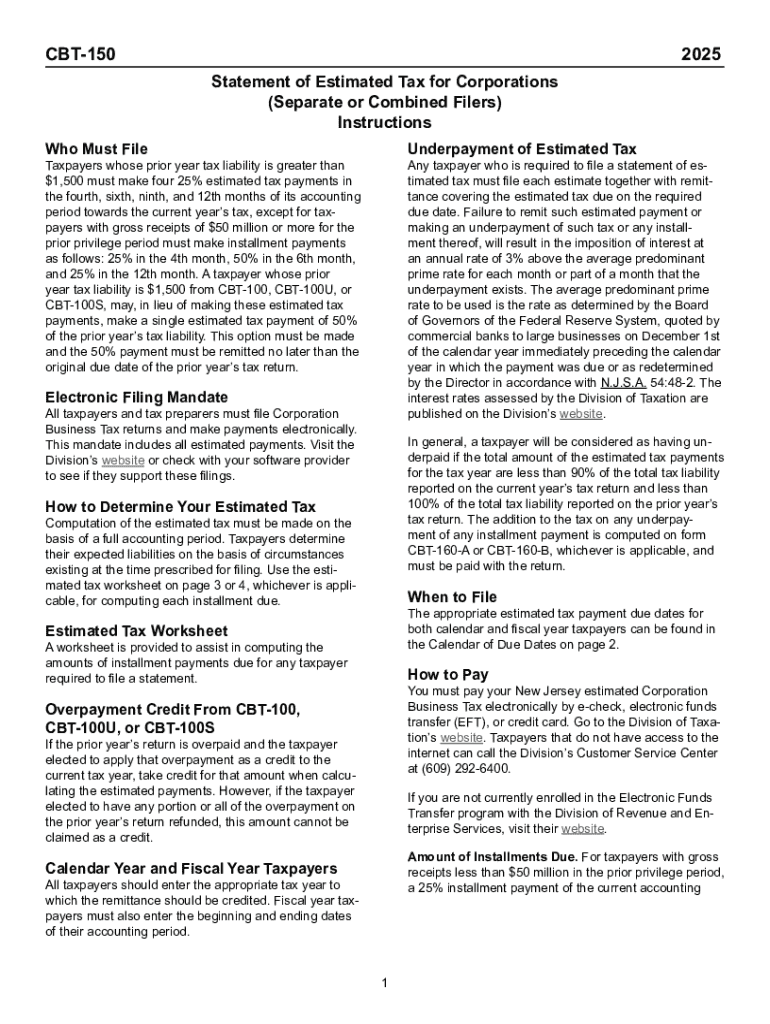







Definition & Purpose of the New Jersey CBT-150 Corporate Estimated Tax Form
The New Jersey CBT-150 Corporate Estimated Tax Form is a critical document used by corporations operating within the state to report and pay estimated taxes on income. This form serves as a mechanism for the state of New Jersey to collect anticipated taxes from corporations whose projected tax liability exceeds $1,500. By utilizing this form, businesses ensure compliance with state tax regulations, avoiding potential penalties for underpayment.
Importance of Filing Estimated Taxes
Corporations are required to file estimated taxes to avoid incurring underpayment penalties. The CBT-150 provides a structured way for companies to report these calculations quarterly, aligning with the fiscal year. This proactive approach aids in budgetary planning and financial forecasting by allowing businesses to manage tax liabilities incrementally rather than in a lump sum at year-end.
How to Use the New Jersey CBT-150 Corporate Estimated Tax Form
Step-by-Step Completion Process
-
Calculate Estimated Income: Begin by estimating your corporation's income for the fiscal year. Consider all revenue streams, existing contracts, and market conditions that may affect profitability.
-
Determine Tax Liability: Utilize the New Jersey corporate tax rates to determine your expected liability. Careful adherence to rate brackets ensures accurate calculations.
-
Complete the Form: Input the calculated amounts into the corresponding sections of the CBT-150 form. Ensure data is accurately reflected to match your fiscal projections.
-
Quarterly Payments: Divide your total estimated tax liability into quarterly installments. This can be managed using the payment vouchers included with the form.
Submitting the Form
The CBT-150 can be submitted via multiple channels:
- Online: Filing electronically through the state’s portal ensures a quicker process and receipt confirmation.
- Mail: Send completed forms to the designated New Jersey Division of Taxation address, allowing additional time for postal delays.
Steps to Complete the Form
Detailed Breakdown of Sections
-
Part 1: Identification Information: Ensure the correct corporation name, Employer Identification Number (EIN), and fiscal period.
-
Part 2: Estimated Tax Calculation: Clearly present the income estimates and deductions permitted under New Jersey law.
-
Part 3: Payment Schedule: Lay out scheduled payments, ensuring each is clearly defined and aligned with expected cash flow.
Important Terms Related to the Form
Key Terminology
- Estimated Tax: The projected amount of tax a corporation expects to pay over the course of a year.
- Underpayment: A situation where a business pays less than the full amount owed, potentially leading to penalties.
- Fiscal Period: The specified timeframe for which tax obligations are calculated; typically aligns with a corporation’s financial year.
Filing Deadlines and Important Dates
Critical Dates to Remember
-
Quarterly Deadlines: Corporations must adhere to the April 15th, June 15th, September 15th, and December 15th schedule for estimated payments.
-
Annual Reconciliation: Align with the federal tax return deadline for annual reconciliation of estimated payments against actual tax liability.
Who Typically Uses the New Jersey CBT-150 Corporate Estimated Tax Form


Applicable Business Entities
- Corporations: Both large and small corporations with a physical or economic presence in New Jersey.
- Partnerships/LLCs: Some LLCs and partnerships may need to file if electing to be taxed as a corporation under New Jersey law.
Industry Examples
Many businesses operating within New Jersey’s borders, from retail to manufacturing, are required to use the CBT-150 form to comply with state tax obligations.
Key Elements of the Form
Essential Sections
- Taxpayer Information: Identifies the corporation and aligns tax records with submitted payments.
- Estimated Income and Deductions: Forms the basis for the estimated tax calculation.
- Payment Vouchers: Used to accompany each installment, ensuring proper crediting to accounts.
Legal Use of the New Jersey CBT-150 Corporate Estimated Tax Form
Compliance and Penalties
- Adherence to Tax Laws: The CBT-150 ensures corporate compliance with New Jersey state tax laws.
- Penalties: Understanding potential fines for late submissions or underpaid taxes is critical for frequent filers.
Corporations must engage in regular financial reviews to remain compliant and avoid penalties. By effectively using the CBT-150 form, businesses remain aligned with legal tax requirements, contributing to their overall fiscal health and sustainability within New Jersey’s business environment.




