Definition & Meaning
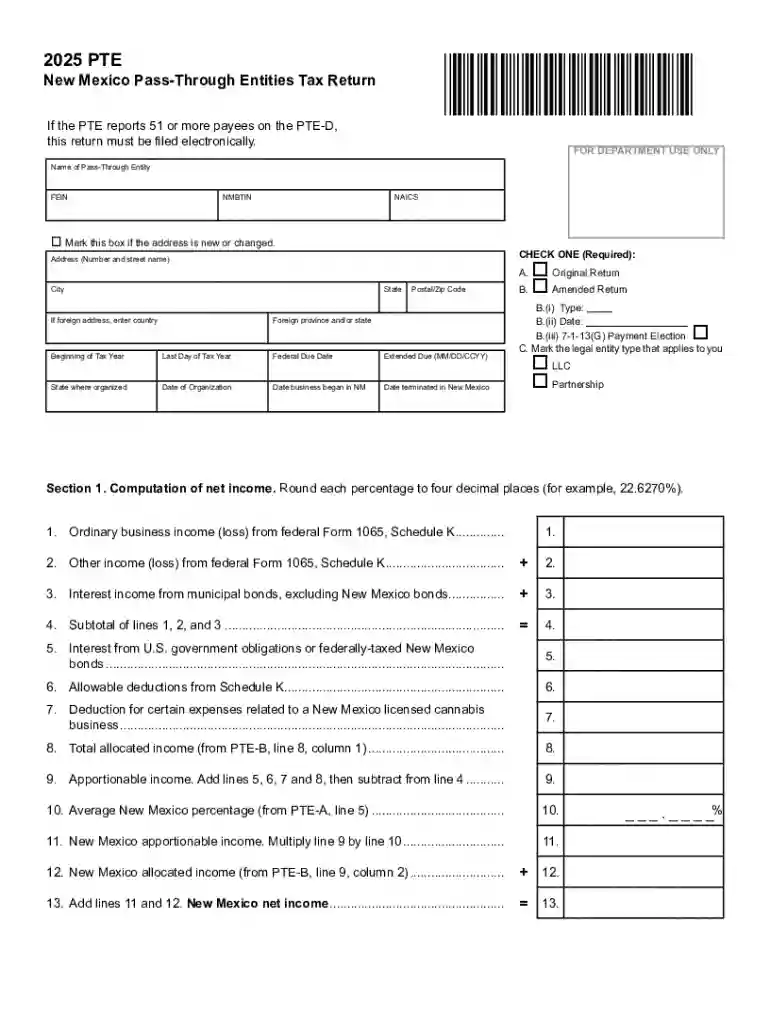
The New Mexico Pass-Through Entities Tax Return is a tax form specifically designed for pass-through entities, such as partnerships, S corporations, and certain LLCs, conducting business in New Mexico. This form is used to report income, deductions, gains, and losses that flow through to the entity owners, who then declare these on their personal tax returns. The primary purpose of this form is to ensure these entities comply with state tax regulations, allowing the state to accurately assess and collect taxes based on the income apportioned to New Mexico.
Understanding Pass-Through Entities
- Pass-through entities do not pay corporate income tax at the business level; instead, income is distributed to owners.
- Owners report this income on their individual tax returns, ensuring taxation occurs at the personal level.
Role in New Mexico's Tax System
- Ensures equitable taxation by attributing income to the state where business is operated.
- Helps in mobilizing state revenues while offering a simplified reporting system for business owners.
Steps to Complete the New Mexico Pass-Through Entities Tax Return
To complete the New Mexico Pass-Through Entities Tax Return, entities must follow specific steps to ensure accuracy and compliance. This process involves multiple stages, from gathering necessary documentation to filling out specific sections of the form.
Gather Required Financial Information:
- Compile income statements, balance sheets, and cash flow statements.
- Collect details on distributed and undistributed income.
Determine Apportionable Income:
- Calculate the portion of income that is sourced to New Mexico.
- Use New Mexico's apportionment formula to allocate income accurately.
Complete Each Section of the Form:
- Fill out general business information, including entity type and federal employer identification number (FEIN).
- Report total income, apportionment factors, and applicable credits.
Review and Verify Information:
- Double-check for accuracy and completeness to prevent penalties.
- Verify all mathematical calculations and ensure information matches financial records.
Submit the Form:
- Choose a submission method: online via the state's electronic filing system or by mail.
- Keep copies of the submission for your records, which may be required during audits.
Filing Deadlines / Important Dates
Adhering to filing deadlines is crucial for avoiding penalties and maintaining compliance with New Mexico tax laws.
- Regular Filing Deadline: Pass-through entities must file their tax returns by March 15th following the tax year.
- Extension Period: Entities can file for a six-month extension, moving the deadline to September 15th. This extension must be officially requested through the state's tax department.
- Estimated Taxes: If the entity estimates their tax liability, quarterly payments are due on April 15th, June 15th, September 15th, and January 15th of the following year.
Importance of Timely Filing
- Filing on time helps avoid interest and penalties, which can accrue daily at a rate determined by the state.
- Ensures compliance with state regulations, preventing legal actions or audits.
Key Elements of the New Mexico Pass-Through Entities Tax Return
Understanding the key elements within the New Mexico Pass-Through Entities Tax Return is essential to ensure accurate filing and compliance.
- Income Reporting: Must specify both gross income and net income, factoring in permissible deductions.
- State Apportionment: Calculate income apportionment using prescribed methodologies reflecting in-state versus out-of-state operations.
- Owner Information: Detail share distribution among partners or shareholders, including allocation percentages.
- Credits and Adjustments: Report any allocated tax credits or adjustments affecting tax liability.
Special Considerations
- Certain industries may have specific deductions or credits applicable, such as green energy incentives.
- Include any modifications or preferences attributable to state taxation vs. federal tax considerations.
Relevant Business Scenarios
- A professional law firm structured as an LLP will use this tax return to report income attributed to partners.
- Small family-run S corporations leverage the form to minimize state tax liability and streamline personal tax filings for their members.
Legal Use of the New Mexico Pass-Through Entities Tax Return
The legal use and obligations of filing the New Mexico Pass-Through Entities Tax Return involve compliance with state tax codes and ensuring proper representation of financial data.
- State Compliance: Required by law for all pass-through entities conducting business in New Mexico.
- Accurate Reporting: Legal obligation to provide truthful reporting and correct calculation of tax liabilities.
Legal Implications
- Failure to file or incorrect filings can result in audits, fines, and potential legal action.
- Adherence to state-specific rules and regulations mitigates risks of legal repercussions.
Software Compatibility
Filing the New Mexico Pass-Through Entities Tax Return can be supported by various tax preparation software, enhancing convenience and accuracy.
- TurboTax and QuickBooks: Offer modules specifically designed for business entities, with options for pass-through entity tax returns.
- DocHub Integration: Possibility to prepare, sign, and store tax-related documents securely, easing the transition between document preparation and filing.
Advantages of Using Software
- Helps in navigating state tax requirements with guided forms and built-in calculations.
- Reduces errors by automating complicated portions of tax reporting.
- Enhances collaboration with accounting professionals through shared access to digital documents.
Penalties for Non-Compliance
Non-compliance with the New Mexico Pass-Through Entities Tax Return carries specific penalties, highlighting the importance of accurate and timely filing.
- Financial Penalties: Regular penalties may include a percentage of the unpaid tax, compounded daily.
- Interest Charges: Accumulate daily on overdue taxes, aligning with state-mandated rates.
- Legal Repercussions: Potential for increased scrutiny, audits, and legal actions from state tax authorities.
Mitigating Penalties
- Consistently meet deadlines and maintain accurate records to avoid incurring additional charges.
- Promptly address any notices from tax authorities to prevent escalation.
Business Types that Benefit Most from New Mexico Pass-Through Entities Tax Return
Understanding which businesses benefit most from the New Mexico Pass-Through Entities Tax Return is crucial for recognizing its value in tax management.
- Service-Based Partnerships: Legal, accounting, and consulting firms benefit from pass-through tax treatment.
- Real Estate Investments: Often structured as partnerships or LLCs to optimize tax obligations.
Why Utilize This Form?
- Provides financial transparency and equitable tax distribution among entity members.
- Offers simplified tax reporting, reducing administrative burdens by maintaining single-level taxation.
Practical Example
- A group of investors forms an LLC for real estate investments in New Mexico; using the pass-through tax return ensures income is only taxed at the owner level, aligning with their strategic financial objectives.