




01. Edit your form online
Type text, add images, blackout confidential details, add comments, highlights and more.

Type text, add images, blackout confidential details, add comments, highlights and more.

Draw your signature, type it, upload its image, or use your mobile device as a signature pad.

Send it via email, link, or fax. You can also download it, export it or print it out.
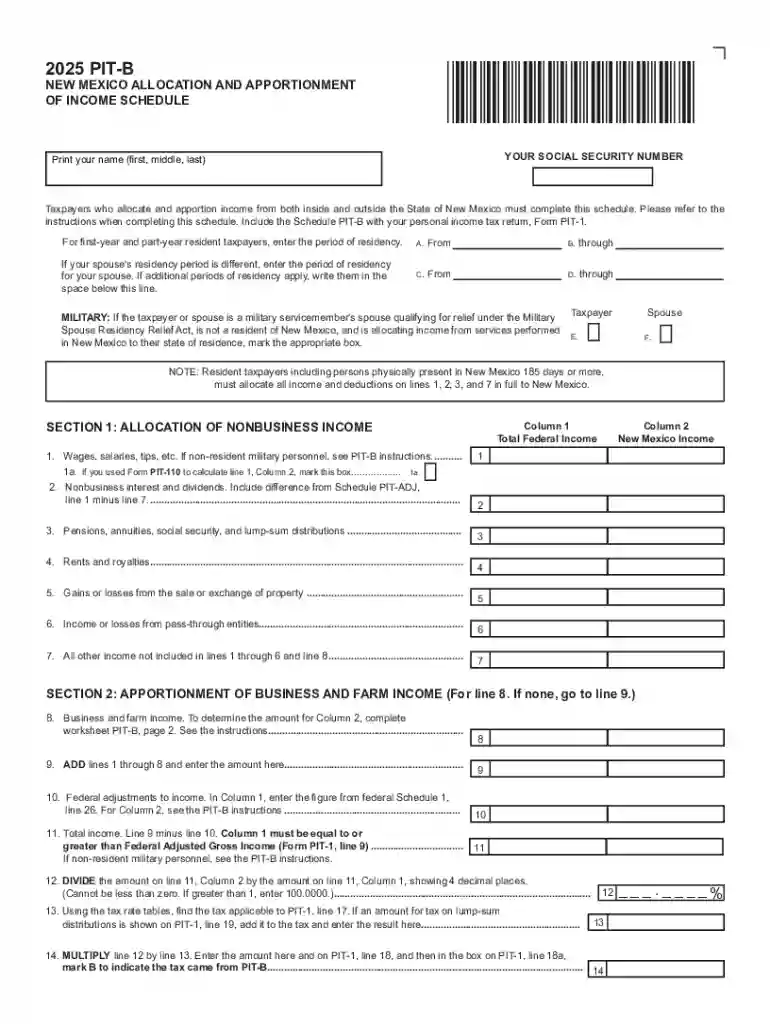
The New Mexico Allocation and Apportionment of Income Schedule is a tax form used by businesses operating within New Mexico to determine the portion of income that should be taxed by the state. This form helps to allocate and apportion income based on specific criteria and factors, ensuring businesses only pay taxes on the income earned from New Mexico sources. Understanding this schedule is crucial for businesses to comply with state tax obligations accurately.
Gather Required Information: Before starting, collect all necessary documentation, including financial statements, previous tax returns, and records of income sources.
Determine Allocation Factors: Identify the factors used for allocation, such as property, payroll, and sales factors within and outside New Mexico.
Calculate Apportionment Percentage: Use the allocation factors to compute the apportionment percentage of your income subject to New Mexico taxation.
Complete Each Section Carefully: Fill in each required section of the form, ensuring all calculations reflect the accurate distribution of income.
Cross-Verify Entries: Double-check all figures and ensure consistency with supporting documents to avoid errors and potential audits.
Submit the Form: Once completed, submit the form using approved methods, either online or via mail, to the New Mexico Taxation and Revenue Department.
Manufacturing Company: A manufacturing company that operates partially in New Mexico and partially in Arizona calculates its New Mexico sales, property, and payroll to determine the taxable income.
Service Provider: A consulting firm with branches across several states uses this form to allocate income derived specifically from New Mexico operations due to client engagements within the state.


Self-employed individuals operating partially in New Mexico must use the form to apportion business income to determine the state tax due.
Retired individuals generally do not require this form unless they have business interests with activities in New Mexico that generate taxable income.
Students running small businesses or side projects generating income in New Mexico need to assess whether income should be apportioned using the relevant schedule.
The sections provided above concentrate on the practical application, essential terms, and required processes for using the New Mexico Allocation and Apportionment of Income Schedule efficiently while adhering to state-specific rules and deadlines.

We've got more versions of the New Mexico Allocation and Apportionment of Income Schedule form. Select the right New Mexico Allocation and Apportionment of Income Schedule version from the list and start editing it straight away!
At DocHub, your data security is our priority. We follow HIPAA, SOC2, GDPR, and other standards, so you can work on your documents with confidence.
Part 11 - TAX CREDIT - INCOME ALLOCATION AND APPORTIONMENT; N.M. Admin. Code New Mexico tax return including the allocation and apportionment schedule.Read more
Refer to the Form PIT-B, New Mexico Allocation and Apportionment of Income Schedule instructions for more information. I have income from both inside and outside New Mexico. Are there special forms that I must file? For non-residents with income from New Mexico sources, a Form PIT-B, New Mexico Allocation andRead more
Feb 17, 2017 income before income taxes. This decrease in income before income taxes was primarily due to continued pressure on TiO 2 prices, soft demandRead more


