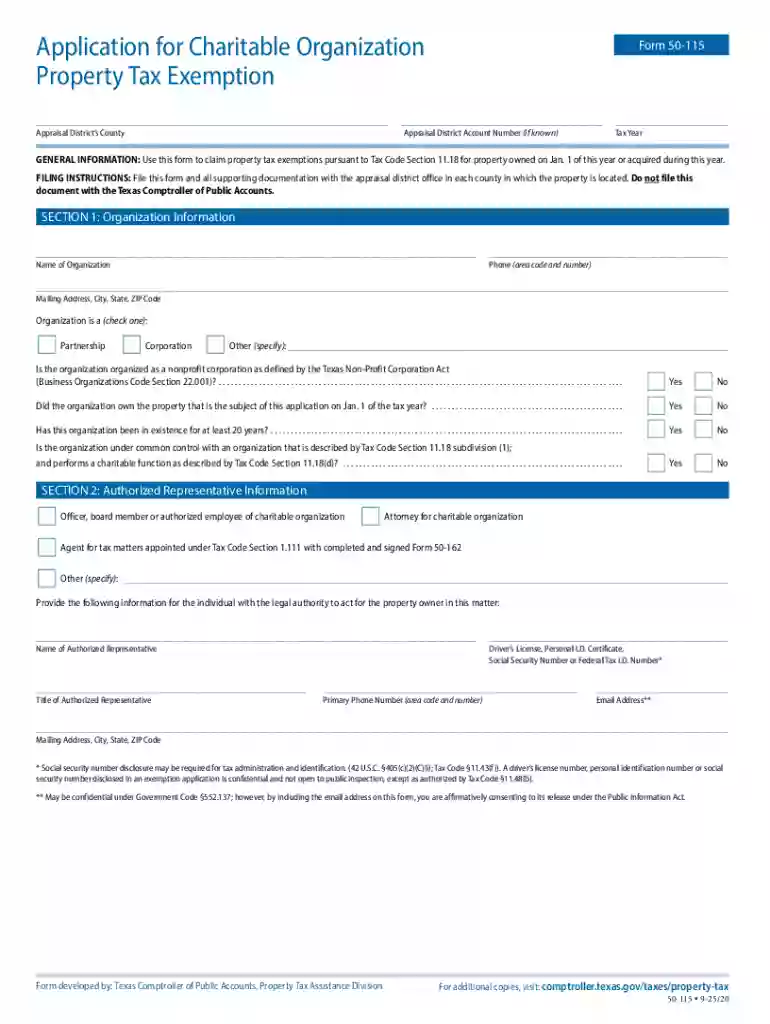
Application for Charitable Organization Property Tax Exemption 2026

Get Form
Application for Charitable Organization Property Tax Exemption Preview on Page 1

Here's how it works

01. Edit your form online
Type text, add images, blackout confidential details, add comments, highlights and more.

02. Sign it in a few clicks
Draw your signature, type it, upload its image, or use your mobile device as a signature pad.

03. Share your form with others
Send it via email, link, or fax. You can also download it, export it or print it out.

Definition & Meaning

The "Application for Charitable Organization Property Tax Exemption" is a form utilized by charitable organizations in the United States to apply for an exemption from property taxes. This form is essential for organizations that qualify under specific IRS guidelines as non-profit entities. By submitting this application, charitable organizations can alleviate financial burdens, allowing them to allocate more resources toward their public service objectives.

  • Charitable organizations may include churches, hospitals, educational institutions, and other non-profits.
  • The exemption is specific to properties used for charitable purposes.
  • The form serves as a legal declaration of the organization’s eligibility for property tax exemption.

Key Terms

  • Charitable Purpose: Activities that provide relief to the poor, advance religion or education, or prevent cruelty to children or animals.
  • Non-Profit Entity: An organization that operates without the primary goal of profit generation, typically recognized under IRS Section 501(c)(3).

How to Obtain the Application

There are several methods to obtain the "Application for Charitable Organization Property Tax Exemption". Understanding these methods ensures that organizations can choose the most convenient option based on their needs.

  1. State or Local Tax Authority Website: Most states provide the form on their tax authority's official website. It is usually accompanied by guidelines and instructions for completion.
  2. In-Person: Visiting the local tax assessor's office can be an option for those who prefer hard copies or require direct assistance.
  3. Mail Requests: Organizations can request that the form be mailed to them by contacting the relevant tax authority.

Online Access

  • Many states offer downloadable PDF versions of the form.
  • Some states may require online submission through a dedicated portal, particularly for initial applications.

Steps to Complete the Application

Filling out the "Application for Charitable Organization Property Tax Exemption" requires careful attention to detail to ensure compliance and accuracy. The following steps provide a comprehensive guideline:

  1. Gather Necessary Documents: Before starting the application, collect documentation such as the IRS determination letter, proof of charitable use, and financial statements.
  2. Complete Organizational Information: This includes the legal name, address, and identification number of the organization.
  3. Provide Property Details: Furnish specific details about the property, including location, use, and any income generated.
  4. Attach Supporting Documents: Required documents may vary by jurisdiction but generally include proof of non-profit status and an explanation of the property’s use.
  5. Review and Sign: Ensure all sections are complete and accurate. An authorized representative must sign the form.
  6. Submit the Application: Depending on state requirements, submission can be via mail, online portal, or in-person delivery at the assessor's office.

Eligibility Criteria

Eligibility for the property tax exemption demands adherence to certain criteria set forth by state laws and IRS guidelines. Not all organizations qualify, so understanding these criteria is crucial.


  • The organization must be recognized as a non-profit entity under Section 501(c)(3) of the Internal Revenue Code.
  • The property must be owned and used exclusively for charitable purposes.
  • Commercial activities conducted on the property may partially affect eligibility, depending on state regulations.
decoration image ratings of Dochub

Common Exclusions

  • Properties used for unrelated business activities.
  • Facilities that generate income not used for charitable purposes.

Key Elements of the Application

Critical elements in the "Application for Charitable Organization Property Tax Exemption" help determine the organization’s eligibility and the scope of the exemption.

  • Declaration of Charitable Use: A section where the organization must outline how the property is used to further its mission.
  • Financial Assessments: Information demonstrating financial reliance on donations, grants, or other non-commercial income.
  • Ownership Proof: Documentation showing the organization’s legal ownership of the property.

State-Specific Rules

Each state may have different rules governing the property tax exemption application process. Understanding these variations is essential for compliance.

  • Exemption Criteria: Some states have specific definitions of "charitable use" that influence eligibility.
  • Application Deadlines: Filing dates can vary widely, often aligning with the fiscal year or specific tax cycles.
  • Renewal Requirements: Periodic reapplication or renewal processes may be required to maintain the exemption.

Filing Deadlines / Important Dates

Missing critical dates associated with the "Application for Charitable Organization Property Tax Exemption" can lead to denied applications or delays in tax relief.

  • Initial Application Deadline: Usually within certain months after acquiring the property or establishing non-profit status.
  • Renewal Dates: Often annual, with specific periods to confirm continued eligibility.

Consequences of Late Submission

  • Loss of exemption status for the tax year.
  • Potential late fees or penalties imposed by the state.

Required Documents

The documentation necessary for submitting the "Application for Charitable Organization Property Tax Exemption" varies by state but typically includes:

  • IRS Determination Letter: Confirms non-profit status.
  • Property Deed: Establishes ownership.
  • Financial Statements: Demonstrate use of funds in support of charitable purposes.
  • Use Plan: Details intended property use and space allocation.

Ensuring these documents are complete and accurate is vital for submission approval and ongoing compliance.

be ready to get more

Complete this form in 5 minutes or less

Get form

Security and compliance

At DocHub, your data security is our priority. We follow HIPAA, SOC2, GDPR, and other standards, so you can work on your documents with confidence.

Learn more
ccpa2
pci-dss
gdpr-compliance
hipaa
soc-compliance
be ready to get more

Complete this form in 5 minutes or less

Get form