
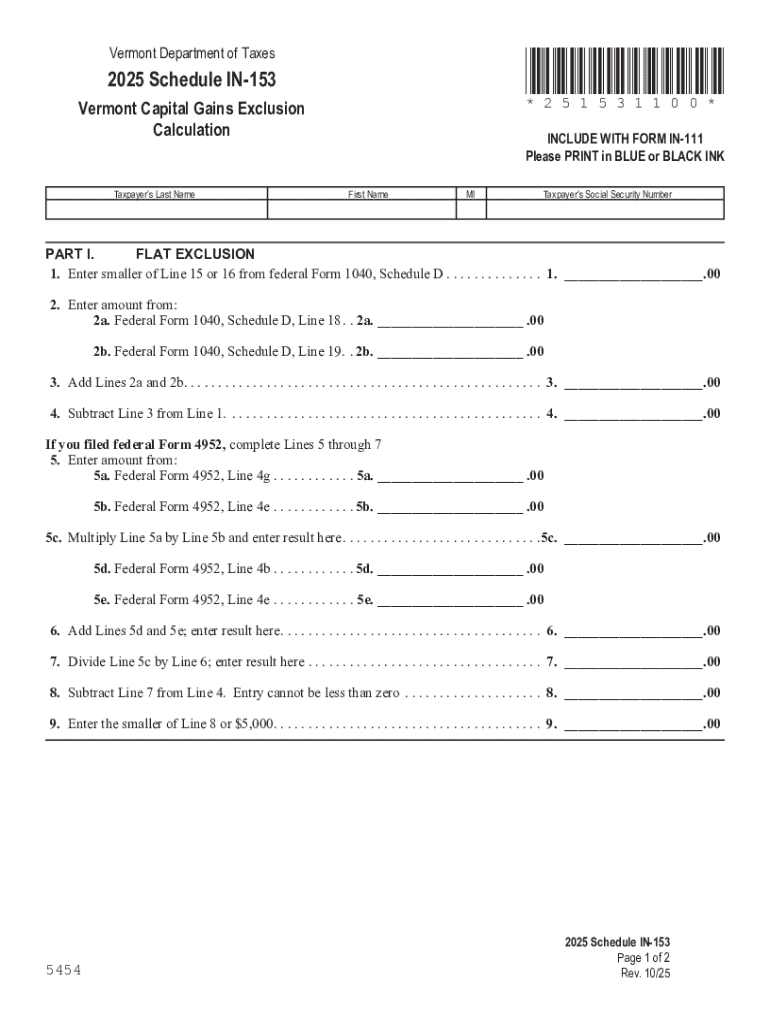







Definition and Meaning
The 2025 Schedule IN-153, Vermont Capital Gains Exclusion Calculation, is a specific tax form used to determine the exclusion applicable to capital gains for Vermont state tax purposes. This document assists taxpayers in calculating the portion of their capital gains that can be excluded from Vermont taxable income. Essentially, capital gains exclusion reduces the amount of taxable capital gains, potentially lowering the overall state tax owed.
Importance of Capital Gains Exclusion
- Tax Reduction: By excluding a portion of capital gains, taxpayers can reduce their state tax liability.
- Investment Incentive: Encourages investment by allowing taxpayers to retain more earnings from asset sales.
- Economic Mobility: Facilitates wealth-building opportunities, promoting financial growth within the state economy.
How to Use the 2025 Schedule IN-153
To properly utilize the 2025 Schedule IN-153, taxpayers must follow a series of steps:
- Gather Necessary Information: Ensure you have all relevant documents, such as the federal tax return, to verify capital gains.
- Determine Eligibility: Confirm if your capital gains qualify for exclusion by reviewing Vermont-specific criteria.
- Calculate Exclusion Amount: Use the form to compute the exact exclusion based on Vermont tax codes and guidelines.
Detailed Steps
- Calculate your total capital gains from sales or exchanges.
- Identify gains that meet Vermont’s exclusion criteria.
- Subtract the allowable exclusion to determine the taxable amount.
How to Obtain the 2025 Schedule IN-153
Obtaining the 2025 Schedule IN-153 can be done through several methods:
- Vermont Department of Taxes Website: Forms and instructions are usually available for download directly from the state’s official website.
- Tax Preparation Software: Software like TurboTax and QuickBooks may offer direct access to the form as part of their state filing packages.
- Local Tax Offices: Visit a local Vermont tax office to retrieve a printed version if digital access is not convenient.
Steps to Complete the 2025 Schedule IN-153
Completing the 2025 Schedule IN-153 involves detailed financial analysis and precise input into the form. Follow these steps for accurate completion:
- Review Instructions: Carefully read and understand the form instructions, ensuring compliance with all guidelines.
- Input Personal Information: Enter your name, taxpayer identification number, and other required personal details.
- Fill in Financial Data: Accurately input the figures pertaining to capital gains and any relevant deductions.
- Complete Calculations: Use the form’s mathematical sections to compute the exclusion.
- Review and Verify: Double-check all filled sections for accuracy and completeness.
Who Typically Uses the 2025 Schedule IN-153
The primary users of the 2025 Schedule IN-153 include:
- Individuals with Capital Gains: Taxpayers who have sold assets like stocks, real estate, or business interests in Vermont.
- Retirees: Those who may sell investment properties or securities as part of their retirement planning.
- Small Business Owners: Entrepreneurs selling business assets or entire companies may need to use this form for tax purposes.


Key Elements of the 2025 Schedule IN-153
Understanding the form's essential components is necessary for accurate completion:
Sections to Focus On
- Income Details: Input your total capital gains and losses.
- Exclusion Calculations: Detailed breakdown of eligible exclusion amounts.
- Adjustments and Deductions: Areas where additional tax codes may apply to modify gains.
State-Specific Rules
Vermont has certain rules regarding capital gains exclusion that differ from federal regulations:
- Percentage of Exclusion: Vermont permits a specific percentage of gains to be excluded which may change annually.
- Eligible Property Types: Not all capital gains are treated equally; ensure the asset type meets state guidelines.
Filing Deadlines and Important Dates
Adhering to filing deadlines is crucial:
- April 15th: Typically the deadline for submitting the Schedule IN-153 along with Vermont state tax returns.
- Extension Requests: If unable to file by the deadline, submit an extension request before April 15th to avoid penalties.
Required Documents
Ensure you have the following documents prepared:
- Federal Tax Return: To align reported capital gains with state filings.
- Asset Sale Records: Proof of sale and valuations for assets sold during the tax year.
- Supporting Schedules: Additional documentation if required to substantiate the exclusion amounts.
Penalties for Non-Compliance
Failing to accurately complete or submit the form can lead to consequences:
- Fines and Interest: Late submissions or inaccuracies may result in financial penalties.
- Audits: Incomplete or incorrect filings could trigger audits, necessitating further scrutiny and correction.
Examples of Using the 2025 Schedule IN-153
Real-world scenarios illustrate typical use cases for the form:
- Homeowners Selling Property: May qualify for exclusion if specific criteria are met.
- Investors Liquidating Stock: Using the form to deduct portions of gains from state taxable income.
- Business Owners Exiting: Calculating exclusions on gains from business sales.




