




01. Edit your form online
Type text, add images, blackout confidential details, add comments, highlights and more.

Type text, add images, blackout confidential details, add comments, highlights and more.

Draw your signature, type it, upload its image, or use your mobile device as a signature pad.

Send it via email, link, or fax. You can also download it, export it or print it out.
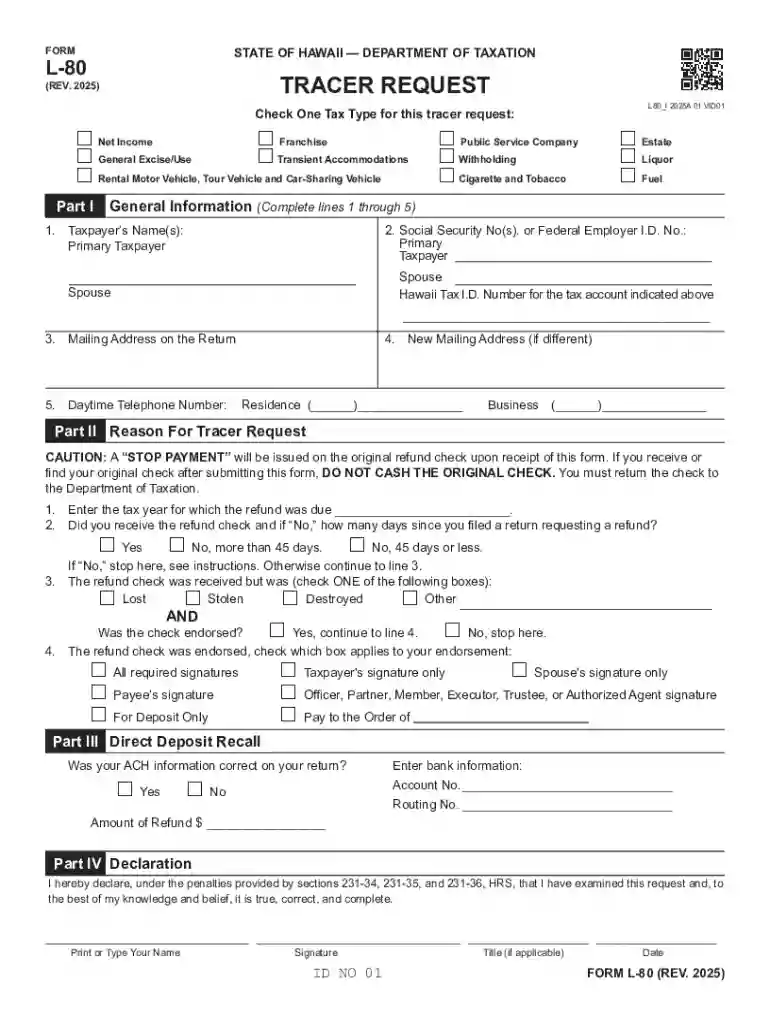
Form L-80 Rev 2025, also known as the "Tracer Request for Tax Year Forms 2025," is a document issued by the Department of Taxation in Hawaii. Its primary function is to facilitate the tracing of tax-related forms or submissions that a taxpayer has not received or requires confirmation of submission for tax year 2025. Taxpayers may use this form to request updates on the status of tax forms within different taxation categories, including net income, franchise, general excise/use, transient accommodations, and rental income taxes.
The primary use of Form L-80 Rev 2025 is straightforward, focusing on tracing unreceived tax-related documents. Below is a step-by-step guide detailing its usage:
Identify Tax Type: First, users should identify the specific tax type they are inquiring about, such as net income, franchise, or general excise/use taxes.
Provide Necessary Details: Complete required fields such as taxpayer information, including name, social security or tax identification number, and address to facilitate accurate processing.
Specify Form Details: Clearly indicate the form or submission in question, including submission date and any relevant reference or tracking numbers.
Submit the Form: You can usually send the completed Form L-80 via mail or electronic submission to the Hawaii Department of Taxation.
Track Submission: Keep a copy of the completed form and any tracking information. Follow up if no response is received within the expected timeframe.


Completing Form L-80 requires a meticulous approach to ensure all information provided is accurate and comprehensive.
Gather Information: Collect all necessary documentation related to the form being traced.
Complete Personal Details: Fill in your name, taxpayer identification number, and contact information.
Select Tax Category: Check the appropriate box for the tax type associated with the form.
Detail the Submission: Provide identification numbers, submission dates, and any tracking details available.
Verification and Submission: Review the form for accuracy before submitting it via the selected method.
Using Form L-80 does not inherently involve penalties, but it serves an essential role in avoiding potential compliance issues by ensuring tax forms are processed in a timely fashion. Failure to trace misplaced forms could result in:
While the form itself does not impose a deadline, understanding critical tax submission deadlines helps prevent the necessity of filing a tracer request. Keeping track of the following can reduce dependencies on Form L-80:
Form L-80 can be integrated with various tax software programs, facilitating easier electronic submissions.
Integration with such platforms not only simplifies the submission process but also helps track and manage follow-ups effectively.
By providing comprehensive, detailed coverage of Form L-80 and its applications, taxpayers and businesses can ensure effective tracking and management of their tax communications with the Hawaiian Department of Taxation.
We've got more versions of the Form L-80 Rev 2025 Tracer Request for Tax Year Forms 2025 form. Select the right Form L-80 Rev 2025 Tracer Request for Tax Year Forms 2025 version from the list and start editing it straight away!
At DocHub, your data security is our priority. We follow HIPAA, SOC2, GDPR, and other standards, so you can work on your documents with confidence.

Jan 20, 2026 Rev. 2018. L-80, Tracer Request For Tax Year , Rev. 2025. L-82, Refund Change Request for Tax Year , Rev. 2025. N-848, Power ofRead more
Use Form L-80 to trace a refund check or to request a recall of a refund issued by direct deposit. INSTRUCTIONS. (NOTE: References to married and spouse areRead more
Dec 31, 2019 report on Form 10-K for the fiscal year ended December 31, 2019, to be signed on its behalf by the undersigned, and in the capacities.Read more


