



01. Edit your form online
Type text, add images, blackout confidential details, add comments, highlights and more.

Type text, add images, blackout confidential details, add comments, highlights and more.

Draw your signature, type it, upload its image, or use your mobile device as a signature pad.

Send it via email, link, or fax. You can also download it, export it or print it out.
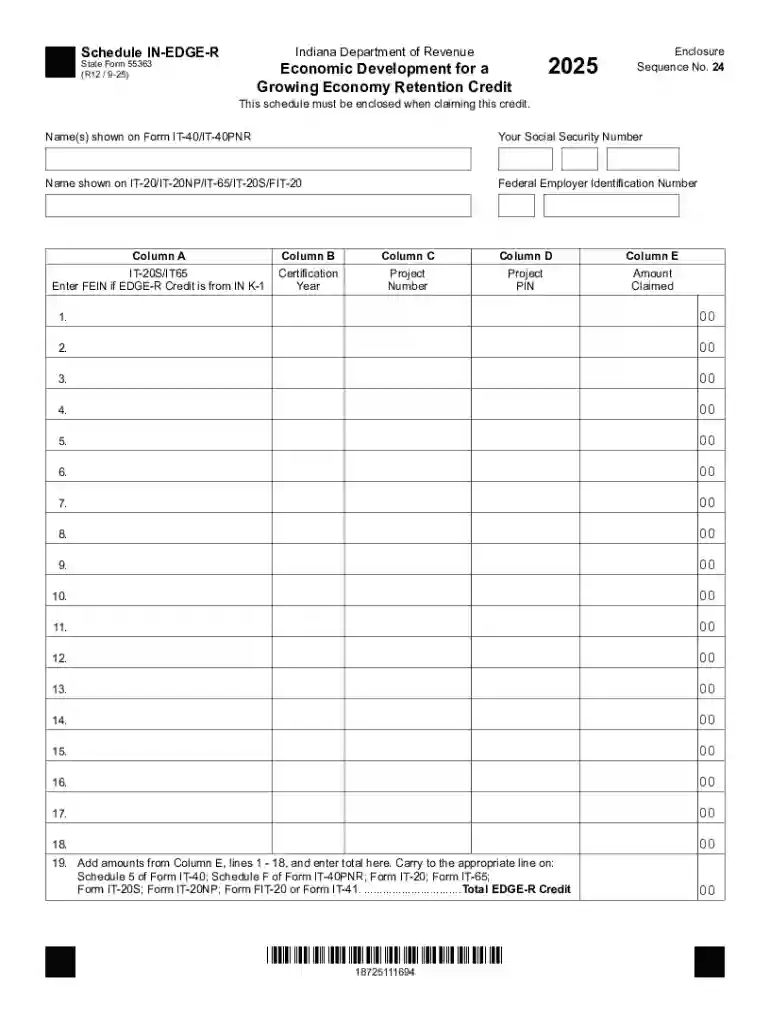
The Indiana EDGE-R Credit Schedule is an official tax form used by businesses to claim the Economic Development for a Growing Economy Retention Credit in Indiana. This credit is designed to incentivize businesses to retain employees in the state by offering financial benefits. The schedule, numbered as State Form 55363 (R12 / 9-25), specifically focuses on documenting the necessary details required for calculating and claiming this tax credit. Understanding this form is crucial for businesses aiming to reduce their state tax liabilities while complying with Indiana's economic development policies.
Identification Information: The form begins with a section to input basic identification information of the business, including business name, address, and taxpayer identification number.
Basic Tax Information: This includes segments meant to outline the fiscal year or tax period for which the credit is being claimed.
Credit Calculation: The heart of the form involves calculating the credit amount. Businesses must accurately record specific financial data, such as wages paid to retained employees and qualifying expenses.
Enclosure Sequence Number: This specifies the necessary documentation that must accompany the form to validate the credit claim.
Qualified Employment: It refers to jobs that meet specific criteria set by the Indiana Department of Revenue, critical for businesses looking to apply the retention credit.
Retention Credit: A tax benefit granted to businesses for maintaining employment levels as per the established guidelines.
To effectively use the Indiana EDGE-R Credit Schedule, businesses should gather all necessary financial information and documents concerning their workforce and wages. The process typically involves:
Collecting Employee Data: Gather and verify employment information, including wages and types of jobs, which must qualify under state guidelines.
Completing the Form: Carefully fill out each section of the schedule using financial records, ensuring all entries match with supporting documents.
Cross-Verifying Data: Double-check all calculations and entries to prevent errors that could lead to compliance issues or delayed processing.
Submission: Once completed and verified, the form can be submitted as part of the annual tax filing or specific state tax claim procedures, according to Indiana state instructions.
Manufacturing Firms: A manufacturing company retaining over 50 permanent employees may use this form to secure tax credits for maintaining workforce levels while expanding operations within Indiana.
Tech Startups: Startups particularly in the tech sector that have received state grants to foster local employment can leverage the credit schedule to manage cash flow by reducing state taxes.
Gather Information: Start by collecting all pertinent company and employee-related information, such as Tax ID numbers and payroll records.
Fill Out Company Information: Begin by entering the business identification information in the designated sections of the form.
Input Financial Data: Using records, fill in accurate financial data, which includes wages paid and other qualifying expenses for the fiscal year.
Calculate Credit: Follow the instructions outlined in the form to compute the total retention credit.
Attach Required Documentation: Review enclosure sequence requirements to ensure all necessary documents, such as payroll records and employee contracts, are attached.
Review and Submit: Once the schedule is complete and verified, submit it according to the specified methods – electronically or via mail.


Businesses with Significant Employment: Companies that retain a specified number of employees at risk of relocation or downsizing are prime candidates for claiming this credit.
Compliance with State Development Goals: Employers that align their growth with Indiana’s economic plans and strategies, often detailed in state development directives.

Corporations and LLCs: Large entities incorporated within Indiana or doing business there are suitable for utilizing this form.
Partnerships: Partnerships operating in high-impact industries that create and retain jobs as outlined by Indiana laws.
Businesses must adhere to specific legal guidelines while completing the credit schedule, ensuring all entries are truthful and supported by appropriate documentation.
Failure to comply with these legal mandates can result in penalties, including disqualification from receiving the credit and possible legal action.
Fines and Interest: Misreporting or failure to submit necessary documentation may incur financial penalties and interest.
Loss of Future Benefits: Persistent non-compliance may result in disqualification from future state incentives and credits, impacting the business's ability to claim benefits.
Online Submission: The Indiana Department of Revenue provides a digital platform for filing state tax forms, including the EDGE-R Credit Schedule, for ease of processing and verification.
Mail Submission: Though less common, businesses can also submit hard copies of the form along with supporting documents via postal services.
We've got more versions of the Indiana EDGE-R Credit Schedule form. Select the right Indiana EDGE-R Credit Schedule version from the list and start editing it straight away!
At DocHub, your data security is our priority. We follow HIPAA, SOC2, GDPR, and other standards, so you can work on your documents with confidence.







The purpose of this handbook is to provide brief summaries of various state and local taxes and revenues, and state appropriations.Read more
On the first schedule, enter the total EDGE-R credit amounts from all pages on line 19. Instructions for Schedule IN-EDGE-R. *24100000000*. 24100000000.Read more
The Interstate Technology and Regulatory Council (ITRC) is a public-private coalition working to reduce bar- riers to the use of innovative environmentalRead more


