
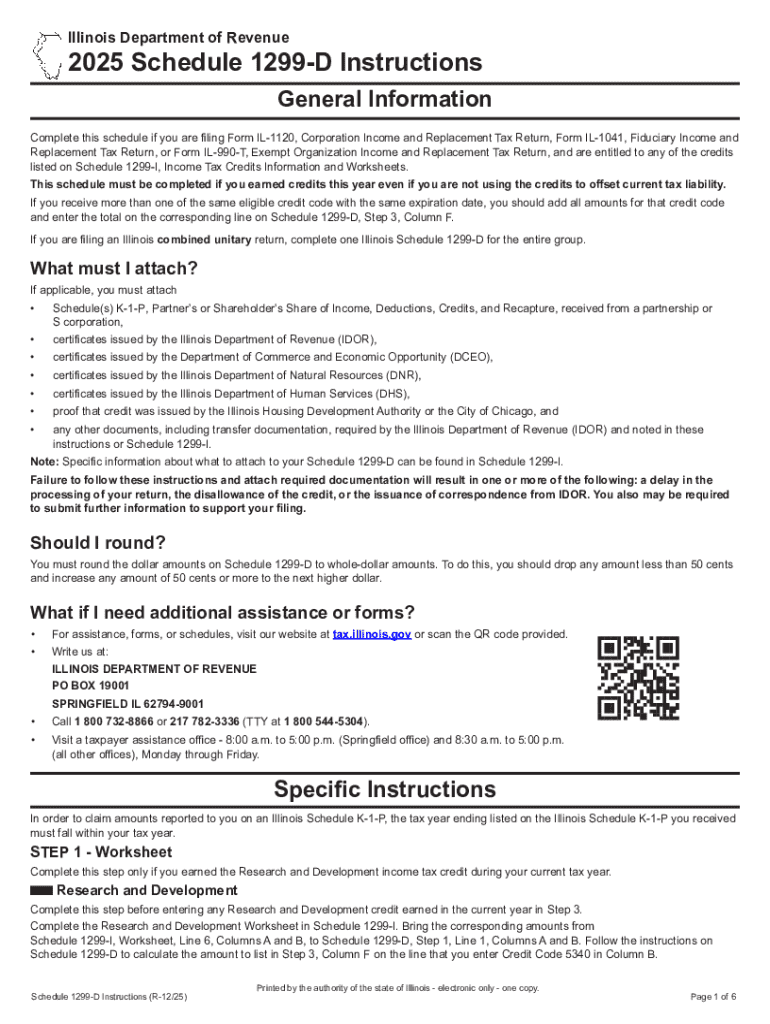







Definition & Meaning
The Illinois Schedule 1299-D is a supplemental tax form used in conjunction with the Illinois Corporation Income and Replacement Tax Return (Form IL-1120) and other applicable forms like the Form IL-1041. It provides instructions on how to calculate and report various tax credits that are available to businesses in Illinois. These credits can include edge tax credits, environmental impact credits, and more, all of which aim to provide financial relief and incentives for businesses that invest in Illinois' economic and environmental development.
Specific Examples
- EDGE Credit: Designed to encourage job creation and investment within the state. Businesses that are expanding operations in Illinois may be eligible.
- Environmental Impact Credit: Offered to businesses that implement environmentally friendly practices, like reducing carbon emissions or using renewable energy.
How to Use the Illinois Schedule 1299-D Instructions
Using the Illinois Schedule 1299-D Instructions involves following a series of steps to ensure accurate completion of the form and calculation of potential credits. The instructions guide taxpayers through identifying eligible credits, calculating them, and entering them correctly on the corresponding tax returns.
Step-by-Step Process
- Identify Applicable Credits: Determine which credits your business may qualify for based on activities and investments.
- Calculate Credit Amounts: Use provided formulas and guidelines within Schedule 1299-D to compute each credit's value.
- Complete the Schedule: Enter the computed amounts into the correct sections of Schedule 1299-D.
- Integrate with Main Forms: Transfer totals to your primary tax return forms, such as Form IL-1120 or IL-1041.
Steps to Complete the Illinois Schedule 1299-D Instructions
Completing Illinois Schedule 1299-D involves detailed attention to various sections of the instructions and the form itself. Here, we provide a comprehensive step-by-step guide to ensure thorough and accurate completion.
Detailed Steps
- Gather Required Information: Compile all relevant financial information, such as investments in qualified property and expenses related to credits.
- Read Instructions Thoroughly: Review the instructions to understand the criteria and methodologies for each credit.
- Calculate Each Credit Separately: For each applicable credit, use examples and guidelines to compute the proper credit amount.
- Enter Information: Populate Schedule 1299-D with the calculated credit amounts, ensuring accuracy in every field.
- Double-Check Entries: Verify each entry to avoid common errors or omissions that might affect the total credit amount.
- Attach to Tax Return: Once completed, attach Schedule 1299-D to the appropriate main tax return form.
Practical Scenarios
- A manufacturing business investing in energy-efficient machinery should calculate the Environmental Impact Credit precisely, following specific sections in the instructions.
Who Typically Uses the Illinois Schedule 1299-D Instructions
The primary users of the Illinois Schedule 1299-D Instructions are businesses operating in Illinois that are eligible for certain tax credits. This includes companies across various industries, from manufacturing to technology, applying for tax relief based on investment and employment activities.


Examples of Eligible Businesses
- Corporations expanding and creating new jobs in Illinois.
- Manufacturers implementing environmentally sustainable processes.
- Tech Startups making significant capital investments in the state.
Key Elements of the Illinois Schedule 1299-D Instructions
Understanding the key elements of the Illinois Schedule 1299-D Instructions is essential for proper completion and maximizing available credits. Key elements include definitions, eligibility criteria, calculation methods, and form submission guidelines.
Detailed Components
- Eligibility Criteria: Outlines who can apply and what qualifies a business for each credit.
- Definitions: Clear definitions of terms such as “qualified property” or “investment credit” that are crucial for correct form completion.
- Calculation Methods: Step-by-step formulas and examples detailing how to compute each type of credit.
- Submission Guidelines: Directions on attaching Schedule 1299-D to other forms and deadlines for submission.
Potential Pitfalls
- Misunderstanding eligibility requirements can lead to incorrect credit claims.
- Omitting necessary attachments may cause processing delays or denials.
State-Specific Rules for the Illinois Schedule 1299-D Instructions
The state of Illinois has specific guidelines and regulations concerning the use and submission of Schedule 1299-D. These rules ensure the form is used correctly and fairly among all businesses applying for credits.
Important State Rules
- Filing Deadlines: Aligns with the state’s tax return deadline, generally aligning with federal tax timelines.
- Amendments and Corrections: Specifies procedures for submitting corrections if an error is discovered after filing.
- Taxpayer Responsibilities: Obligations to provide accurate information and maintain records that support credit claims.
Filing Deadlines / Important Dates
To maintain compliance and reap the benefits of tax credits, businesses must adhere to specific filing deadlines and keep track of important dates related to Illinois Schedule 1299-D. Failure to comply can result in penalties and lost credits.
Key Filing Dates
- Annual Deadline: Typically coincides with the federal tax deadline, usually April 15.
- Extension Provisions: Information on how to apply for an extension if additional time is needed for tax computations.
Compliance Guidance
- Ensure timely submission to avoid penalties.
- Use reminders and scheduling tools to track deadlines effectively.
Penalties for Non-Compliance
Failing to adhere to the requirements for Illinois Schedule 1299-D can lead to significant penalties, impacting financial health and eligibility for future credits. Understanding and mitigating these risks is crucial for businesses seeking tax relief through this form.
Types of Penalties
- Late Filing Fees: Imposed for failure to submit the form by the due date.
- Incorrect Filing Penalties: Applied if forms are completed inaccurately.
- Loss of Credits: Risk of disqualification from claimed credits if proper documentation and procedures are not followed.
Risk Mitigation Strategies
- Conduct pre-filings reviews to ensure accuracy.
- Use tax professionals or software to assist in mapping form responses to official guidance.




