01. Edit your form online
Type text, add images, blackout confidential details, add comments, highlights and more.

Type text, add images, blackout confidential details, add comments, highlights and more.

Draw your signature, type it, upload its image, or use your mobile device as a signature pad.

Send it via email, link, or fax. You can also download it, export it or print it out.
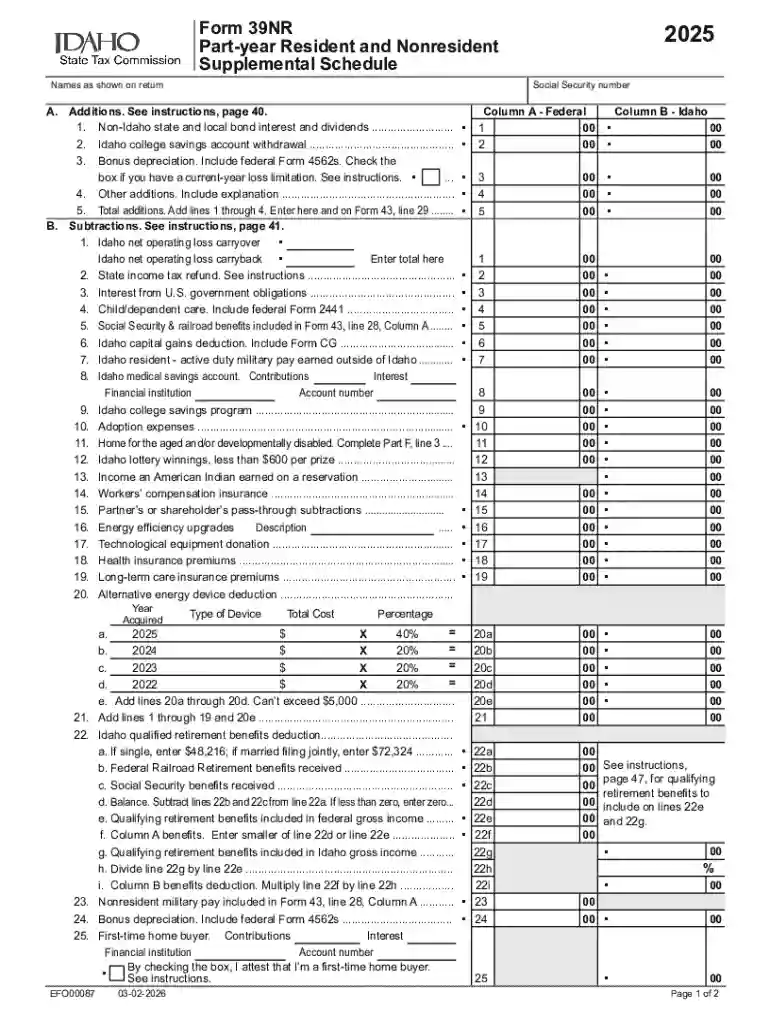
Idaho Form 39NR 2025 serves as a Part-Year Resident and Nonresident Supplemental Schedule primarily for individuals who have partial or nonresident tax liabilities in Idaho. This form is used to calculate and adjust state taxes, ensuring compliance with Idaho's specific tax regulations for nonresidents and part-year residents. The form allows taxpayers to account for income earned both within and outside Idaho, providing a balanced approach to state tax liabilities.
Personal Information: Begin by entering your name and social security number as it appears on your primary tax return.
Additions to Income: Identify non-Idaho state and local bond interest and other taxable income required to be reported.
Subtractions from Income: Include any Idaho source income that is not taxable or adjustments specific to Idaho laws.
Tax Calculation: Follow the instructions to compute your tax liability based on the adjusted income figures, using the detailed worksheets provided.
Review and Sign: After completion, review the form for accuracy, sign, and date it before submission.
Each step must adhere to the instructions provided in the form's guide to ensure accurate reporting and compliance with Idaho's state tax obligations.
The Idaho Form 39NR 2025 is predominantly used by:
This form is crucial for these groups to align their tax responsibilities according to Idaho's requirements while maintaining adherence to multistate income regulations.


These components provide the necessary framework for users to report their income and calculate taxes accurately under Idaho’s jurisdiction.
Users must ensure that the information provided on the Idaho Form 39NR 2025 is accurate and truthful to reflect their genuine tax liabilities in the state. Misrepresentation can lead to penalties or legal issues. The form's proper use aligns with both state tax codes and federal requirements for state-specific tax documentation, offering protection from future audits or legal inquiries.
The Internal Revenue Service requires that state forms like Idaho Form 39NR work in conjunction with federal tax returns to ensure coherence across different jurisdictions. Users must integrate these state-specific documents with their federal tax filings, maintaining consistency in income reporting and tax liabilities as guided by IRS requirements.
Typically, the Idaho Form 39NR 2025 is due on the same date as the federal tax return, usually by April 15. Extensions may change this timeline, and it's critical to double-check for any date changes annually, especially if participating in an extension which may allow for additional time but requires prior confirmation with Idaho tax authorities.
These options cater to diverse taxpayer preferences, ensuring accessibility and convenience across different technological capabilities and comfort levels.
Idaho mandates specific adaptations to federal tax rules, requiring compliance with state-specific income allocations and deductions. As tax laws can vary significantly from federal standards, it’s important for users to familiarize themselves with these regulations, possibly consulting state tax offices or legal experts for advice tailored to their unique circumstances.
We've got more versions of the Idaho Form 39NR 2025 form. Select the right Idaho Form 39NR 2025 version from the list and start editing it straight away!
At DocHub, your data security is our priority. We follow HIPAA, SOC2, GDPR, and other standards, so you can work on your documents with confidence.