




01. Edit your form online
Type text, add images, blackout confidential details, add comments, highlights and more.

Type text, add images, blackout confidential details, add comments, highlights and more.

Draw your signature, type it, upload its image, or use your mobile device as a signature pad.

Send it via email, link, or fax. You can also download it, export it or print it out.
Forms completed online are digital versions of traditional paper forms, enabling users to fill out, submit, and manage documents through their web browsers. This digital transformation simplifies the filing process, reducing physical paperwork and expediting data processing. Key characteristics include easy access, user-friendly interfaces, and enhanced accuracy through error-checking features. Increasingly, organizations and individuals utilize these forms for tasks such as tax reporting, application submissions, and data collection, benefiting from integrations with existing digital workflows.
Using forms online typically involves accessing the form via a specified platform or website, completing required fields, and submitting through the internet. Most platforms offer guides or tutorials to assist users.
Locating and procuring the necessary online form involves a few straightforward steps:
Completing an online form efficiently requires organized approach and due diligence.
Transitioning to online forms offers multiple benefits, enhancing overall experience for both individuals and businesses.
Online forms cater to a wide range of users, from individuals performing personal tasks to organizations managing large-scale processes.


Understanding key terms is crucial for effectively managing online forms.
By incorporating these components, users can effectively engage with and benefit from the transition to online forms for a variety of applications and services.
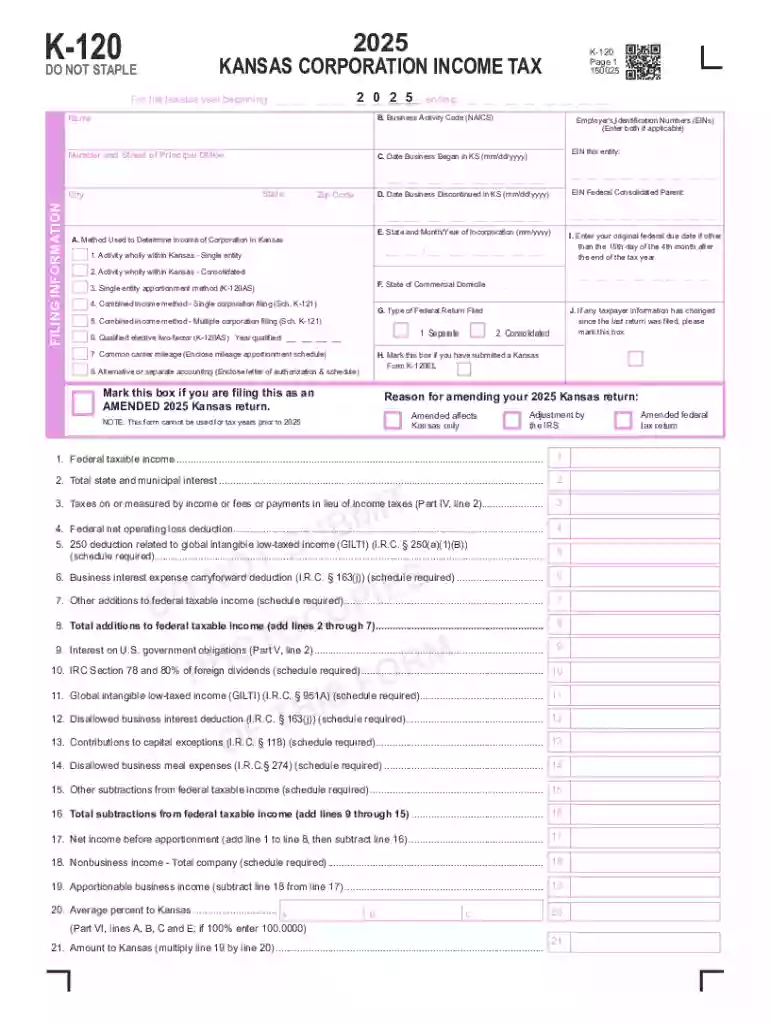
We've got more versions of the Kansas Corporation Income Tax Form K-120 2025 form. Select the right Kansas Corporation Income Tax Form K-120 2025 version from the list and start editing it straight away!
| Versions | Form popularity | Fillable & printable |
|---|---|---|
| 2025 | 4.3 Satisfied (23 Votes) | |
| 2024 | 4.8 Satisfied (40 Votes) | |
| 2023 | 4.1 Satisfied (48 Votes) | |
| 2022 | 4.7 Satisfied (34 Votes) | |
| 2021 | 4.8 Satisfied (90 Votes) | |
| 2020 | 4.3 Satisfied (208 Votes) | |
| 2019 | 4 Satisfied (38 Votes) | |
| 2018 | 4.4 Satisfied (187 Votes) | |
| 2015 | 4.4 Satisfied (559 Votes) | |
| 2014 | 4.4 Satisfied (44 Votes) | |
| 2013 | 4 Satisfied (56 Votes) | |
| 2011 | 4.3 Satisfied (70 Votes) |
At DocHub, your data security is our priority. We follow HIPAA, SOC2, GDPR, and other standards, so you can work on your documents with confidence.


Dec 16, 2025 This page lists the USCIS forms that are currently available to file online. Visit the File Online page to learn about the benefits of filing a form using ourRead more
Open the form in a web browser. Google Chrome and Microsoft Edge are the best for filling in. PDFs. If the form came from a link online, openRead more
CiviCRM ships with an extension that allows you to create your own forms. The extension is called FormBuilder (also known as Afform) and can be enabled on theRead more


