







Definition and Meaning
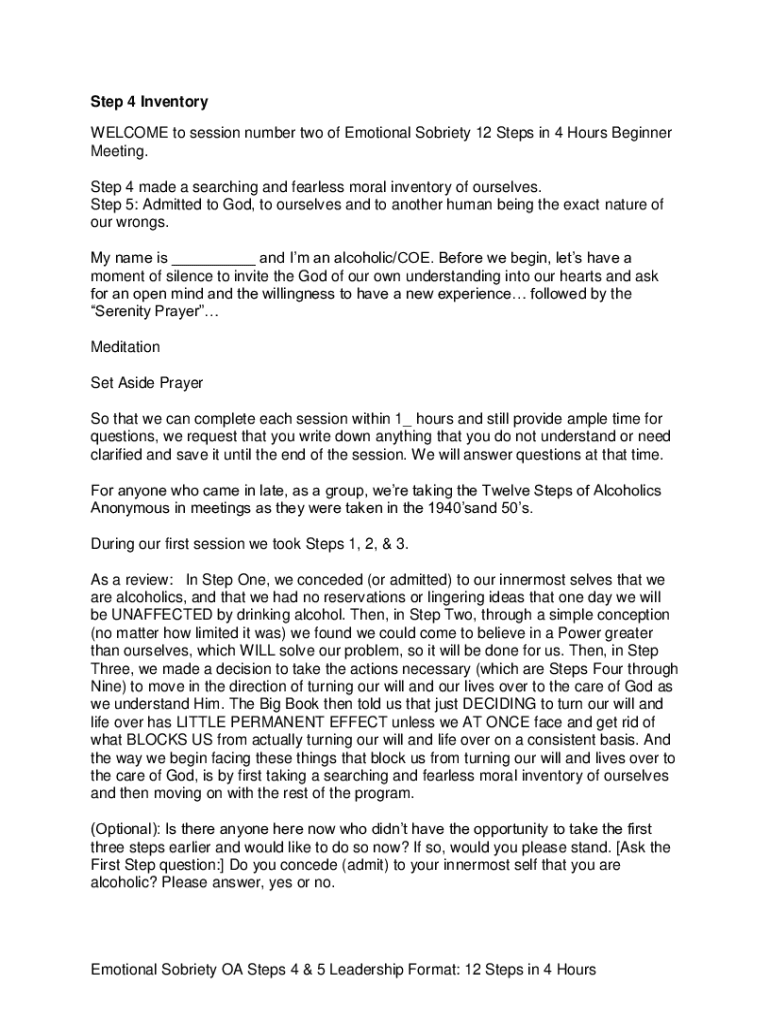
The "4th Step Inventory A A 4th Step Worksheets 12 Step Guides" are specialized tools designed to aid individuals participating in a 12-step recovery program, such as Alcoholics Anonymous (AA). The fourth step of this program involves making a searching and fearless moral inventory of oneself. These worksheets guide users through the process of identifying their behaviors, thoughts, and patterns that either contribute to addictive tendencies or hinder personal growth. By providing a structured approach, the worksheets help individuals reflect on their experiences and foster greater self-awareness.
How to Use 4th Step Inventory A A Worksheets
To utilize these worksheets effectively, individuals should approach the process with honesty and willingness to introspect. Begin by setting aside a quiet space and uninterrupted time to focus entirely on the worksheets. Follow these steps:
- Read each section: Ensure you understand the prompts and questions.
- Reflect: Consider past behaviors, decisions, and their impacts on your life and relationships.
- Write down insights: Document thoughts and feelings as responses to each question or statement.
- Review regularly: Revisit your entries to identify patterns and changes over time.
Utilizing these worksheets helps maintain a record of personal progress in the recovery journey and serves as a cornerstone for upcoming steps in the 12-step program.
Steps to Complete the 4th Step Inventory
Completing the 4th Step Inventory can be a comprehensive and introspective process. Here are key steps to guide users through:
- Identify Resentments: List people, institutions, or principles you hold resentments against.
- Examine Fears: Record various fears and explore their origins.
- Analyze Harm Caused: Reflect on instances where personal actions caused harm to others.
- Review Sexual Conduct: Analyze relationships and behaviors related to intimacy and sexuality.
- Summarize Findings: Compile insights into broader themes or categories for deeper understanding.
Through this structured approach, participants can gain clarity about behaviors and attitudes that need to be addressed as part of their recovery.
Why You Should Use the 4th Step Inventory Worksheets
Engaging with the 4th Step Inventory Worksheets provides several benefits, particularly in the context of a 12-step program:
- Increased Self-Awareness: Offers a clear view of personal strengths and weaknesses.
- Emotional Release: Provides an outlet for expressing and processing complex feelings.
- Improved Relationships: Insights can improve interactions through better understanding of past behaviors.
- Foundation for Change: Establishes a baseline for making meaningful and sustainable changes to one's behavior.
These benefits align with the broader goals of the 12-step program in fostering personal development and recovery.
Key Elements of the 4th Step Inventory
The 4th Step Inventory Worksheets are composed of several key elements that facilitate comprehensive self-examination:
- Resentment Inventory: Examine grudges and unresolved conflicts.
- Fear Inventory: Identify and understand fears that shape behaviors.
- Sexual Conduct Inventory: Reflect on past actions in intimate relationships.
- Harm Caused Inventory: Document instances of causing harm and their impact.
These sections collectively aid individuals in examining various dimensions of their lives that might influence addictive behaviors.
Who Typically Uses the 4th Step Inventory
The primary users of the 4th Step Inventory A A Worksheets are individuals involved in a 12-step recovery program, particularly members of Alcoholics Anonymous or other similar groups. However, these worksheets may also be utilized by:
- Therapists or Counselors: Supporting clients in recovery programs.
- Family Members: Who seek a deeper understanding of loved ones' journeys.
- Self-help Environments: For those independently seeking personal growth.
By catering to a wide range of users, the worksheets facilitate personal development beyond the program setting.


Examples of Using the 4th Step Inventory
Here are practical scenarios illustrating the use of the 4th Step Inventory:
- Conflict Resolution: An individual revisits past grievances with a family member and finds a way to address the conflict maturely.
- Overcoming Fear: A person identifies a fear of change that hinders progress at work and takes steps to embrace new roles or responsibilities.
- Relationship Patterns: By analyzing past relationships, someone learns to overcome patterns that contribute to unhealthy dynamics.
These examples illustrate how this introspective process can lead to actionable changes in everyday life.
Versions or Alternatives to the 4th Step Inventory Worksheets
While the traditional 4th Step Inventory Worksheets are widely used, there are alternative versions or supplementary tools available:
- Digital Versions: Interactive online forms for those who prefer a digital approach.
- Guided Journals: With prompts focusing on the 4th Step, providing additional context or space for expression.
- Group Workbooks: Designed for group settings to facilitate shared experiences and collective reflection.
These variations enable individuals to choose formats that best suit their personal preferences and technological comfort levels.




