




01. Edit your form online
Type text, add images, blackout confidential details, add comments, highlights and more.

Type text, add images, blackout confidential details, add comments, highlights and more.

Draw your signature, type it, upload its image, or use your mobile device as a signature pad.

Send it via email, link, or fax. You can also download it, export it or print it out.
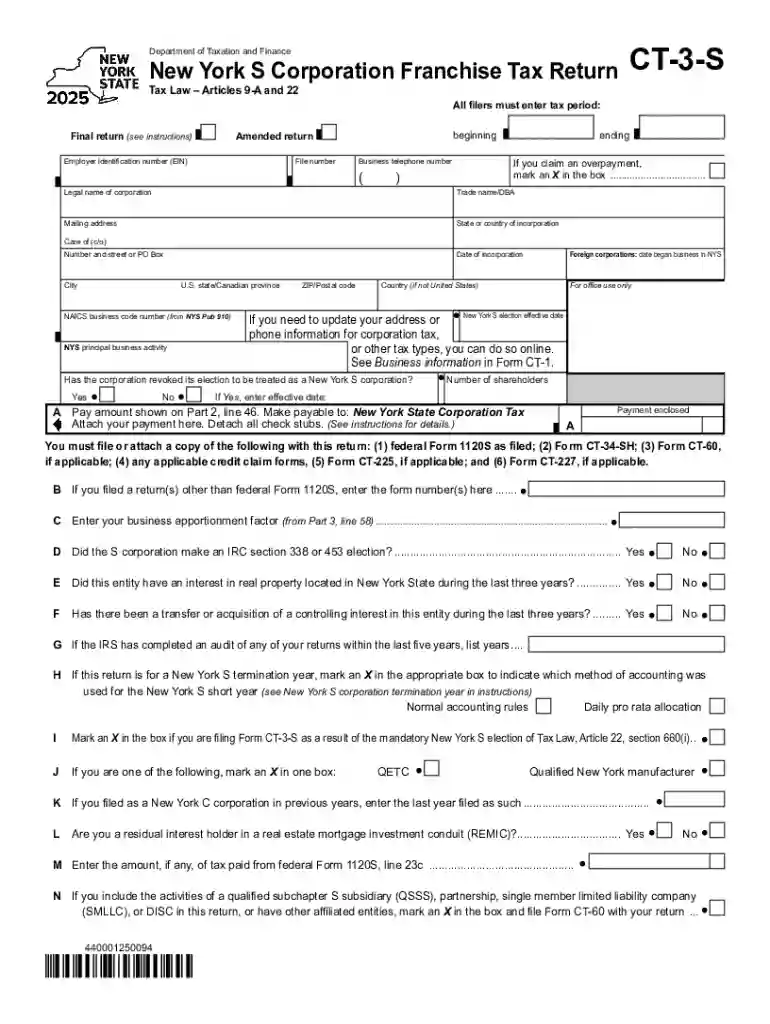
Form CT-3-S, commonly known as the New York S Corporation Franchise Tax Return, is a state-specific tax document that S Corporations, registered in New York, must file to report their financial activity for the 2025 tax year. This form helps determine the tax obligations owed by the corporation to New York State, encompassing various revenues and deductions applicable under state tax laws.
Using the CT-3-S form requires careful preparation and adherence to New York State tax regulations. This process involves gathering relevant financial data and ensuring compliance with specific instructions detailed by the Department of Taxation and Finance.
A structured approach is essential when completing Form CT-3-S to ensure accuracy and compliance with tax regulations.
Enter Basic Corporate Information:
Income Reporting:
Deductions and Credits:
Franchise Tax Calculation:
Finalize the Form:
Adhering to filing deadlines is crucial for avoiding penalties and ensuring compliance with state regulations.
Accessing the correct version of Form CT-3-S is a preliminary step in the filing process.
Understanding the primary users of Form CT-3-S can assist in determining if your entity needs to file this particular return.
The CT-3-S form encompasses several crucial sections imperative for accurate filing.
Ensuring compliance with the legal use of the CT-3-S form is critical to avoid penalties and legal issues.
Several documents must accompany the Form CT-3-S upon submission to ensure a complete and compliant filing.
Failing to comply with filing requirements or submitting incorrect information can lead to significant penalties.
By maintaining a disciplined approach to the preparation and filing of Form CT-3-S, corporations can adhere to New York State's taxing requirements and operate smoothly.
We've got more versions of the Form CT-3-S New York S Corporation Franchise Tax Return Tax Year 2025 form. Select the right Form CT-3-S New York S Corporation Franchise Tax Return Tax Year 2025 version from the list and start editing it straight away!
| Versions | Form popularity | Fillable & printable |
|---|---|---|
| 2025 | 4.5 Satisfied (25 Votes) | |
| 2024 | 4.7 Satisfied (27 Votes) | |
| 2023 | 4.1 Satisfied (54 Votes) | |
| 2022 | 4.5 Satisfied (36 Votes) | |
| 2021 | 4.8 Satisfied (165 Votes) | |
| 2020 | 4.3 Satisfied (133 Votes) | |
| 2019 | 4.1 Satisfied (40 Votes) | |
| 2018 | 4.3 Satisfied (53 Votes) | |
| 2017 | 4.2 Satisfied (94 Votes) | |
| 2015 | 4.4 Satisfied (378 Votes) | |
| 2014 | 4.2 Satisfied (74 Votes) | |
| 2013 | 4 Satisfied (43 Votes) | |
| 2011 | 4 Satisfied (32 Votes) | |
| 2007 | 4.2 Satisfied (33 Votes) | |
| 2006 | 4.3 Satisfied (41 Votes) |
At DocHub, your data security is our priority. We follow HIPAA, SOC2, GDPR, and other standards, so you can work on your documents with confidence.




Jan 23, 2025 NY CT-13 Form. New York State. Department of Taxation and Finance. Corporation Tax Return Summary. Finance. Controller. Audit performed by:.Read more
Dec 16, 2025 This form is for general instructions that apply to all corporation tax forms. It includes a variety of topics about how to fill out your form.Read more
Dec 31, 2019 TRANSITION REPORT PURSUANT TO SECTION 13 OR 15(d) OF THE SECURITIES EXCHANGE ACT OF 1934. For the transition period from to . COMMISSION FILERead more


