




01. Edit your form online
Type text, add images, blackout confidential details, add comments, highlights and more.

Type text, add images, blackout confidential details, add comments, highlights and more.

Draw your signature, type it, upload its image, or use your mobile device as a signature pad.

Send it via email, link, or fax. You can also download it, export it or print it out.
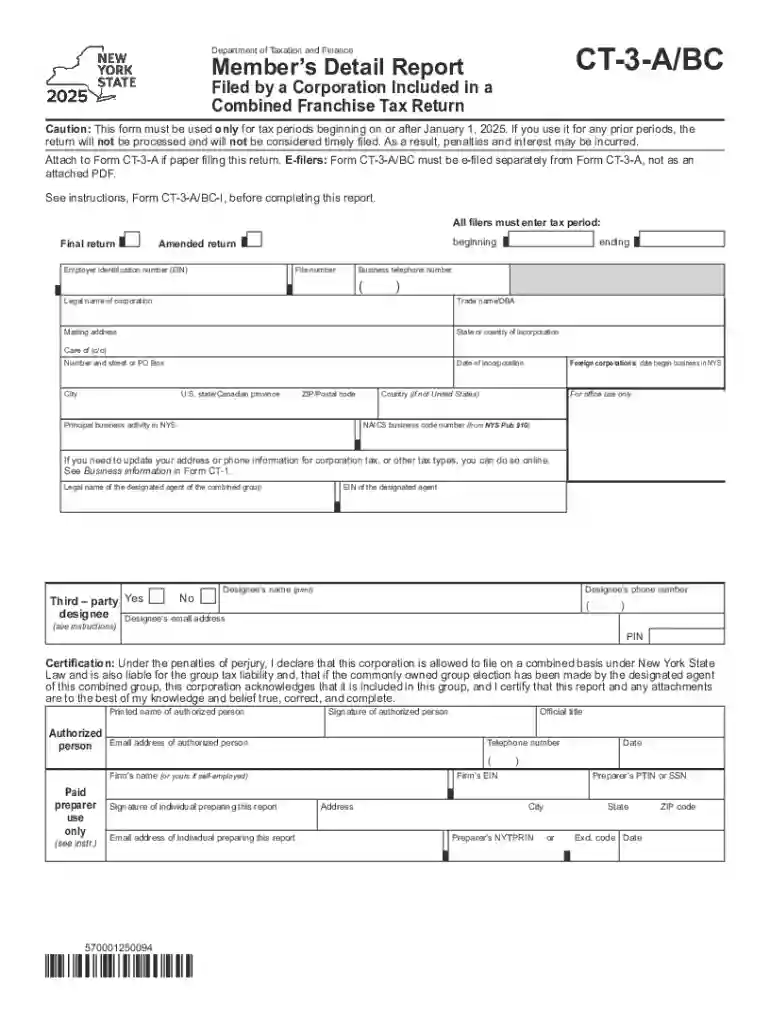
The Form CT-3-A/BC Member's Detail Report Filed by a Corporation Included in a Combined Franchise Tax Return is a tax form used in the United States for reporting details about members of a combined corporate group for franchise tax purposes. This form is specifically relevant to corporations that are part of a combined group and are based in states like New York, where combined reporting is required. It plays a crucial role in ensuring that tax liability is accurately distributed among the different entities within the group.
The form consists of several critical sections designed to capture all necessary membership details:
Identification Information: Basic details about the corporation, including legal name, address, and taxpayer identification number.
Member Details: Information about each member included in the combined report, such as name, EIN, and ownership percentage.
Allocable Income: Data concerning each member’s share of the group’s allocable income and its distribution.
Apportionment Factors: Elements that determine how the tax burden is distributed, which may include factors like property, payroll, and sales.
Signature and Certification: A mandatory section where authorized personnel confirm the accuracy and completeness of the report.
Gather Required Information: Compile all necessary documents, including financial records and membership details for all entities in the combined report.
Fill in Identification Information: Enter the main corporation’s identifying details on the form.
Detail Member Information: Provide precise information for each member of the group, ensuring all data is current and correct.
Calculate Apportionment Factors: Determine and record apportionment factors for income allocation among the corporations.
Review and Submit: Double-check for accuracy and completeness before signing and submitting the form to the appropriate tax authority.
Case Study A: A corporation headquartered in New York with subsidiaries operating in multiple states uses this form to file taxes as a combined group. The form helps in proportionately distributing income among the New York-based and non-resident entities.
Case Study B: A manufacturing company partners with other corporations and files the CT-3-A/BC to streamline its tax obligations, taking advantage when income apportionment factors show diverse geographical operations.
While the CT-3-A/BC is primarily utilized in New York, tax regulations can vary across states. It’s crucial to:
Annual Filing: Typically due in line with the federal tax filing deadline, usually April 15.
Extended Deadlines: Some extensions are available, but requests must be filed accordingly.
It's essential to verify current year deadlines, as they can be subject to legislative changes.
Failure to file Form CT-3-A/BC accurately and on time can lead to:
Financial Penalties: Significant fines based on unpaid taxes and reporting inaccuracies.
Legal Repercussions: Potential legal actions by the state’s tax department, resulting in a more detailed audit.
Digital Filing: Offers a more efficient, accessible, and environmentally friendly option. Many corporations prefer e-filing due to tailor-made software solutions that ease the process.
Paper Filing: Although traditional, it may be required in contexts where digital infrastructure is lacking or specific state mandates require it.
For ease of use and efficiency:
Using these tools ensures data accuracy and compliance through guided workflows.
The CT-3-A/BC is typically used by:
Corporations: Especially those participating in combined reporting.
LLCs and Partnerships: When they elect to be taxed as corporations and are included in combined reports.
Understanding the types of entities involved ensures correct form usage and accurate tax reporting.
We've got more versions of the Form CT-3-A BC Member's Detail Report Filed by a Corporation Included in a Combined Franchise Tax Re form. Select the right Form CT-3-A BC Member's Detail Report Filed by a Corporation Included in a Combined Franchise Tax Re version from the list and start editing it straight away!
| Versions | Form popularity | Fillable & printable |
|---|---|---|
| 2025 | 4.7 Satisfied (47 Votes) | |
| 2024 | 4.1 Satisfied (38 Votes) | |
| 2023 | 4.3 Satisfied (46 Votes) | |
| 2022 | 4.4 Satisfied (25 Votes) | |
| 2021 | 4.9 Satisfied (23 Votes) | |
| 2020 | 4.3 Satisfied (57 Votes) | |
| 2019 | 4.1 Satisfied (38 Votes) | |
| 2018 | 4.3 Satisfied (65 Votes) | |
| 2017 | 4.3 Satisfied (54 Votes) | |
| 2016 | 1 Satisfied (16240 Votes) |
At DocHub, your data security is our priority. We follow HIPAA, SOC2, GDPR, and other standards, so you can work on your documents with confidence.


May 2, 2017 Federal employers are also required to file quarterly and annual reports with the CNMI Division of Revenue and. Taxation. For questionsRead more
Dec 10, 2025 Form CT-3-A/BC is an individual certification which includes a detail schedule of the members business and investment capital and business apportionment lineRead more
Form 100 (California Corporation Franchise or Income Tax Return) is used for filing under the corporation income tax law. 3. LIMITED LIABILITY COMPANY FEE.Read more


