






Definition & Meaning
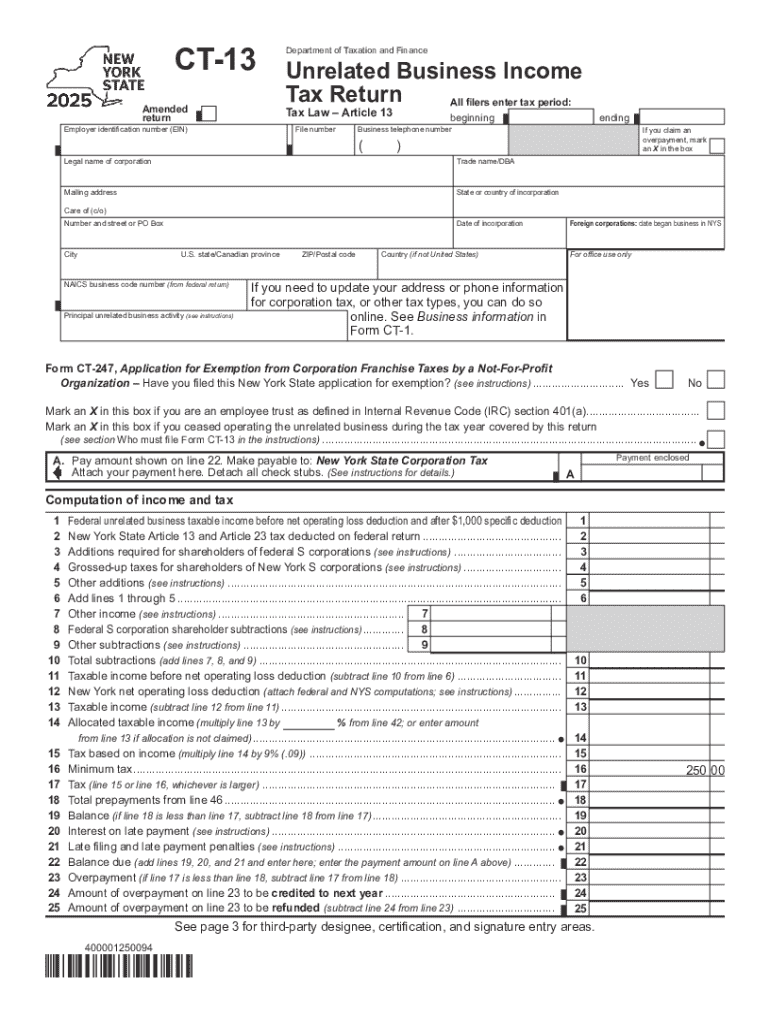
The Form CT-13, known as the Unrelated Business Income Tax Return for the Tax Year 2025, is a specialized tax document used primarily by certain types of organizations to report income derived from business activities not directly related to their main exempt purpose. These organizations typically include tax-exempt entities such as nonprofit organizations, religious organizations, and educational institutions that engage in business operations generating income subject to taxation under the Internal Revenue Code. Understanding the role of Form CT-13 is crucial for these organizations to maintain compliance with federal tax regulations and avoid potential penalties.
How to Obtain the Form CT-13
Form CT-13 can be obtained through multiple channels to ensure accessibility for all eligible filers. Traditionally, it is available for download from the official website of the Department of Taxation and Finance. Additionally, paper versions of the form can be requested from the department or acquired at local tax branches. Many organizations also find it convenient to obtain the form via tax preparation software, which can provide downloadable and fillable versions that streamline the filing process. Access to the form ensures that organizations are prepared to comply with tax requirements in a timely and accurate manner.
Steps to Complete the Form CT-13
Completing the Form CT-13 requires careful attention to detail to ensure accurate reporting of unrelated business income.
-
Gather Required Documents: Prior to filling out the form, collect all necessary documents, such as income statements, expense reports, and relevant business receipts that support the income and deductions claimed.
-
Fill Out Identification Section: Begin with the organization's identification information, including the name, employer identification number (EIN), and address. Double-check for accuracy to avoid processing delays.
-
Calculate Gross Income: Enter the total gross income from unrelated business activities. This includes all revenue generated from non-exempt business pursuits.
-
Deduct Allowable Expenses: List and calculate all deductible expenses directly associated with the unrelated business income, ensuring they comply with IRS guidelines.
-
Determine Taxable Income: Subtract allowable expenses from the gross income to determine the taxable amount. Ensure calculations adhere to tax laws and regulations.
-
Complete Tax Computation and Payment: Calculate the total tax due using the provided tables and complete the payment section. Include any credits or prepayments as applicable.
-
Sign and Submit the Form: Ensure the form is signed by an authorized representative and submitted by the tax filing deadline. Retain a copy of the completed form for organizational records.
Who Typically Uses the Form CT-13
The primary users of Form CT-13 are nonprofit organizations, educational institutions, and religious entities, which are generally exempt from taxes on income related to their core exempt purposes. However, when these entities undertake activities that generate unrelated business income, they must use this form to report such income and any associated taxes due. This requirement emphasizes accountability and ensures that tax-exempt status is not misused to shelter unrelated income from tax obligations.

Key Elements of the Form CT-13
Understanding the key elements of Form CT-13 is essential for accurate completion.
- Identification Information: Includes essential details such as the organization's name, EIN, and address.
- Income Reporting: A comprehensive breakdown of unrelated business income sources is crucial for transparency and compliance.
- Expense Deductions: Detailed reporting of allowable expenses that directly relate to generating the unrelated business income.
- Tax Computation: Accurate calculation of taxable income and the corresponding tax liability.
- Signatures: An authoritative representation is necessary for validating the document's authenticity.
Each of these elements plays a pivotal role in ensuring that the form complies with legal requirements and accurately represents the organization's financial activities related to unrelated business income.
IRS Guidelines
The IRS provides specific guidelines for completing and filing the Form CT-13. These guidelines cover various aspects of unrelated business income, helping organizations understand which activities are taxable and which are exempt. They detail the types of income considered unrelated, the method for calculating income and deductions, and the procedural requirements for filing the form. Adherence to these guidelines is vital to avoid errors that could lead to audits or penalties.
Filing Deadlines / Important Dates
For organizations subject to the Form CT-13 filing requirement, timing is essential. The deadline to file is typically the 15th day of the fifth month after the end of the organization's fiscal year. For instance, if the tax year ends on December 31, the form must be filed by May 15. It is important to mark these dates on the organizational calendar to ensure timely filing. Extensions are available, but they must be requested in advance, and all due taxes should be estimated and paid by the original deadline to avoid interest and penalties.
Required Documents
Filing the Form CT-13 necessitates the collection of several critical documents to support the income and deductions claimed. These documents generally include:
- Income Statements: Detailing revenue received from unrelated business activities.
- Expense Reports: Comprehensive documentation of expenses incurred in relation to the unrelated business activities.
- Financial Records: Include any additional paperwork necessary to substantiate claims on the form, such as receipts, invoices, and contracts.
- Prior Tax Filings: Provides a baseline for consistency in reporting and ensures continuity in financial disclosures.
Gathering these documents well in advance of the filing deadline helps reduce errors and omits the risk of last-minute issues.
Digital vs. Paper Version
Organizations have the option to file Form CT-13 either digitally or on paper. Choosing between digital and paper versions can depend on organizational preferences and operational capacity.
-
Digital Version: Offers ease of access and the ability to quickly make computations and corrections. It can be submitted electronically, reducing mailing costs and ensuring faster processing times.
-
Paper Version: It may be preferable for organizations with limited access to digital tools or for those who maintain paper-based record-keeping. It requires manual completion and mailing, which must be factored into the timeline to meet deadlines.
Using tax preparation software can further enhance the accuracy and convenience of filing, aligning with modern best practices for tax compliance.