




01. Edit your form online
Type text, add images, blackout confidential details, add comments, highlights and more.

Type text, add images, blackout confidential details, add comments, highlights and more.

Draw your signature, type it, upload its image, or use your mobile device as a signature pad.

Send it via email, link, or fax. You can also download it, export it or print it out.
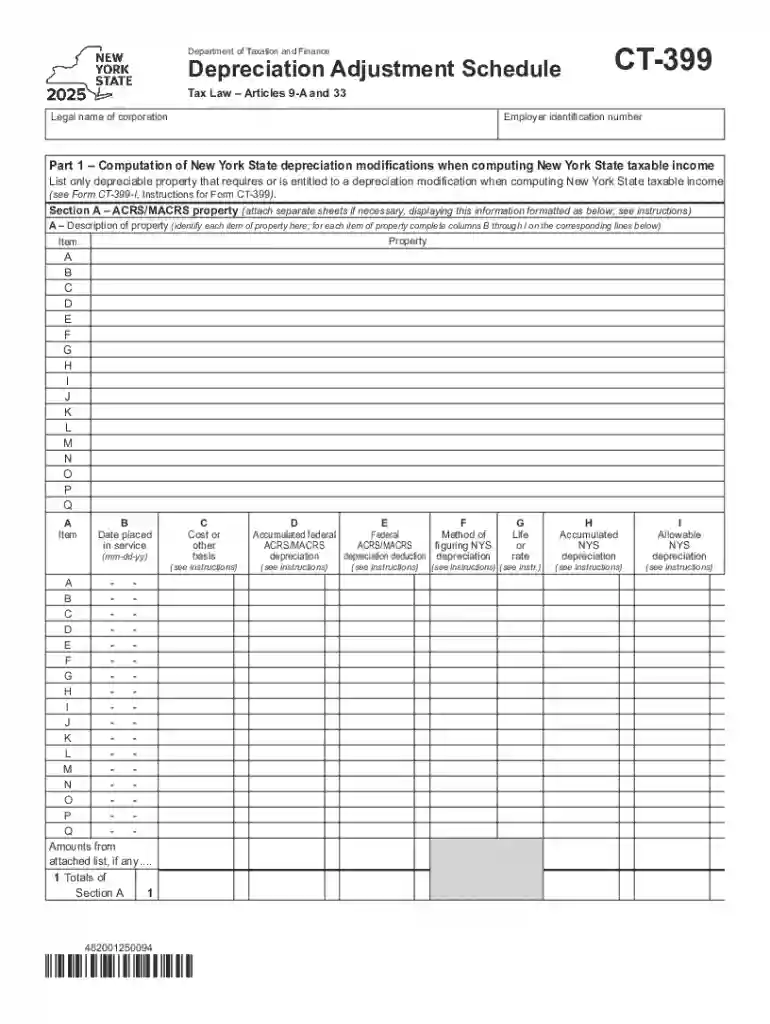
Form CT-399 is a Depreciation Adjustment Schedule used in New York for corporate tax purposes. The form is essential for corporations that need to reconcile the difference between federal and state depreciation on assets. It addresses Articles 9-A and 33 of the New York Tax Law. By completing this form, corporations ensure they are accurately reflecting depreciation adjustments in compliance with state regulations, aligning those calculations with state-specific tax requirements.
Form CT-399 can be filled out online using document management platforms like DocHub. With an intuitive interface, DocHub simplifies the process of filling, signing, and submitting the form digitally. Here's how to do it:
Completing Form CT-399 efficiently requires following precise steps to ensure all details are captured accurately. Below is a detailed procedure:
Understanding the core components of Form CT-399 is crucial for accurate completion. The form includes several key areas:
A comprehensive understanding of relevant terminology enhances the accurate completion of Form CT-399:
Considering real-world applications aids in contextualizing form usage:
Form CT-399 compliance is integral to avoid legal repercussions related to underreporting taxable income due to improper depreciation calculations.
Failure to comply with the correct completion and submission of Form CT-399 can lead to penalties from New York State agencies:
Multiple submission methods are available to comply with state requirements efficiently:
Each of these sections provides detailed information necessary for understanding, completing, and submitting Form CT-399 with accuracy, offering comprehensive insights for corporations operating within New York.
We've got more versions of the Form ct 399 instructions: Fill out and sign online form. Select the right Form ct 399 instructions: Fill out and sign online version from the list and start editing it straight away!
| Versions | Form popularity | Fillable & printable |
|---|---|---|
| 2025 | 4.6 Satisfied (42 Votes) | |
| 2024 | 4.8 Satisfied (60 Votes) | |
| 2023 | 4.4 Satisfied (55 Votes) | |
| 2022 | 4.8 Satisfied (53 Votes) | |
| 2021 | 4.8 Satisfied (30 Votes) | |
| 2020 | 4.3 Satisfied (174 Votes) | |
| 2019 | 4.3 Satisfied (24 Votes) | |
| 2018 | 4.3 Satisfied (54 Votes) | |
| 2016 | 4.1 Satisfied (29 Votes) | |
| 2015 | 4.3 Satisfied (164 Votes) | |
| 2014 | 4 Satisfied (37 Votes) | |
| 2013 | 4.4 Satisfied (71 Votes) | |
| 2012 | 4 Satisfied (29 Votes) |
At DocHub, your data security is our priority. We follow HIPAA, SOC2, GDPR, and other standards, so you can work on your documents with confidence.



Apr 15, 2019 Sign Your Return. After you complete Form CT-1040, sign your name and write the date you signed the return. Your spouse must also sign andRead more
Dec 15, 2025 CT-399-I (Instructions), Depreciation Adjustment Schedule. CT-501 CT Sign up online or download and mail in your application.Read more
Employers who want to sign and file their own Forms 94x, electronically, must complete the 94x. PIN Registration Process, as an Authorized Signer for theirRead more


