




01. Edit your form online
Type text, add images, blackout confidential details, add comments, highlights and more.

Type text, add images, blackout confidential details, add comments, highlights and more.

Draw your signature, type it, upload its image, or use your mobile device as a signature pad.

Send it via email, link, or fax. You can also download it, export it or print it out.
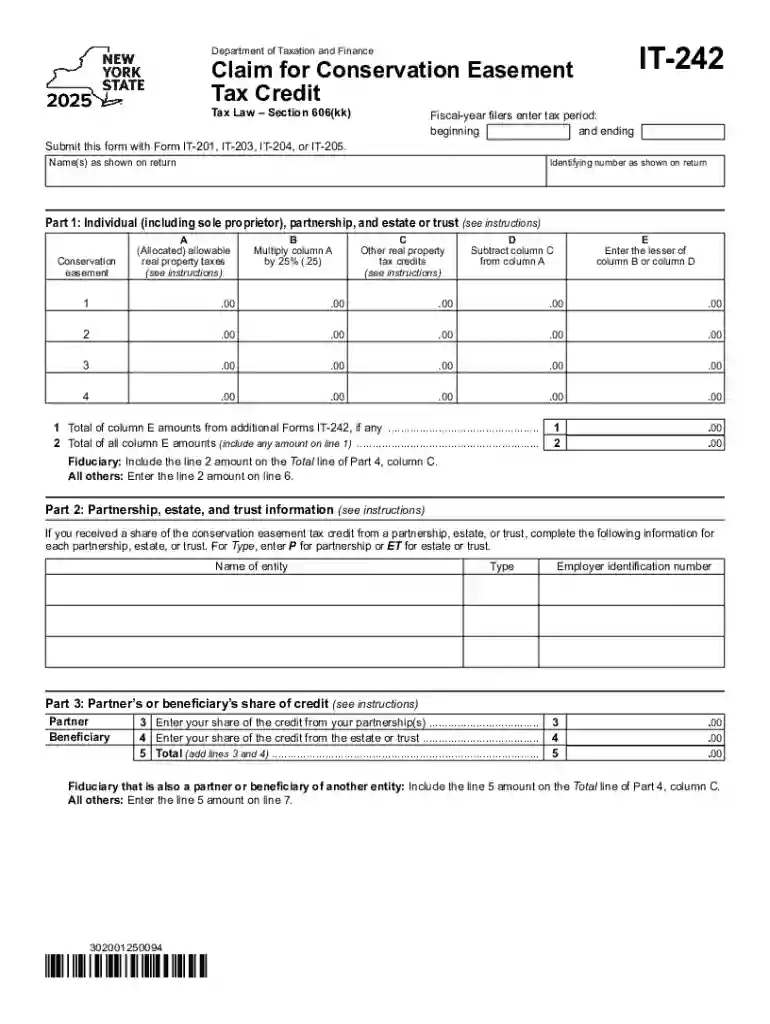
Form IT-242 serves as a tool for taxpayers to claim the Conservation Easement Tax Credit for the tax year 2025. It is part of New York State’s efforts to encourage conservation and sustainable land use practices. By offering this tax credit, landowners are financially incentivized to preserve portions of their land for conservation purposes, thereby contributing to environmental protection and habitat preservation.
Taxpayers can obtain the Form IT-242 from the New York State Department of Taxation and Finance. The form can be downloaded directly from the official website or acquired through tax preparation software that supports New York State forms. For those without internet access, forms may also be available at local tax offices or libraries that provide tax forms during the filing season.
The completion of Form IT-242 involves providing detailed information about the conservation easement and calculating the tax credit amount.
Taxpayers must meet certain eligibility criteria to qualify for the Conservation Easement Tax Credit:


In practice, a farmer who owns a 200-acre property might donate a conservation easement to prevent future development on 50 acres of environmentally sensitive lands. By doing so, the farmer could claim a tax credit, effectively lowering his overall tax liability.
Understanding the essential components of Form IT-242 is crucial for accurate completion:
Failure to comply with state guidelines when claiming conservation easements can result in penalties.
By understanding and following the guidelines associated with Form IT-242, taxpayers can effectively leverage New York State’s Conservation Easement Tax Credit to both reduce tax liability and support environmental preservation efforts.
We've got more versions of the Form IT-242 Claim for Conservation Easement Tax Credit Tax Year 2025 form. Select the right Form IT-242 Claim for Conservation Easement Tax Credit Tax Year 2025 version from the list and start editing it straight away!
| Versions | Form popularity | Fillable & printable |
|---|---|---|
| 2025 | 4.7 Satisfied (39 Votes) | |
| 2024 | 4.4 Satisfied (48 Votes) | |
| 2023 | 4.3 Satisfied (21 Votes) | |
| 2022 | 4.3 Satisfied (30 Votes) | |
| 2021 | 4.8 Satisfied (192 Votes) | |
| 2020 | 4.2 Satisfied (65 Votes) | |
| 2019 | 4.4 Satisfied (135 Votes) | |
| 2018 | 4.3 Satisfied (137 Votes) | |
| 2016 | 4.1 Satisfied (31 Votes) | |
| 2015 | 4.4 Satisfied (323 Votes) | |
| 2014 | 4.2 Satisfied (37 Votes) | |
| 2013 | 4 Satisfied (56 Votes) |
At DocHub, your data security is our priority. We follow HIPAA, SOC2, GDPR, and other standards, so you can work on your documents with confidence.




If you received a share of the conservation easement tax credit from a partnership, estate, or trust, complete the following information for.Read more
deduction of $1,200,000 for the 2025 tax year, instead of the full $2,500,000, due to the invest- ment limit ($2,500,000-$1,300,000). 100 Percent
Feb 26, 2021 For tax years 2009 and 2010, Andeavor had asserted a federal income tax claim for $159 million from the income tax effect of the receipt ofRead more


