







Definition & Meaning
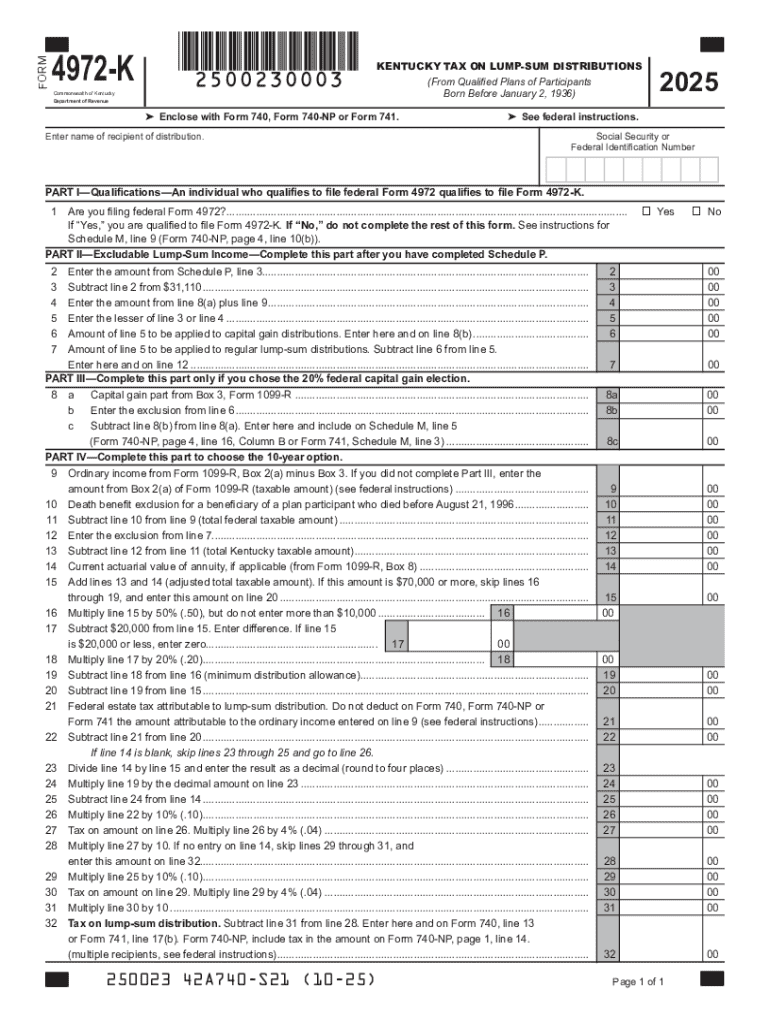
The IRS Draft Form 4972, Used to Claim Special Tax, is an official document provided by the Internal Revenue Service. It allows taxpayers to compute their tax on lump-sum distributions from retirement plans, specifically for those born before January 2, 1936. This form aids in calculating the special tax rate applied to these distributions, helping individuals avoid higher tax rates associated with standard income levels.
Key Functions
- Tax Calculation: Helps in determining the tax owed on lump-sum distributions.
- Special Tax Rate: Applies lower tax rates for eligible distributions.
- Historical Purpose: Targets taxpayers with retirement plans predating tax-reform legislation changes.
How to Use the IRS Draft Form 4972
To effectively use Form 4972, taxpayers need to understand the steps involved in accurately reporting their lump-sum distributions. Here’s a practical guide:
Steps for Completion
- Gather Documentation: Collect all relevant retirement plan documents and distribution details.
- Review Eligibility Criteria: Ensure eligibility based on age and distribution type.
- Carefully Follow Instructions: Adhere to IRS guidelines provided with the form.
- Calculate Tax Using the Schedule: Utilize worksheets in the form to compute tax.
Practical Example
Consider a taxpayer who recently retired and received a distribution from a qualified retirement plan. They could use Form 4972 to apply the favorable tax rate to reduce their overall tax liability.
How to Obtain the IRS Draft Form 4972
Accessing the IRS Draft Form 4972 can be done through various channels to ensure tax compliance:
Methods of Acquisition
- IRS Website: Download directly from the official IRS site.
- Tax Software: Access through popular tax preparation software that incorporates IRS forms.
- Tax Professional: Obtain a physical copy from a certified tax preparer or accountant.
Digital Accessibility
For convenience, the form is available as a downloadable PDF, making it accessible for both electronic completion and printing if a paper submission is preferred.
Steps to Complete the IRS Draft Form 4972
Completing Form 4972 requires attention to detail to ensure accuracy and compliance:
Step-by-Step Breakdown
- Identification Information: Enter personal information such as name and Social Security Number.
- Qualification Verification: Answer questions to confirm eligibility for using the form.
- Tax Computation: Use the redistribution methods provided to calculate the special tax.
- Review: Check all entries for accuracy and completeness before submission.
Common Pitfalls
Be cautious about skipping steps or misunderstanding the qualifying criteria, as errors might lead to incorrect tax calculations or penalties.
Important Terms Related to Form 4972
Familiarity with specific terms related to Form 4972 ensures a smooth filing process:
Glossary of Terms
- Lump-Sum Distribution: A one-time payment of the entire balance from a retirement plan.
- Special Tax Calculation: A tax computation method offering reduced rates.
- Tax Deferral: Postponing tax payments to a later date, common in retirement plans.
Legal Use of IRS Draft Form 4972
Understanding the legal landscape around Form 4972 will help prevent any misapplication:
Compliance Requirements
- Eligibility Verification: Confirm that the taxpayer was born before January 2, 1936.
- Accurate Reporting: Ensure that all distributions are reported and processed according to IRS standards.
- Legal Reporting Framework: Use the form exclusively for the stated purpose to maintain tax compliance.
Legal Implications
Misuse or incorrect filing could result in IRS audits or penalties, making it crucial to adhere strictly to the legal uses of the form.
Filing Deadlines and Important Dates
Being aware of critical dates ensures timely submission:
Key Deadlines
- Annual Tax Filing Deadline: Aligns with the standard tax filing deadline, typically April 15.
- Amendments and Corrections: Can be made within three years after the original filing date.
Impact of Missing Deadlines
Late submissions can incur penalties and interest, emphasizing the importance of adherence to all deadlines.
Eligibility Criteria for IRS Draft Form 4972
Ensuring eligibility is a prerequisite before using Form 4972:


Criteria Overview
- Age Requirement: Must be born before January 2, 1936.
- Plan Type: Must be a lump-sum distribution from a qualified retirement plan.
- Exclusivity of Use: Not applicable for every distribution; it’s specifically for pre-1986 reforms.
Edge Cases
Individuals with mixed distribution types may require additional guidance to determine eligibility correctly.




