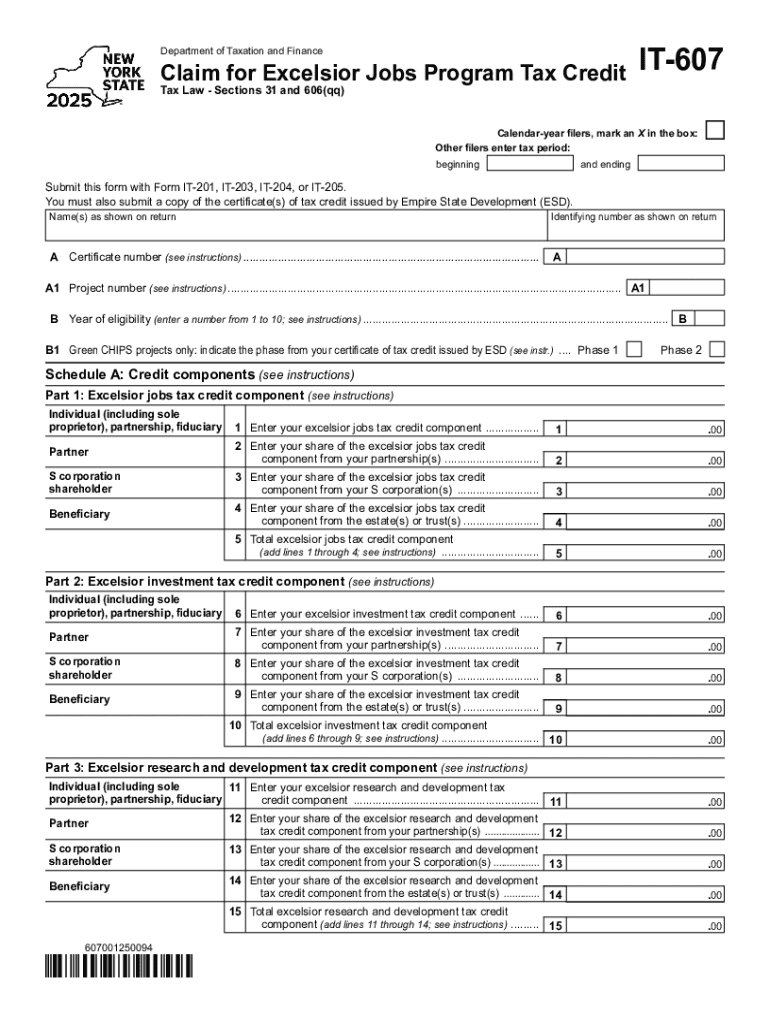







Definition & Meaning
The Form IT-607, known as the Claim for Excelsior Jobs Program Tax Credit Tax, is a tax form used by businesses in New York State to claim tax credits under the Excelsior Jobs Program. This initiative is designed to encourage job creation and investment by offering tax incentives to eligible companies. The form allows businesses to report qualified activities and calculate the amount of tax credit they are entitled to receive. By understanding the Excelsior Jobs Program Tax Credit, participating companies can significantly reduce their tax liabilities, making it a vital document in strategic financial planning.
Key Components of Excelsior Jobs Program
- Job Creation: Companies must commit to creating a specific number of jobs to qualify.
- Capital Investments: Significant investment in property and equipment is often required.
- Wage Standards: Employees must be paid above a defined baseline wage.
How to Use the Form IT-607 Claim for Excelsior Jobs Program Tax Credit Tax
The process of using Form IT-607 involves several steps that must be carefully followed to ensure compliance and accurate filing. Businesses should first verify their eligibility for the tax credit by reviewing the Excelsior Jobs Program requirements. Once eligibility is confirmed, the form should be used to calculate the credit amount based on factors such as job creation and investment activities.
- Verify Eligibility: Check requirements for job creation and investment.
- Gather Necessary Information: Collect employment and investment data.
- Complete the Form: Accurately enter data into the Form IT-607.
- Calculate Credit: Use provided formulas to determine credit amount.
- Submit Form: Properly file the form with New York State Taxation and Finance.
Common Challenges and Solutions
- Complex Calculations: Use software tools for accurate calculations.
- Documentation: Ensure thorough records to support claims.
Steps to Complete the Form IT-607 Claim for Excelsior Jobs Program Tax Credit Tax
Completing Form IT-607 requires attention to detail and an understanding of the Excelsior Jobs Program's framework. Businesses must carefully document all relevant activities throughout the fiscal year.
- Section A - Identifying Information: Enter the business's legal name, address, and EIN.
- Section B - Tax Credit Component Claims: Detail each component of the tax credit being claimed.
- Section C - Calculation of Credit: Input figures for jobs created and capital investment.
- Section D - Certification: Authorize the form with a signature from an authorized officer.
Critical Tips
- Accuracy is Key: Double-check all entries to avoid errors.
- Use Precise Data: Ensure information aligns with financial statements.
Important Terms Related to Form IT-607 Claim for Excelsior Jobs Program Tax Credit Tax
Understanding the terminology associated with Form IT-607 is crucial to completing it correctly.
- Qualified Investments: Capital expenditures that qualify for tax credits.
- Baseline Employment Number: The pre-determined number of employees used for comparative purposes.
- Net New Jobs: Calculated by subtracting the baseline employment from current employment numbers.
Glossary
- EIN: Employer Identification Number.
- Credited Wages: Portion of wages that factor into tax credit calculations.
Eligibility Criteria
Before a business can file Form IT-607, it must meet certain eligibility criteria set forth by the Excelsior Jobs Program. These criteria ensure that only qualifying companies benefit from tax credits.
- Industry Focus: Primarily available to businesses in technology, manufacturing, and export services.
- Minimum Job Creation: Businesses must create a prescribed number of jobs.
- Geographic Consideration: Availability may vary based on location within New York State.


Examples of Eligible Entities
- Technology Startups: Companies that invest heavily in R&D and employment.
- Manufacturing Firms: Those engaging in significant capital expenditure.
Filing Deadlines / Important Dates
Adhering to deadlines is a crucial aspect of successfully claiming the Excelsior Jobs Program Tax Credit.
- Annual Deadline: Typically aligns with the New York State tax filing deadline.
- Extension Possibilities: While extensions may be available, they often require notification and justification.
Practical Advice
- Plan Ahead: Prepare documentation well in advance of the deadline.
- Track Changes: Be aware of any alterations to deadlines due to fiscal policy changes.
Penalties for Non-Compliance
Non-compliance with the rules governing Form IT-607 can result in penalties that are both financial and procedural. Businesses must fully understand compliance requirements to avoid costly mistakes.
- Monetary Fines: Incorrect or fraudulent claims can result in fines and repayment of credits.
- Legal Repercussions: Violations may lead to audits and further investigation.
- Reputation Damage: Compliance issues can tarnish a company's reputation, impacting future opportunities.
Avoiding Pitfalls
- Regular Audits: Conduct internal audits to ensure compliance.
- Consult Professionals: Use tax professionals to review submissions.
Software Compatibility (TurboTax, QuickBooks, etc.)
Utilizing software can streamline the process of completing and filing Form IT-607. Various platforms can aid in managing the calculations and integrating tax credit claims into regular accounting practices.
- TurboTax & QuickBooks: Both platforms provide tools for integrating state tax forms.
- Specialized Tax Software: Consider platforms with specific modules for state tax credits.
Best Practices
- Stay Updated: Ensure software is current with the latest tax law changes.
- Integration Features: Opt for software that can seamlessly integrate with existing accounting systems.
By successfully navigating these aspects of Form IT-607, businesses can maximize the benefits of the Excelsior Jobs Program Tax Credit, fostering growth and development within the state.