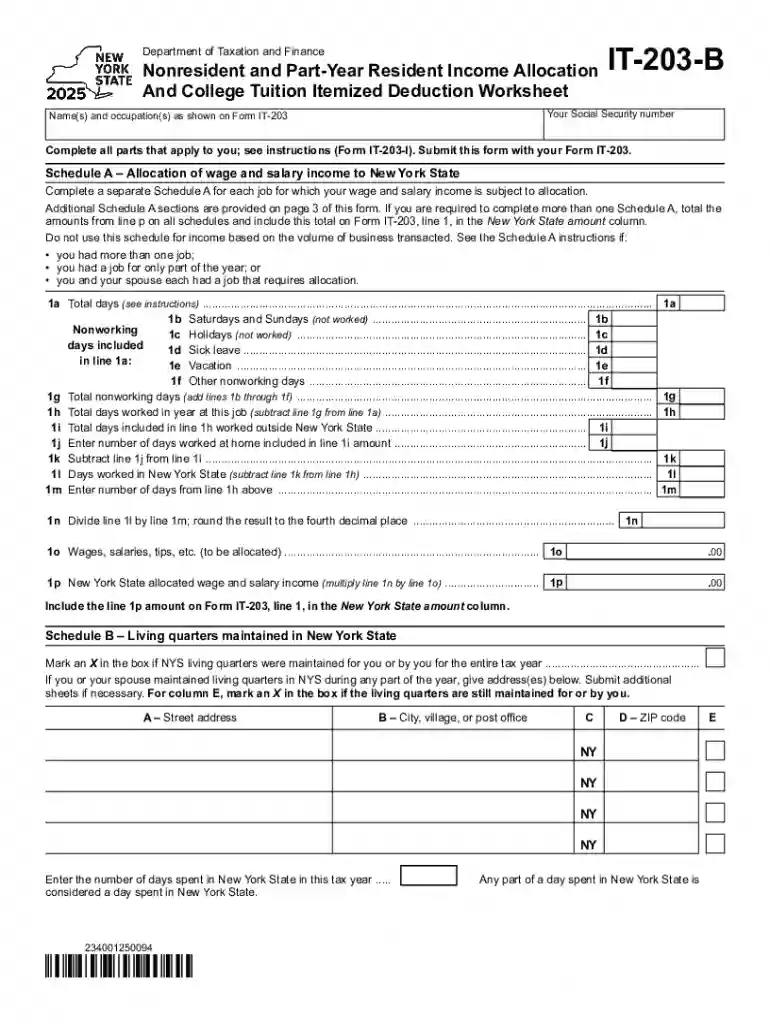
Form IT-203-B Nonresident and Part-Year Resident Income Allocation and College Tuition Itemized Dedu 2026

Get Form
Form IT-203-B Nonresident and Part-Year Resident Income Allocation and College Tuition Itemized Dedu Preview on Page 1

Here's how it works

01. Edit your form online
Type text, add images, blackout confidential details, add comments, highlights and more.

02. Sign it in a few clicks
Draw your signature, type it, upload its image, or use your mobile device as a signature pad.

03. Share your form with others
Send it via email, link, or fax. You can also download it, export it or print it out.

Definition and Purpose of Form IT-203-B

Form IT-203-B is an essential tax document used by individuals who are nonresidents or part-year residents of New York State. It facilitates the allocation of income between New York and other states, as well as the calculation of itemized deductions, including college tuition. This form plays a pivotal role in ensuring taxpayers pay the correct amount of state taxes based on their residency status and income sources.

  • Nonresident Definition: Individuals who do not reside in New York but earn income from sources within the state.
  • Part-Year Resident Definition: Individuals who resided in New York for part of the tax year and need to allocate their income accordingly.

Understanding these definitions helps taxpayers determine their filing status and ensure compliance with New York State tax law.

How to Use Form IT-203-B

Using Form IT-203-B correctly is crucial for accurate tax reporting. The form is used to report income earned in New York and calculate state-specific deductions and credits.

  1. Resident Status Determination: First, determine whether you are a nonresident or a part-year resident, as this affects how income is allocated.
  2. Allocate Income: Separate New York income from non-New York income, ensuring proper allocation across different categories (e.g., wages, interest, dividends).
  3. Calculate Deductions: Include any permissible itemized deductions, such as college tuition, ensuring compliance with allowable limits.
  4. Review and File: Double-check all entries for accuracy before filing with your state tax return.

Steps to Complete Form IT-203-B

Completing Form IT-203-B requires careful attention to detail and an understanding of the form’s structure.

  1. Personal Information: Fill in your Social Security number, name, and address.
  2. Residency Status: Indicate your residency status for the tax year (nonresident or part-year resident).
  3. Income Allocation: Specify the amounts of income allocated to New York State and other states, ensuring all sources are accurately included.
  4. Deductions: Calculate and enter itemized deductions, emphasizing those specific to New York laws, such as college tuition expenses.
  5. Final Review: Check for completeness and accuracy, ensuring all relevant sections are filled out before submission.

Key Elements of Form IT-203-B

The essential components of Form IT-203-B include:

  • Income Sections: Detailed areas for entering and allocating income by source and location.
  • Adjustment Lines: Sections for adjustments to income based on state-specific criteria.
  • Deduction Fields: Spaces for claiming itemized deductions, including college tuition and other eligible expenses.

Each element serves a specific purpose in calculating the tax obligations accurately.

Eligibility Criteria for Form IT-203-B

Eligibility for using Form IT-203-B depends on specific criteria related to residency and income.


  • Nonresidents: Those who earn income from New York sources are required to allocate this income on the form.
  • Part-Year Residents: Individuals residing in New York for part of the year must complete this form to allocate income to New York only for the months of residency.
  • Income Type: Eligible income includes wages, business income, and other state-specific earnings.
decoration image ratings of Dochub

State-Specific Rules for Form IT-203-B

New York State imposes rules and guidelines specific to nonresidents and part-year residents:

  • Taxation Rules: Only income directly tied to New York activities is subject to state tax, with specific sourcing rules applicable.
  • Tuition Deductions: Itemized deductions, like tuition, may be capped; taxpayers should be aware of any limits imposed by New York tax law.

Meeting these state-specific requirements ensures the form is used correctly and legal obligations are satisfied.

Penalties for Non-Compliance

Failure to accurately complete and file Form IT-203-B may lead to penalties imposed by the New York State Department of Taxation and Finance.

  • Monetary Fines: Incorrect filings may result in fines or interest on unpaid taxes.
  • Legal Ramifications: Persistent non-compliance can lead to further legal actions, including audits or legal proceedings.

Form Submission Methods

Taxpayers have several options for submitting Form IT-203-B, ensuring accessibility and convenience.

  1. Online Submission: E-filing through authorized platforms provides quick and secure form submission.
  2. Mailing: Physical mailing is an option, though it may result in longer processing times.
  3. In-Person Filings: Submission through local tax offices ensures guided assistance but may take additional time for appointment scheduling.

Each method accommodates different preferences and circumstances.

be ready to get more

Complete this form in 5 minutes or less

Get form

Got questions?

We have answers to the most popular questions from our customers. If you can't find an answer to your question, please contact us.
Contact us
Form 1098-T is an informational document from your school that signals you might qualify for education tax credits, like the American Opportunity Tax Credit (AOTC) or Lifetime Learning Credit, or potentially taxable scholarship income, helping you and the IRS track education expenses. While not mandatory to attach, you use its figures (Box 1 for payments received, Box 5 for scholarships) with your own records to determine eligibility for DocHub tax breaks, potentially reducing tax owed or even getting a refund, but it doesnt guarantee eligibility. How it affects your taxes: Information for Credits/Deductions: The form shows amounts paid for qualified tuition and related expenses (QTRE) and scholarships/grants, acting as a prompt to explore education credits or deductions. Claiming Credits: You (or your parents, if youre a dependent) might claim the AOTC (up to $2,500) or Lifetime Learning Credit, reducing your tax bill dollar-for-dollar. Refundable Portion: The AOTC has a refundable part, meaning you could get some money back even if you owe no tax. Taxable Scholarships: If your scholarships/grants (Box 5) are more than your QTRE (Box 1), the excess might be taxable income you must report. Your Records Matter More: The 1098-T is informational; you must use your own financial records to accurately claim credits or report income, as the form figures can sometimes differ from actual payments. What to do with Form 1098-T: Verify the Amounts: Check if the figures in Box 1 (payments received) and Box 5 (scholarships/grants) match your records. Gather Supporting Docs: Keep receipts for expenses not on the form, like books or required materials. File if Eligible: Use the information to complete IRS Form 8863 (Education Credits) when filing your taxes if you qualify. Report Excess Scholarships: If grants exceed expenses, report the difference as income on your tax return. For financial advice, consult a professional. Education credits: Questions and answers | Internal Revenue ServiceSep 4, 2025 Q3. How much is AOTC worth? A3. Its a tax credit of up to $2,500 of the cost of tuition, certain required fees and couIRS (.gov)What is Form 1098-T, Tuition Statement? | HR BlockWhat should you do with Form 1098-T? The information on the form may have to be reported on your income taxes. In fact, its necesHR Block
You likely need to file a nonresident state tax return if you earned income from sources in a state where you dont live, such as wages for working there, rental income, gambling winnings, or business profits, and that income exceeds the states specific filing threshold (which can be just $1 or a certain number of days). Check the specific states Department of Revenue website, as rules vary DocHubly; some states require filings for even minimal income, while others have higher income or days-worked thresholds. Key Indicators You Might Need to File You Worked in Another State: If you commuted to a job in a different state or worked remotely for a company based elsewhere and had taxes withheld for that state. You Have State-Sourced Income: This includes gambling winnings, lottery winnings, income from renting out property, or profits from selling real estate in another state. Youre a Partner/S Corp Shareholder: Income from partnerships or S-corporations sourced from a state where youre a nonresident. Your Home State Has No Reciprocity: If your home state doesnt have a tax agreement (reciprocity) with the state where you earned income, youll likely need to file. How to Determine Your Obligation Identify Your Residency: Determine your legal state of residence for tax purposes (where you have your permanent home, drivers license, voter registration, etc.). Check the Other States Rules: Go to the Department of Revenue or Taxation website for the state where you earned income (e.g., Colorado, New York, California). Look for Nonresident Filing Thresholds: Find their specific rules, which often specify: Income Amount: Minimum income (e.g., $600 in Missouri, $1 in Pennsylvania). Days Worked: Number of days you were physically present and working (e.g., 30 days in Illinois). Type of Income: Some income, like certain interest, might not count. In summary, if you received income from a state you dont live in, you probably need to file a nonresident return for that state unless you meet very specific, high thresholds or the state has no income tax. For financial advice, consult a professional. Why would I have to file a nonresident state return? - TurboTax Supportby TurboTax 390. Updated December 22, 2025 12:05 PM. Generally, youll need to file a nonresident state return if you made moneyTurboTax SupportPart-Year and Nonresident | Department of Revenue - TaxationColorado tax (.gov)
The 90-day rule for non-residents refers to two main concepts: in U.S. immigration, its a guideline where actions like unauthorized work or marrying a U.S. citizen within 90 days of entry trigger scrutiny for visa fraud, suggesting intent to immigrate. In Canadian taxes, the 90% rule helps determine if a non-resident can claim full tax credits if 90% or more of their income comes from Canadian sources, affecting eligibility for benefits like the Basic Personal Amount. In U.S. Immigration (90-Day Rule) Purpose: To detect willful misrepresentation of nonimmigrant intent (e.g., entering as a tourist but intending to stay and work). When it Applies: If a non-immigrant engages in activities inconsistent with their visa status within 90 days of arrival. Suspicious Activities: Unauthorized employment, enrolling in school without proper authorization, or marrying a U.S. citizen/LPR and planning to reside in the U.S. Consequences: Can lead to inadmissibility, visa revocation, or denial of green card applications. In Canadian Taxes (90% Rule) Purpose: To qualify for full federal non-refundable tax credits. When it Applies: If 90% or more of your total income for the year is from Canadian sources. Benefits: Allows claim of full credits like the Basic Personal Amount (BPA). If You Dont Qualify: Credits are prorated or limited based on your date of entry into Canada. AI can make mistakes, so double-check responses2025 Income Tax and Benefit Guide for - Non-Residents - Canada.caPart A You are a non-resident (including a non-resident electing under section 216.1) not electing under section 217. If line 3 Canada.caThe 90-Day Rule: A Guide to Avoiding Immigration Status ViolationsThe 90-day rule is also known as the 30/60 day rule. USCIS looks at the first 30 days with extra scrutiny. The following activitNew Frontier Immigration Law
No, Tax Topic 203 doesnt automatically mean youre not getting any refund, but it does signal that your refund might be reduced (offset) to pay past-due debts like child support, federal/state taxes, or other government obligations, or it could mean your fee was deducted from your refund. Youll receive a letter from the Bureau of the Fiscal Service explaining the offset, and the remainder of your refund (if any) will be processed, but you should check your IRS Wheres My Refund status and contact BFS if you dont recognize the debt. What Tax Topic 203 Means: Refund Offset: The Department of the Treasurys Bureau of the Fiscal Service (BFS) intercepts your refund to pay debts like: Past-due child support. Federal agency non-tax debts (e.g., student loans). State income tax or unemployment compensation debts. Tax Preparation Fees: Sometimes, if you chose to pay your tax preparation fees (like TurboTax) from your refund, this topic might appear, indicating the fee was deducted. What to Do Next: Check Your Mail: You should receive an official notice from the Bureau of the Fiscal Service (BFS) explaining the offset. Check IRS WMR: Use the IRS Wheres My Refund tool for details on your specific refund status and any offset. Contact BFS: If you dont understand the notice or believe its an error, call the number on the BFS notice to get details on the debt. Consider Identity Theft: If you dont recognize any debt and didnt file the return, you might be a victim of tax-related identity theft; contact the IRS immediately. For financial advice, consult a professional. Topic no. 203, Reduced refund | Internal Revenue ServiceFeb 2, 2026IRS (.gov)Can tax topic 203 mean the money TurboTax is taking out of my Jun 6, 2019 Can tax topic 203 mean the money TurboTax is taking out of my refund? I called the number concerning possible offsets aTurboTax Support
To determine how much tax you owe, use Form IT-203, Nonresident and Part‑Year Resident Income Tax Return. You will calculate a base tax as if you were a full-year resident, then determine the percentage of your income that is subject to New York State tax and the amount of tax apportioned to New York State.Jan 22, 2026

Security and compliance

At DocHub, your data security is our priority. We follow HIPAA, SOC2, GDPR, and other standards, so you can work on your documents with confidence.

Learn more
ccpa2
pci-dss
gdpr-compliance
hipaa
soc-compliance
be ready to get more

Complete this form in 5 minutes or less

Get form

People also ask

Generally, NRIs are not mandated to file ITRs solely based on their non-resident status. However, their obligation to file hinges on their total income generated in India during a specific financial year. The Income Tax Act 1961 dictates the income threshold that triggers mandatory ITR filing for NRIs.Dec 19, 2025
A Nonresident of New York is an individual that was not domiciled nor maintained a permanent place of abode in New York during the tax year. A Part-Year Resident is an individual that meets the definition of resident or nonresident for only part of the year.

Related links