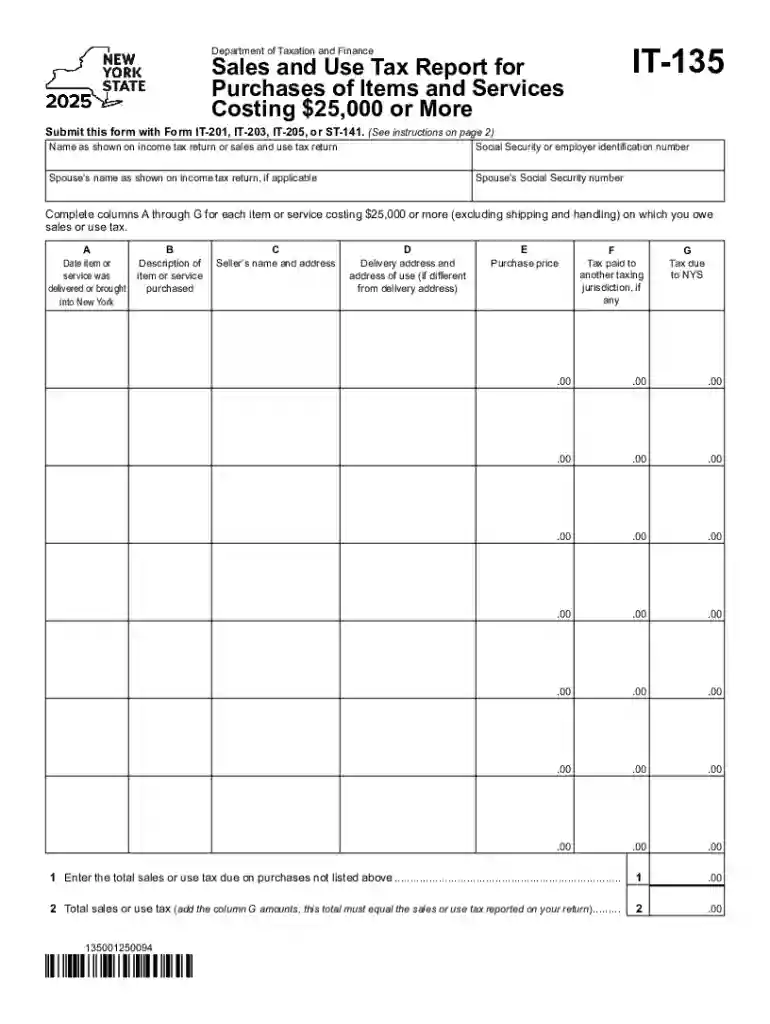
New York Sales and Use Tax Report IT-135 2026

Get Form
New York Sales and Use Tax Report IT-135 Preview on Page 1

Here's how it works

01. Edit your form online
Type text, add images, blackout confidential details, add comments, highlights and more.

02. Sign it in a few clicks
Draw your signature, type it, upload its image, or use your mobile device as a signature pad.

03. Share your form with others
Send it via email, link, or fax. You can also download it, export it or print it out.

Definition & Meaning

The New York Sales and Use Tax Report IT-135 is a specific form that taxpayers in New York must utilize to report purchases of items and services costing $25,000 or more. This document is essential for ensuring compliance with tax regulations and is typically submitted alongside other forms such as IT-201, IT-203, IT-205, or ST-141. It captures information about large purchases to guarantee proper tax collection and reporting.

Steps to Complete the New York Sales and Use Tax Report IT-135

  1. Gather Necessary Information: Before you start filling out Form IT-135, ensure you have all relevant information about your large purchases, including invoices, purchase receipts, and vendor details.

  2. Fill Personal and Business Details: Enter your personal or business information accurately, including your name, address, and taxpayer identification number.

  3. Report Purchases: Itemize each purchase over $25,000, providing specifics such as the date of acquisition, description of the item or service, and the amount paid.

  4. Calculate Tax Owed: Use the purchase details to calculate the use tax owed, considering that sales taxes might have already been accounted for at the point of sale.

  5. Attach Required Forms: If applicable, include supplementary forms like IT-201 or IT-203 to give additional context or detail about your purchase.

  6. Review and Submit: After completing the form, carefully review it for accuracy, ensuring all necessary fields are filled. Submit it as directed by the New York Department of Taxation and Finance.

Key Elements of the New York Sales and Use Tax Report IT-135

  • Purchase Information: Detailed documentation about items and services purchased, including cost, vendor information, and receipt numbers.
  • Tax Calculation: A section to compute the appropriate use tax, which must reflect any applicable local tax rates.
  • Supporting Documents: Additional attachments may be required, especially in cases involving complex transactions or exemptions.

Filing Deadlines / Important Dates

The New York Sales and Use Tax Report IT-135 must be filed in conjunction with your annual state tax return. Typically, the deadline aligns with the tax filing season, generally on or around April 15, but this may vary. It's essential to verify specific due dates each year as they can change based on legislative updates or calendar shifts.

Penalties for Non-Compliance

Failure to timely file the IT-135 form, or misreporting purchases, can lead to significant penalties. These may include fines, interest on unpaid taxes, and potential audits by the New York Department of Taxation and Finance. It is crucial to maintain accurate records and ensure compliance to avoid these risks.

Form Submission Methods (Online / Mail / In-Person)

  1. Online Submission: Filing electronically is recommended as it offers a faster processing time and an immediate confirmation of receipt. New York State provides a secure portal for electronic submissions.

  2. Mail: If you prefer, the form can be sent via traditional mail, but ensure the mailing address is current. Note that processing via mail might take longer.

  3. In-Person: Although less common, in-person submission at a local tax office is an option if you require immediate assistance or confirmation of submission.

Who Typically Uses the New York Sales and Use Tax Report IT-135

This form is usually utilized by:

  • Businesses: Companies making substantial capital investments or large inventory purchases often need to file this report.
  • High-Value Purchasers: Individuals making significant personal purchases, such as artwork or specialized equipment, must report these expenditures.
  • Non-Resident Entities: Out-of-state entities conducting taxable transactions within New York are also required to complete this form.
decoration image ratings of Dochub

State-Specific Rules for the New York Sales and Use Tax Report IT-135

New York has unique regulations concerning sales and use tax reporting. For example, certain localities within the state may have specific rates or exemptions not applicable elsewhere. It's important to understand these nuances, particularly if the purchases span across multiple locations within New York.

Required Documents

To accurately complete the form, you'll need:

  • Invoices and Receipts: Details of each qualifying purchase.
  • Vendor Information: Names and addresses from whom significant items or services were purchased.
  • Proof of Previous Tax Payments: Documentation showing sales tax already paid, if applicable.

Business Types that Benefit Most from New York Sales and Use Tax Report IT-135

Entities that are most impacted by this report include:

  • Retail Businesses: Frequently purchasing large quantities of goods.
  • Construction Companies: Procuring high-cost materials and equipment.
  • Manufacturers: Buying parts and machinery integral for production processes.
be ready to get more

Complete this form in 5 minutes or less

Get form

Got questions?

We have answers to the most popular questions from our customers. If you can't find an answer to your question, please contact us.
Contact us
New York exempts many essential items from sales tax, including most food for home consumption, medicines, medical equipment, feminine hygiene products, and clothing and footwear costing under $110 per item, along with various services like education and medical care, and specific items like diapers, newspapers, and some agricultural items. Exemptions also cover items used directly in manufacturing, sales for resale, and purchases by government or certain charities. Common Exempt Items Groceries: Most food products for home consumption, dietary foods, and some beverages. Clothing Footwear: Items under $110 per item/pair (e.g., shirts, shoes, coats, underwear). Health Medical: Prescription/non-prescription drugs, medical equipment for home use, prosthetic aids, eyeglasses, hearing aids, and feminine hygiene products. Services: Medical care, educational services, personal professional services, and most laundry/dry cleaning. Newspapers Periodicals . Diapers . Water: delivered through mains or pipes. Exempt Transactions Purchases Manufacturing: Machinery, equipment, tools, and supplies used directly in manufacturing property for sale. Government Charities: Sales to/by federal/NY State governments, and certain exempt organizations. Resale: Items sold for resale. Whats Generally Taxable (for comparison) Prepared foods, candy, soft drinks, and dietary supplements. Clothing/footwear over $110 per item. Services like salon treatments, massage, and parking in NYC. For financial advice, consult a professional. Sales Tax NYC311 - NYC.govFood products, dietary foods, certain beverages and health supplements sold by food markets. Diapers. Drugs and medicines for peopNYC 311 (.gov)Listings of Taxable and Exempt Foods and Beverages Sold - Tax.NY.govFeb 23, 2026 Introduction. Most food is exempt from sales tax. The exemption for food includes: food products; dietary foods; healtDepartment of Taxation and Finance (.gov)
The annual return, Form ST-101, New York State and Local Annual Sales and Use Tax Return, covers the period March 1 through February 28/29. Since sales tax returns are generally due within 20 days after the end of the reporting period, annual returns are due by March 20 each year.Jul 16, 2025
Purchases above $110 are subject to a 4.5% NYC sales tax and a 4% NY State sales tax. The City Sales Tax rate is 4.5%, NY State Sales and use tax is 4% and the Metropolitan Commuter Transportation District surcharge of 0.375% for a total sales and use tax of 8.875 percent.
New Yorks sales tax is a combination of a 4% state rate and local rates, totaling between 4% and 8.875%, depending on the city and county, with the highest rate (8.875%) in New York City, which includes state, city, and MCTD surcharge. The specific rate varies by jurisdiction, with local rates adding up to 4.875% on top of the 4% state tax. Key Components State Rate: A mandatory 4%. Local Rates: Cities and counties add their own taxes, from 0% up to 4.875%. MCTD Surcharge: An additional 0.375% for counties in the Metropolitan Commuter Transportation District (like NYC boroughs, Dutchess, Nassau, etc.). Examples New York City: 4% (State) + 4.5% (City) + 0.375% (MCTD) = 8.875%. Other Areas: Rates vary, but most areas fall in the 8.25% range, with some as low as 4% (state only). How to Find Your Specific Rate Because rates are destination-based (where the item is delivered), you must check your specific location. Use the NYS Department of Taxation and Finance website for official rate tables. Use online tools like Avalara or TaxJar to look up rates by ZIP code or county. For financial advice, consult a professional. Sales Tax Rate Publications - Tax.NY.govFeb 24, 2026 Sales and use tax rates in New York State reflect a combined statewide rate of 4%, plus the local rate in effect in thDepartment of Taxation and Finance (.gov)Sales Tax Rates, Additional Sales Taxes, and Fees - Tax.NY.govAug 11, 2025 How to identify the rate and compute sales tax. To determine the total amount of tax due on a sale, multiply the amounDepartment of Taxation and Finance (.gov)
0:31 1:53 This is not a tax but a fee although the receipt. Says tax it says that it is working withMoreThis is not a tax but a fee although the receipt. Says tax it says that it is working with developers. And retailers to make sure in the future the receipts say fee instead of tax.

Security and compliance

At DocHub, your data security is our priority. We follow HIPAA, SOC2, GDPR, and other standards, so you can work on your documents with confidence.

Learn more
ccpa2
pci-dss
gdpr-compliance
hipaa
soc-compliance
be ready to get more

Complete this form in 5 minutes or less

Get form

People also ask

Every person who sells taxable tangible personal property or taxable services (even if you make sales from your home, are a temporary vendor, or only sell once a year) must register with the Tax Department through New York Business Express before beginning business.Jul 25, 2025

Related links