Definition & Meaning
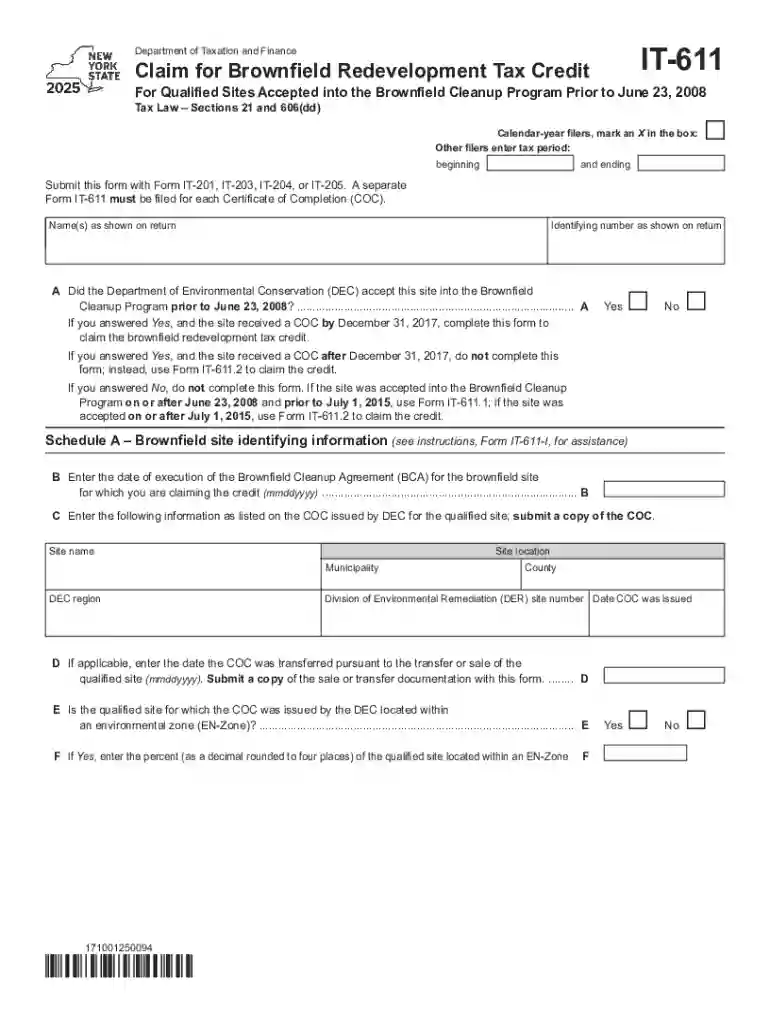
The Form IT-611 Claim for Brownfield Redevelopment Tax Credit Tax Year 2025 is a document used by taxpayers in the United States to claim tax credits for expenses related to the cleanup and redevelopment of brownfield sites. Brownfields are properties where the presence or potential presence of hazardous substances, pollutants, or contaminants may complicate the property's expansion, reuse, or redevelopment. This form facilitates economic revitalization while addressing environmental concerns.
Purpose of the Tax Credit
- Promote economic development in distressed areas.
- Encourage the cleanup and reuse of contaminated properties.
- Provide financial incentives to taxpayers for undertaking brownfield redevelopment projects.
Importance in Tax Planning
- Utilized for strategic tax reduction.
- Helps balance financial investment and environmental responsibilities.
Eligibility Criteria
To qualify for the Brownfield Redevelopment Tax Credit using Form IT-611, specific conditions must be met:

- Site Qualification: The brownfield site must be part of the Brownfield Cleanup Program prior to June 23, 2008.
- Qualified Investment: Redevelopment costs, including remediation and construction expenses, need to comply with tax credit regulations.
- Eligibility of Applicant: Taxpayers must demonstrate involvement in the redevelopment or ownership of a qualified site.
Common Eligibility Missteps
- Including ineligible expenses in the claim.
- Failing to secure site qualification under the Brownfield Cleanup Program.
Steps to Complete the Form IT-611
- Gather Required Documentation: Collect all records of eligible expenses related to the project, including remediation and construction costs.
- Determine the Credit Amount: Consult relevant state guidelines to accurately calculate your credit entitlement.
- Fill Out Personal Information: Enter your taxpayer information, including identification, in the designated sections.
- Detail Investment Activities: Provide a comprehensive report of activities undertaken as part of the redevelopment.
- Attach Supporting Documents: Include all necessary documentation that substantiates the claimed expenses.
Tips for Accurate Completion
- Double-check figures for accuracy.
- Confirm all documentation aligns with state and federal guidelines.
Key Elements of the Form IT-611
The essential components of the form include:
- Taxpayer Information: Name, address, and taxpayer identification number.
- Site Details: Location and description of the brownfield site.
- Expenditure Documentation: Detailed list and evidence of remediation and redevelopment costs.
- Certifications: Verification of program acceptance and compliance with legal requirements.
Importance of Each Element
- Accuracy in Taxpayer Information: Helps ensure proper processing and credit allocation.
- Comprehensive Site Details: Necessary for confirming site eligibility.
- Expenditure Documentation: Critical for substantiating the claimed tax credit.
State-Specific Rules
Each state may have unique requirements for processing Form IT-611, reflecting regional environmental policies and economic goals.
- New York Example: Requires specific certifications from state environmental agencies.
- California Standards: May involve additional reporting on redevelopment impacts.
Navigating State-Specific Challenges
- Understand any regional variations in eligibility or documentation required.
- Ensure compliance with state deadlines and approved site projects.
Filing Deadlines / Important Dates
Filing deadlines play an essential role in ensuring the tax credit is credited for the correct fiscal year:
- State and Federal Deadlines: Align submission dates to avoid errors in tax returns.
- Project Completion Dates: Recognize timelines for completing redevelopment activities.
Key Filing Deadlines
- Typically coincide with annual tax filing deadlines.
- May vary based on state-specific requirements.
Form Submission Methods (Online / Mail / In-Person)
Taxpayers have multiple options for submitting the completed Form IT-611:
- Online Submission: Streamlines the process, reducing paperwork.
- Mail: Traditional method, may be required for certain documentation that necessitates physical signatures.
- In-Person: Offers an opportunity for a direct handover to ensure receipt.
Advantages of Online Filing
- Quicker response times.
- Immediate confirmation of receipt.
Taxpayer Scenarios
The form is applicable across various taxpayer situations, providing flexibility based on business or individual cases.

Common Scenarios
- Small Businesses: Redeveloping localized brownfield sites for commercial use.
- Large Corporations: Involved in extensive urban renewal projects spanning multiple properties.
Sector-Specific Considerations
- Real Estate Developers: Benefit significantly due to property value increases post-redevelopment.
- Local Governments and Non-Profits: May leverage tax credits to fund community infrastructure projects.
Legal Use of Form IT-611
Compliance with legal requirements is crucial when using this form to claim tax credits.
- Adherence to Environmental Regulations: Ensure all redevelopment activities meet federal and state environmental laws.
- Verification of Expenditures: Only eligible expenses under tax code sections can be claimed.
Legal Challenges
- Facing audits if discrepancies are noted in claims.
- Understanding and aligning with specific tax code stipulations for redevelopment credits.
By understanding and adhering to these structured blocks of information, taxpayers can effectively navigate the complexities of the Form IT-611, ensuring compliance and maximizing potential tax benefits from brownfield redevelopment projects.