






Definition and Purpose of the Louisiana Oil Severance Tax Return
The Louisiana Oil Severance Tax Return is a specialized tax form used by entities involved in the production of oil within the state. This form is necessary for reporting and remitting taxes levied on the extraction of oil resources, which are considered severance taxes. Severance taxes are designed to compensate the state for the depletion of its natural resources and are a key revenue source for various public services. The form ensures compliance with Louisiana Revised Statutes 47:633 through 47:647 and is critical for entities operating in this sector to accurately report their tax obligations.
How to Use the Louisiana Oil Severance Tax Return
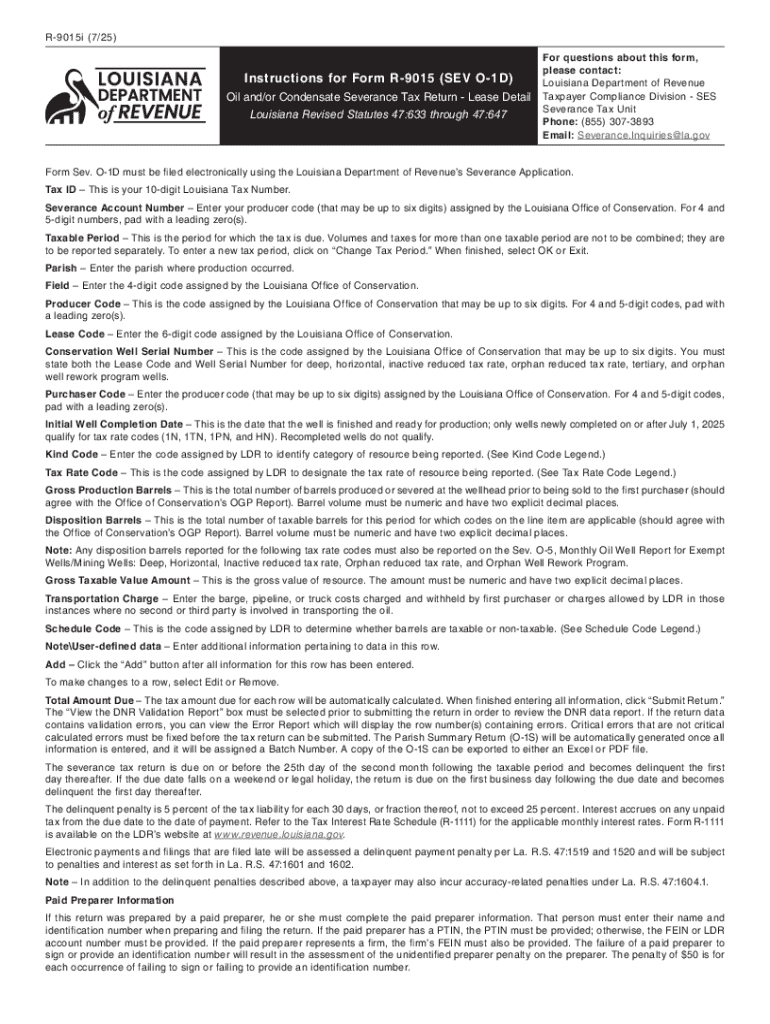
To effectively use the Louisiana Oil Severance Tax Return, entities must collect detailed production data, including the volume of oil extracted and the value of that production during the tax period. The form requires input of lease-specific information, which aligns with the detailed instructions provided in R9015i (7/25) for Form R9015 (SEV O1D). It's essential to ensure accuracy in these entries as errors can lead to audit triggers and potential penalties. Filling out this form involves careful adherence to the definitions of taxable events as outlined by the state, and it requires a comprehensive understanding of specific exemptions that may apply, such as those for reduced-rate wells or marginal well incentives.
Essential Steps
- Gather production data: Collect all relevant production volumes and values for the period in question.
- Calculate tax liability: Apply the correct tax rates to the gathered data, considering any applicable allowances or exemptions.
- Complete form specifics: Enter lease details and production specifics as required by the form instructions.
- Review and verify: Double-check all entries for accuracy to ensure compliance and to avoid penalties.
Steps to Complete the Louisiana Oil Severance Tax Return
Completing the Louisiana Oil Severance Tax Return involves a careful process to ensure accuracy and compliance. Below are the core steps typically involved in filling out this form:
- Preparation: Collect necessary documentation such as lease agreements, production logs, and financial records reflecting market value at the time of extraction.
- Form Identification: Locate the correct version of the form, R9015 (SEV O1D), ensuring that it reflects the latest statutory requirements.
- Detailed Entry: Fill out each section with precise production and lease data, using guidance from the instructions relevant to Form R9015.
- Calculation and Verification: Accurately compute the tax due by applying statutory tax rates to the calculable lease and production details.
- Submission: Submit the completed form by the stipulated deadline, either electronically if supported or via mail to the designated state office.
- Recordkeeping: Retain copies of the completed form and all supporting documents to meet statutory record retention obligations.
Key Elements of the Louisiana Oil Severance Tax Return
The Louisiana Oil Severance Tax Return includes several essential components that must be accurately completed to avoid compliance issues.
Key Elements
- Lease and Operator Details: Includes specific identifiers and descriptions for each well or lease.
- Production Data: Requires detailed reporting of volumes and sales value for oil extracted.
- Tax Rate Application: Specifies the tax rates applicable to different classes of oil or condensate, requiring operators to input precise calculations.
- Deductions and Exemptions: Allows for certain deductions or exemptions to be claimed, provided they are properly documented and meet statutory criteria.
Required Documents for Filing the Louisiana Oil Severance Tax Return
Accurate filing of the Louisiana Oil Severance Tax Return mandates the compilation of various documents to substantiate claims and entries made on the form:
- Production Logs: Records demonstrating the total volumes of oil extracted during the tax period.
- Sales Receipts: Documentation on the sale or disposal of the extracted oil indicating sale prices.
- Lease Papers: Legal documents verifying lease agreements and operator rights, crucial for input sections pertaining to lease descriptions.
- Previous Tax Returns: Copies of past filings may be required to verify continuity in filing and to reconcile any pending adjustments.
Filing Deadlines and Important Dates
Proper timing in filing the Louisiana Oil Severance Tax Return is crucial for avoiding penalties. The state delineates specific deadlines which taxpayers must adhere to:
- Monthly Filing Requirement: Generally, severance tax returns are due on the 25th of the month following the period for which the tax is owed.
- Extended Deadlines: The form provides options for extension under certain conditions, but these require pre-approval and adherence to early application processes.
- State Holidays: In cases where the regular due date falls on a state holiday, the deadline is typically extended to the next business day.
Penalties for Non-Compliance with the Louisiana Oil Severance Tax Return
Failing to properly complete and submit the Louisiana Oil Severance Tax Return can lead to various penalties, aimed at ensuring compliance and accurate reporting:
- Late Filing Penalties: Include additional fees calculated as a percentage of the tax owed, escalating with the degree of lateness.
- Underreporting Penalties: Apply in cases where entities fail to accurately report the full volume or value of extracted oil.
- Interest on Unpaid Taxes: Levied on overdue tax amounts, the state imposes interest as a compounding liability accruing until the time of full payment.
Examples and Scenarios Utilizing the Louisiana Oil Severance Tax Return
Understanding the nuances of the Louisiana Oil Severance Tax Return can be enhanced through practical examples:
- High Production Case: A company with expansive operations extracts a large volume of oil. They must meticulously document each unit's sale value and apply varying tax rates based on oil categories.
- Exemption Scenario: A producer qualifies for marginal well exemptions, impacting their effective tax rate. They must ensure documentation about the well's qualifications for these exemptions to avoid future audits.
- Lease Acquisitions: In scenarios where multiple leases are acquired within one tax period, combining data from different sites while ensuring legal verification is crucial.
Who Typically Uses the Louisiana Oil Severance Tax Return
The user base for the Louisiana Oil Severance Tax Return is primarily composed of oil producers and operators within the state, including both traditional and independent operators. These entities range from multinational corporations engaged in large-scale extraction to smaller independent firms dedicated to niche areas of production. The form is critical to their operations as it helps ensure compliance with the state's taxation requirements on natural resource extraction.


Why Should You File the Louisiana Oil Severance Tax Return
Filing the Louisiana Oil Severance Tax Return is a statutory obligation for any entity involved in oil production within state boundaries. Compliance ensures that companies contribute appropriately to the state’s revenue, facilitating public services funded through these taxes. Additionally, accurate filing helps mitigate the risk of audits, penalties, and interest charges, which can significantly impact an entity's financial health and operational efficiency.