






Definition & Meaning
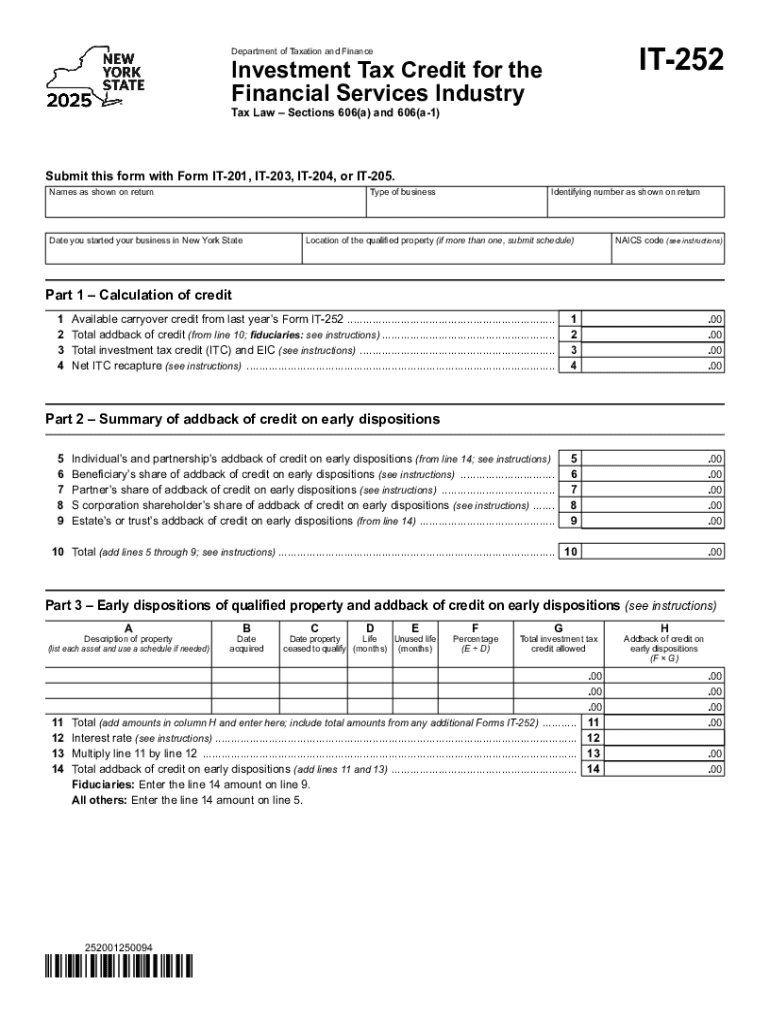
Form IT-252, known as the Investment Tax Credit for the Financial Services Industry, is a tax form used by individuals and entities involved in financial services to claim a credit for qualified investments. The form is vital for those looking to reduce their tax liabilities by taking advantage of investment credits provided through sections 606(a) and 606(a1) of the Tax Law.
Purpose and Capabilities
- Investment Tax Credit Benefits: Allows financial services businesses to claim credits for investments in tangible property, reducing taxable income.
- Specific Industry Focus: Tailored for the financial services industry, highlighting items such as buildings and equipment.
How to Use the Form IT-252 Investment Tax Credit for the Financial
Form IT-252 is essential for entities looking to leverage tax incentives available to the financial industry. Understanding how to use it effectively impacts tax savings significantly.
Completion Process
- Identify Eligible Investments: Determine the property and improvements that qualify, including newly acquired or constructed assets.
- Fill Out Form: Accurately complete each section, ensuring investments meet eligibility criteria.
- Attach to Tax Filing: Submit Form IT-252 with the appropriate New York State tax return forms, such as IT-201, IT-203, IT-204, or IT-205.
Additional Considerations
- Record Keeping: Maintain comprehensive documentation of investments for audit purposes.
- Software Compatibility: Ensure your tax software supports IT-252 for streamlined processing.
Steps to Complete the Form IT-252 Investment Tax Credit for the Financial
The process for completing Form IT-252 requires attention to detail and an understanding of investment qualifications.
Detailed Steps
- Gather Necessary Information: Collect detailed records of eligible investments made during the tax year.
- Complete Identification Details: Fill in the taxpayer's identification information accurately.
- Calculate Credit Amount: Calculate the credit based on qualifying purchase costs.
- Review Instructions Carefully: Follow the instructions provided to avoid errors.
Example Calculation
- Property Cost Calculation: Consider costs like IT equipment purchase, ensuring it meets criteria.
- Apply Percentage Rate: Apply the credit percentage rate specified in the instructions to determine the exact credit amount.
Important Terms Related to Form IT-252 Investment Tax Credit for the Financial
A solid understanding of specific terms helps in navigating and accurately filling out Form IT-252.
Key Definitions
- Tangible Property: Physical items such as machinery or equipment.
- Credit Rate: The percentage applied to eligible property costs to determine the credit amount.
Practical Use
- Illustrative Example: If a financial company installs $100,000 worth of computers, the credit applies to this tangible property investment.
- Qualification Terms: Ensure assets are purchased or leased under qualifying financial service operations.
Legal Use of the Form IT-252 Investment Tax Credit for the Financial
Adhering to legal guidelines when using Form IT-252 ensures compliance and reduces the risk of penalties.
Compliance Necessities
- Document Submission: Submit Form IT-252 alongside state tax documents, observing deadlines and requirements.
- Maintain Compliance: Ensure qualified properties are held for a sufficient duration to avoid recapture of the credit.
Case Studies
- Scenario Example: A corporation acquires new office equipment—claimed correctly, reducing tax payable by leveraging IT-252.
Key Elements of the Form IT-252 Investment Tax Credit for the Financial
Understanding the form's key elements is crucial for accurate completion and maximizing potential tax benefits.
Form Components
- Part 1 - Identification: Details about the taxpayer and the claim period.
- Part 2 - Investment Summary: Summarizes eligible investments and calculates the total credit claimable.
Breakdown of Components
- Component Explanation: Understand each part's requirements to avoid mistakes.
- Example: A checklist verifying eligible investments' alignment with tax credit requirements.
Filing Deadlines / Important Dates
Awareness of deadlines associated with Form IT-252 ensures timely submissions, preventing potential penalties.
Crucial Deadlines
- Annual Filing Date: Align submission with annual tax filing, typically by April 15.
- Mid-Year Updates: For fiscal-year filers, deadlines may vary—ensure accurate calendar tracking.
Impact of Deadline Compliance
- Avoiding Penalties: Late submissions might incur penalties, impacting financial planning.
Required Documents
A comprehensive set of documents is necessary to substantiate claims made on Form IT-252.
Document Checklist
- Purchase Receipts: Detailed invoices for acquired assets.
- Asset Documentation: Proof of property use within the financial services sector.
Verification Process
- Supporting Documentation: Additional substantiation may be requested by state authorities.
Eligibility Criteria
Eligibility for using Form IT-252 revolves around specific investments made by financial services organizations.


Criteria Overview
- Qualifying Investments: Only certain types of property qualify for credits.
- Business Type: Applicability may be limited to specific finance-oriented businesses.
Examples of Eligible Entities
- Corporations: Large-scale entities that have significant tangible property investments.
- LLCs: Limited Liability Companies involved in eligible financial transactions.
The detailed understanding of each block provides deep insights into using Form IT-252 effectively, ensuring financial services entities can maximize tax benefits through eligible investment claims.