




01. Edit your form online
Type text, add images, blackout confidential details, add comments, highlights and more.

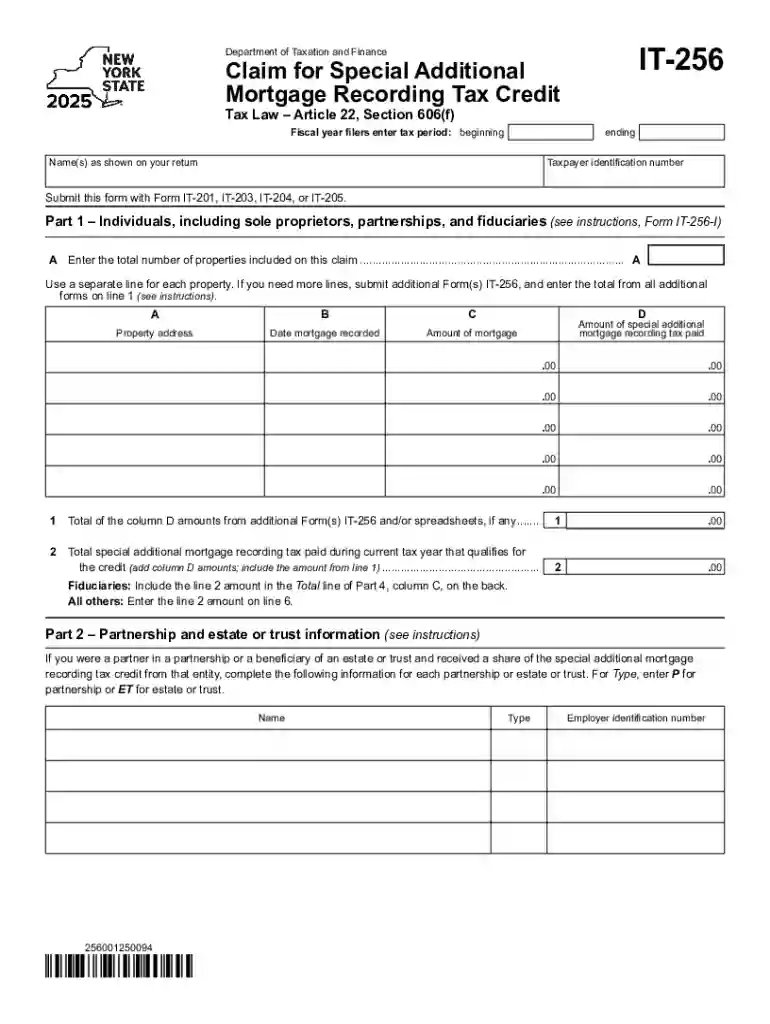
Type text, add images, blackout confidential details, add comments, highlights and more.

Draw your signature, type it, upload its image, or use your mobile device as a signature pad.

Send it via email, link, or fax. You can also download it, export it or print it out.
The "Form IT-256 Claim for Special Additional Mortgage Recording Tax Credit Tax Year 2025" is used by taxpayers to claim a tax credit for the special additional mortgage recording tax paid on recorded mortgages in New York. This form allows individuals and entities to offset their New York State taxes by the amount of special additional mortgage recording tax they have paid, making it an important tool for reducing tax liability.
The IT-256 form can be acquired through several avenues, such as:
The completion process involves several key steps, which are critical for accurate filing and ensuring eligibility for the credit:
Understanding the main components of the form enhances accuracy and compliance when filing:
To qualify for the tax credit via the IT-256 form, applicants must meet several eligibility criteria:


Timely submission of the IT-256 form is crucial:
Although the IT-256 is specific to New York state taxes, it needs to be correctly coordinated with IRS filings:
Filing can be done either through electronic or physical forms, each having its own benefits:
Balancing between comprehensive details and structured instructions, this guide aims to provide a thorough yet accessible approach to understanding and utilizing Form IT-256 effectively.
We've got more versions of the Form IT-256 Claim for Special Additional Mortgage Recording Tax Credit Tax Year 2025 form. Select the right Form IT-256 Claim for Special Additional Mortgage Recording Tax Credit Tax Year 2025 version from the list and start editing it straight away!
At DocHub, your data security is our priority. We follow HIPAA, SOC2, GDPR, and other standards, so you can work on your documents with confidence.






Share of special additional mortgage recording tax. Part 5 Computation of special additional mortgage recording tax credit available for the current tax year.Read more
Oct 22, 2025 Step 1: Calculate gross income from the home office, excluding home office expenses, and include direct costs like supplies, equipment, mileage,Read more
Apr 15, 2015 Premium tax credit. You may be eligible to claim the premium tax credit if you, your spouse, or a dependent enrolled in health insurance through.Read more


