Claim for Nursing Home Assessment Credit, it258 - Tax NY 2026

Get Form
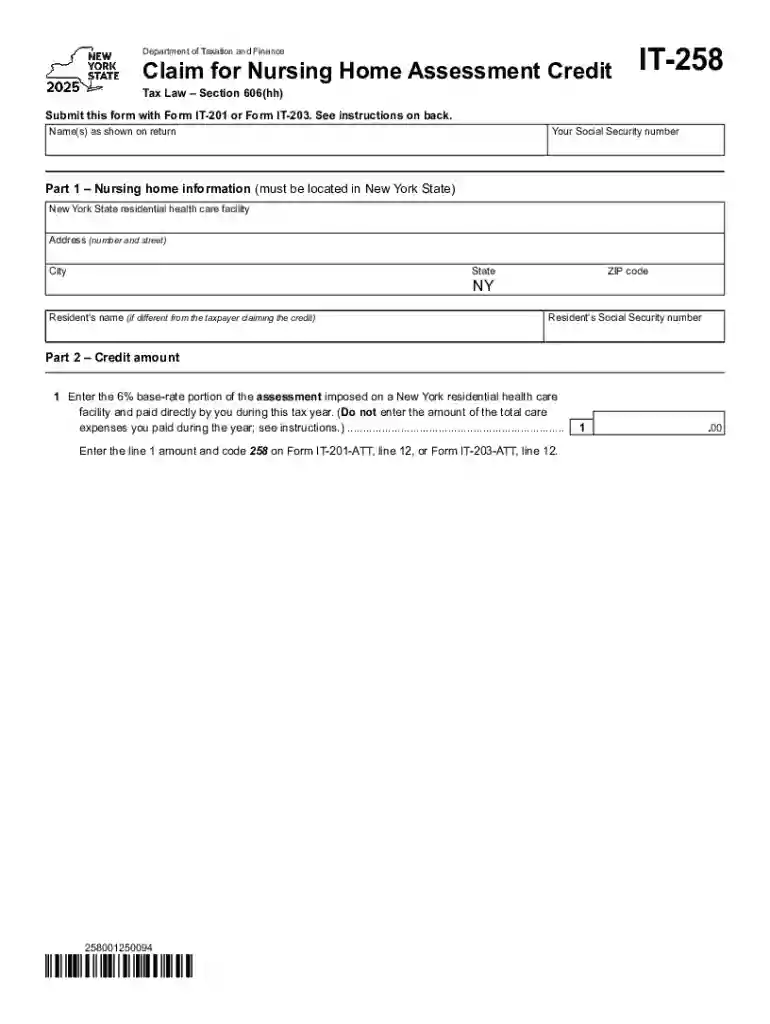
Claim for Nursing Home Assessment Credit, it258 - Tax NY Preview on Page 1

Here's how it works

01. Edit your form online
Type text, add images, blackout confidential details, add comments, highlights and more.

02. Sign it in a few clicks
Draw your signature, type it, upload its image, or use your mobile device as a signature pad.

03. Share your form with others
Send it via email, link, or fax. You can also download it, export it or print it out.

Definition & Meaning

The Claim for Nursing Home Assessment Credit, referred to as IT-258, is a tax form used in New York State. This form allows taxpayers to claim a credit against the assessments levied on nursing home operations. The credit aims to alleviate the financial burden for individuals or entities responsible for paying these assessments, ensuring they only bear their intended fiscal responsibilities.

  • Nursing Home Assessment: The payments imposed on nursing home operators, which contribute to Medicaid programs and other health-related state expenses.
  • Tax Credit: A direct reduction in the income tax owed by a taxpayer, based on specific eligible criteria and expenses.

These definitions help delineate the purpose and scope of the IT-258 form, highlighting its role in balancing state-mandated costs and tax liabilities.

How to Use the Claim for Nursing Home Assessment Credit, IT-258

Using the IT-258 requires understanding its sections and what information each block demands. It is primarily aimed at individuals or businesses who have paid nursing home assessments during the taxable year.

  1. Confirm Eligibility: Before using the form, verify that you qualify for the credit by checking if you have paid eligible nursing home assessments in New York.
  2. Accurate Entry: Fill out the form with precise details, including the total amount paid for nursing home assessments.
  3. Attach Required Forms: Submit the IT-258 alongside your main tax return forms, IT-201 or IT-203.

Following these steps ensures that the credit is applied correctly, reducing your total tax liability accurately.

Steps to Complete the Claim for Nursing Home Assessment Credit, IT-258

Completing the IT-258 requires diligence in filling out each section to avoid errors that could delay processing or lead to disallowed credits.

  1. Gather Information: Start by collecting all relevant documents detailing the nursing home assessments paid.
  2. Fill Personal Details: Include the names and identifying information as shown on your primary tax return.
  3. Enter Tax Credit Details: Specify the total eligible amount related to nursing home assessments paid.
  4. Verification: Double-check all entries for accuracy.
  5. Submit with Main Tax Forms: Attach to your IT-201 or IT-203 tax return.

Ensure each step is performed meticulously to maximize the chances of receiving the credit promptly and accurately.

Eligibility Criteria

Eligibility for the IT-258 primarily depends on whether the taxpayer bore any nursing home assessments during the taxable year. Key criteria include:

  • Assessment Payment: The taxpayer must have paid nursing home assessments.
  • New York Residency or Business Presence: Must either reside in or have business operations within New York State.
  • Taxpayer Status: The form can be used by individual taxpayers, partnerships, and certain business entities subjected to these assessments.

Satisfying these criteria is essential for claiming the credit without complications.

decoration image ratings of Dochub

Important Terms Related to Claim for IT-258

Several terms are crucial for understanding the IT-258 form and its applications:

  • Assessment: A fixed fee or tax imposed by government entities, specifically targeting nursing home operators in this context.
  • Tax Year: The calendar year for which the tax return and the claim are being filed.
  • Tax Return Forms (IT-201/IT-203): The primary forms where the IT-258 should be attached, representing individual and nonresident income, respectively.

Acquiring clarity on these terms facilitates efficient navigation through the process of claiming the credit.

Filing Deadlines / Important Dates

Adhering to the filing timeline ensures your claim is processed without delay.

  • Regular Deadline: Generally, the credit must be claimed by the due date for your state tax return, which typically aligns with federal tax filing deadlines (April 15, unless adjusted for holidays or weekends).
  • Extensions: If a filing extension is granted, the credit claim can be submitted along with the extended tax return.

Meeting these deadlines mitigates penalties and ensures timely tax credit issuance.

Required Documents

To substantiate your claim for the IT-258, specific documentation is necessary:

  • Proof of Assessment Payments: Documentation confirming the amount and recipient of nursing home assessments paid.
  • Tax Returns (IT-201/IT-203): The main forms to which the IT-258 will be attached, providing a comprehensive view of your income and taxes.

These documents are essential for verifying the legitimacy of your claimed credit.

Digital vs. Paper Version

Taxpayers have the option to submit the IT-258 either digitally or on paper, depending on their preference and resources.

  • Digital Submission: Allows faster processing and ease of integration with other digital systems like TurboTax.
  • Paper Submission: Offers a more manual approach, suitable for those who prefer traditional methods or lack access to digital platforms.

Understanding the pros and cons of each method helps in choosing the most convenient submission strategy.

be ready to get more

Complete this form in 5 minutes or less

Get form

Got questions?

We have answers to the most popular questions from our customers. If you can't find an answer to your question, please contact us.
Contact us
Yes, in certain instances nursing home expenses are deductible medical expenses. If you, your spouse, or your dependent is in a nursing home primarily for medical care, then the nursing home cost not compensated for by insurance or otherwise (including meals and lodging) is deductible as a medical expense.Oct 8, 2025
The $2,500 expense rule refers to the IRSs De Minimis Safe Harbor Election, allowing businesses to immediately deduct the full cost of small tangible property items (up to $2,500 per item/invoice) instead of depreciating them over time, provided they dont have an Applicable Financial Statement (AFS). For businesses with an AFS, this threshold increases to $5,000 per item/invoice, making it easier to expense smaller assets like computers, furniture, or even some building improvements. This election simplifies accounting and offers faster tax deductions for small-dollar purchases, but it must be elected annually on your tax return and doesnt apply to inventory or land. Key Details of the $2,500 Rule What it is: An IRS rule to immediately expense small asset purchases, avoiding complex depreciation schedules. Threshold: Up to $2,500 per item or invoice if you dont have an AFS. AFS Threshold: Up to $5,000 per item or invoice if you do have an AFS (like a certified audited financial statement). Applies to: Tangible property, including some building improvements (like a new fence or flooring), not land or inventory. How to Use: You must make a special election (often checking a box or filing Form 3115 with your return) each year to use this safe harbor. Benefit: Saves administrative burden and provides quicker tax deductions. Considerations: Some states may not conform to this rule, so check your states tax laws. Example A small business buys a new office printer for $1,500 (including tax and delivery) on one invoice. Without the rule, theyd depreciate it. With the $2,500 De Minimis Safe Harbor Election, they can deduct the full $1,500 in the year of purchase. For financial advice, consult a professional. Tangible property final regulations | Internal Revenue ServiceOct 2, 2025IRS (.gov)Harnessing the Power of the De Minimis Safe Harbor Tax Rule CBIAOct 6, 2024CBIA
If at the end of the year youve taken more premium tax credit in advance than youre due based on your final income, youll have to pay back the excess when you file your federal tax return. If youve taken less than you qualify for, youll get the difference back.
Nurses can claim tax deductions for work-related expenses like uniforms/scrubs, licensing/union fees, continuing education, professional dues, medical supplies (e.g., stethoscope), home office costs, and work-related travel/mileage, provided these arent reimbursed by an employer and help maintain or improve job skills. The specifics depend on whether youre a W-2 employee or a 1099 (self-employed) contractor, with 1099 nurses generally having broader deductions, including self-employment tax deductions. Common Deductible Expenses Work Clothes Gear: Scrubs, specific nursing shoes, lab coats, medical bags, and even the cost to clean/repair them. Education: Courses, conferences, and workshops for continuing education (CE) or to maintain certification, including related travel and meals. Licenses Fees: State license renewals, registration fees, and professional organization dues (like the ANA). Supplies Equipment: Pens, notebooks, stethoscopes, sanitizing supplies, and work-related apps. Travel: Mileage for work-related trips (not your daily commute), parking, and tolls. Home Office: A portion of home expenses if you have a dedicated space for work. Technology: A portion of cell phone, internet, or computer costs if used for work. Insurance: Malpractice insurance premiums. Key Considerations W-2 vs. 1099: If youre a W-2 employee, some unreimbursed job expenses might be claimed as an itemized deduction on Schedule A, but new rules limit this; 1099 contractors deduct from business income on Schedule C. Not for Personal Use: Items must be used for your nursing job and not for everyday personal use (e.g., regular clothes). Documentation is Key: Keep detailed records (receipts, mileage logs) for everything you claim. Consulting a tax professional is recommended to ensure youre maximizing deductions while staying compliant with IRS rules. What Can Nurses Claim on Tax Returns? - uPagedApr 20, 2023 If you use Your Nurse Diary, pens, or logbooks for work, you can claim them as a deduction.uPagedNavigating Tax Season: What Can I Claim on Tax as a Nurse? - Dr. WoofApr 12, 2024 Remember, not your ordinary commute, but those that meet unique work-related travel criteria, such as patient home visDr Woof Apparel
The real property tax credit may be available to New York State residents who have household gross incomes of $18,000 or less, and pay either real property taxes or rent for their residences. The amount of the credit for each household will vary depending on income and real property taxes paid (see table to the right).

Security and compliance

At DocHub, your data security is our priority. We follow HIPAA, SOC2, GDPR, and other standards, so you can work on your documents with confidence.
Learn more
ccpa2
pci-dss
gdpr-compliance
hipaa
soc-compliance

People also ask

You are entitled to this nonrefundable credit if you: Filing statusFederal adjusted gross income Single $28,000 or less Married filing jointly Qualifying surviving spouse Head of household with qualifying person $32,000 or less Married filing Separately $32,000 or less Oct 23, 2025
If the resident is in the nursing home primarily for medical reasons (e.g., chronic illness, Alzheimers, post-surgery rehab), then the entire costincluding meals and lodgingmay be tax deductible as a medical expense.
Yes, theres a new temporary federal tax deduction for seniors: an extra $6,000 (or $12,000 for couples) available from the 2025 to 2028 tax years as part of the One Big Beautiful Bill (OBBB), adding to the existing senior standard deduction for those 65+ to lower taxable income, though it phases out for higher earners. To claim it, you must be 65 or older by year-end, have a valid Social Security Number, file a Form 1040/1040-SR, and file a Schedule 1-A. Key Details Amount: Up to an extra $6,000 per eligible individual, or $12,000 for married couples where both qualify. Eligibility: Must be age 65 or older by December 31st of the tax year, and have a valid SSN. Income Phase-Out: Begins phasing out for Modified Adjusted Gross Income (MAGI) over $75,000 (single) or $150,000 (joint). Duration: Applies for the 2025, 2026, 2027, and 2028 tax years only. How it Works: Its an additional deduction that stacks with the standard deduction (not instead of it) and reduces your taxable income, not a direct rebate. How to Claim It File Form 1040 or 1040-SR: Use your regular tax form for the relevant year. Complete Schedule 1-A: This form is used to claim the enhanced senior deduction. Provide SSN: Ensure your Social Security Number is correctly entered. Check Income: Verify your MAGI is within the phase-out limits. For financial advice, consult a professional. Understanding the New Senior Deduction in OBBBAJan 22, 2026 The new senior deduction allows seniors to deduct from taxable income, up to $6,000 individually or $12,000 if marriedPeter G. Peterson FoundationCheck your eligibility for the new enhanced deduction for seniors5 days ago If youre 65 or older, you may be eligible for the enhanced deduction for seniors, a provision of the One, Big, BeautifuIRS (.gov)

Related links