




01. Edit your form online
Type text, add images, blackout confidential details, add comments, highlights and more.

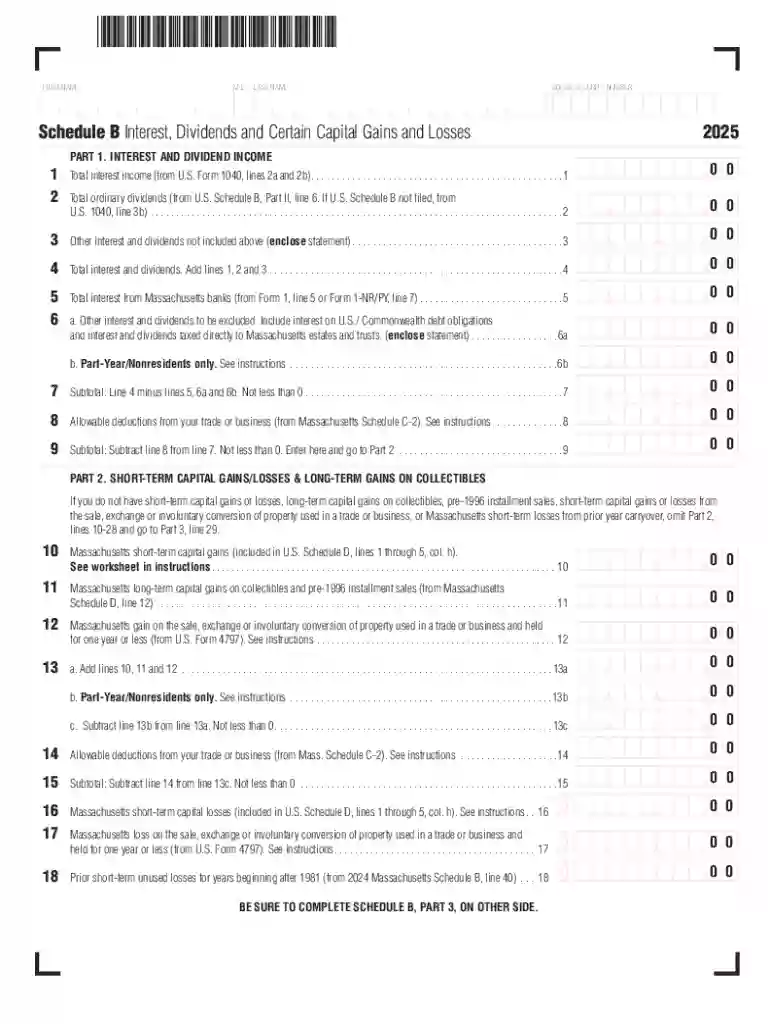
Type text, add images, blackout confidential details, add comments, highlights and more.

Draw your signature, type it, upload its image, or use your mobile device as a signature pad.

Send it via email, link, or fax. You can also download it, export it or print it out.
Schedule B Interest Dividends 2025 is a crucial IRS tax form used to report income from interest and ordinary dividends. This form is essential for taxpayers who receive substantial interest or dividend income during the tax year 2025. It's particularly relevant if you have earned interest over $1,500 from investments like savings accounts, certificates of deposit, or other financial instruments. The form also covers ordinary dividends from stock holdings, ensuring accurate income reporting for tax calculations. By using Schedule B, taxpayers can provide a detailed breakdown of these income sources to comply with IRS regulations.
Gather Financial Documents: Collect all necessary documents, including 1099-INT and 1099-DIV forms, which detail interest and dividend income, respectively.
Identify Income Sources: Determine all sources of interest and dividend income. This includes bank accounts, brokerage accounts, and any other investment platforms.
Fill Out Part I for Interest: List all interest income sources in Part I. Include the name of the payer and the amount received.
Complete Part II for Dividends: Similar to Part I, enter details of ordinary dividends received. Specify the payer's name and the dividend amount.
Subtotal and Total: Calculate the subtotals for both sections and determine the total interest and dividend income.
Review and File: Double-check entries for accuracy. Submit the completed Schedule B with your Form 1040 tax return.
Filing Schedule B Interest Dividends 2025 is critical for maintaining tax compliance and avoiding IRS penalties. Failure to report interest and dividend income accurately can lead to audits, fines, or other legal issues. By using Schedule B, taxpayers demonstrate their transparency in disclosing all relevant income sources, which is essential for accurate tax liability calculations. Additionally, filing this form allows individuals to maximize their tax efficiency, potentially identifying deductions or credits related to investment income.


Self-employed taxpayers who earn significant interest from their business savings accounts must report this income accurately using Schedule B.
Retired individuals relying on dividends for additional income should ensure all investment income is captured.
Students investing their savings or scholarships should include all interest and dividends received in the tax year.
Adhering to IRS guidelines is paramount when filing Schedule B. Ensure that all reported amounts match the figures on your 1099 forms. For those with complex financial situations involving foreign accounts or substantial investment portfolios, meticulous entry accuracy is vital. The IRS also mandates disclosures for foreign accounts exceeding specific thresholds, necessitating precise reporting on Schedule B.
The typical deadline for submitting Schedule B is April 15, coinciding with the annual tax filing due date for individual tax returns. Ensure timely submission to avoid penalties. Taxpayers should consider filing for an extension if additional time is necessary but should remember that extending the filing deadline does not extend the payment deadline for any taxes owed.
Failing to submit Schedule B or inaccurately reporting interest and dividend income can result in significant fines or audits. The IRS enforces penalties to encourage full disclosure and compliance among taxpayers. In severe cases, continued non-compliance may lead to legal action or an in-depth audit of all financial records.
Modern taxpayers often prefer the convenience of filing online. Utilizing software such as TurboTax or QuickBooks simplifies the process of completing Schedule B. These platforms automatically import data from electronic 1099 forms, eliminating manual entry errors. For those opting to file paper returns, ensure every section of the form is legible and complete.
Compatibility with tax software like TurboTax or QuickBooks enhances the accuracy and efficiency of filing Schedule B. These platforms offer automated data entry, importing financial information directly from linked accounts or uploaded documents. Users benefit from embedded checks and balances, ensuring that all required information is included and accurate before submission.
For further information, taxpayers can consult the IRS's official resources or seek guidance from tax professionals specializing in investment income reporting. Detailed instructions for Schedule B, available on the IRS website, provide in-depth explanations of each section and its requirements. Tax advisors can offer personalized advice based on individual financial circumstances, ensuring compliance and optimization of tax liabilities.
We've got more versions of the Schedule B Interest Dividends 2025 form. Select the right Schedule B Interest Dividends 2025 version from the list and start editing it straight away!
At DocHub, your data security is our priority. We follow HIPAA, SOC2, GDPR, and other standards, so you can work on your documents with confidence.



Apr 23, 2025 See instructions. You must complete this part if you (a) had over $1,500 of taxable interest or ordinary dividends; (b) had a foreign.Read more
Jan 21, 2026 1040 Schedule B Interest and Ordinary Dividends. Instructions for 1040 Schedule B 1040 Schedule EIC Earned Income Credit; 1040 Schedule 8812Read more
Dec 6, 2017 In most cases, if an NOL is more than the modified taxable income for the earliest year to which it is carried, you must file Schedule B toRead more


