






Definition & Meaning
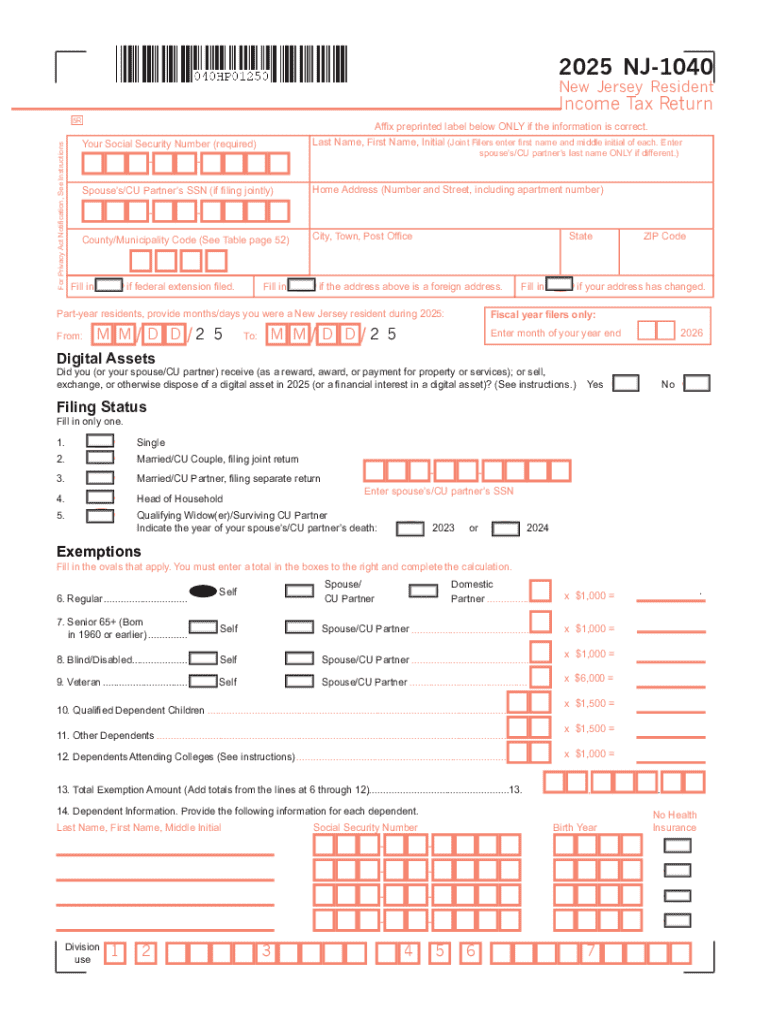
The 2 Form NJ-1040, commonly referred to as the NJ-1040, is a document used by residents of New Jersey to file their state income tax returns for the years 2024 through 2026. This form is crucial for individuals living in New Jersey to report their earnings, calculate their tax obligations, and ensure compliance with state tax laws. By using this form, taxpayers provide the state with information necessary to assess their tax liabilities or refunds.
Key Components of the Form
- Personal Information: Includes taxpayers' names, social security numbers, and addresses.
- Income Details: Various sections capture income from wages, business earnings, and other sources.
- Deductions and Credits: Allows reporting of eligible deductions and tax credits that can reduce tax liability.
- Tax Calculation: Summarizes total income, deductions, and calculates the amount owed or to be refunded.
How to Use the 2 Form NJ NJ-1040 Fill Online, Printable, Fillable
The NJ-1040 form can be accessed online, filled out digitally, or printed for manual completion. This flexibility caters to the diverse preferences of taxpayers.
- Access the Form: Available through the New Jersey Division of Taxation website or platforms like DocHub.
- Complete Online: Utilize fillable fields to input information directly on the digital form.
- Print and Fill: Download as a printable form if preferred or necessary for physical submission.
- Review Information: Double-check all fields to ensure accuracy before submission.
Practical Tips for Online Filling
- Use Supported Browsers: Ensure compatibility with the chosen platform.
- Save Frequently: Regularly save progress to prevent data loss.
- Utilize Guidance Sections: Refer to embedded instructions for complex queries.
Steps to Complete the 2 Form NJ NJ-1040 Fill Online, Printable, Fillable
Completing the NJ-1040 form involves several steps. Here’s a structured procedure to guide taxpayers through the process:
- Gather Necessary Documents: Collect W-2 forms, 1099 forms, and any documentation relevant to income and deductions.
- Fill Personal Information: Enter your name, social security number, and current address.
- Report Income: Include all sources of income, carefully following the provided instructions.
- Calculate and Enter Deductions: Identify eligible deductions and input accordingly.
- Determine Tax Credits: Apply any applicable credits that reduce tax obligations.
- Finalize Calculations: Sum up total tax due or anticipated refund.
- Review and Sign: Ensure all sections are accurately completed and sign the form.
- Submit Form: Follow submission instructions based on the chosen method (online or mail).
Possible Complications
- Incomplete Information: Double-check for missing sections before submission.
- Incorrect Calculations: Use calculators or tax software for precision.
- Mistimed Submissions: File before the deadline to avoid penalties.
Who Typically Uses the 2 Form NJ NJ-1040 Fill Online, Printable, Fillable
This form is primarily used by New Jersey residents required to file state income taxes. It is relevant for various taxpayer groups, including:
- Employees: Individuals receiving wages from employers.
- Self-Employed Individuals: Those with freelance or business income.
- Retirees: Individuals with pension or investment income.
- Students: Those with part-time work or scholarships categorized as taxable.


Usage Scenarios
- Joint Filers: Married couples filing together.
- Single Filers: Individuals filing independently.
- Part-year Residents: Taxpayers who lived in New Jersey for only part of the tax year.
Filing Deadlines / Important Dates
Timely filing of the NJ-1040 form is critical to avoid penalties. Here are essential dates related to the 2 tax years:
- Filing Deadline: Typically falls on April 15 for the preceding year’s taxes.
- Extension Requests: Must be submitted by the original filing deadline if additional time is needed.
- Estimated Tax Payment Deadlines: Quarterly payments may be required for individuals with substantial untaxed income.
Consequences of Late Filing
- Penalties and Interest: Accrue for late submissions and unpaid taxes.
- Delayed Refunds: Processing can be significantly delayed for tardy filings.
Legal Use of the 2 Form NJ NJ-1040 Fill Online, Printable, Fillable
Using the NJ-1040 form is not only a compliance measure but also a lawful obligation for taxpayers in New Jersey. It is designed to accurately reflect income and deductions, helping to precisely calculate tax liabilities.
Compliance Requirements
- Accurate Reporting: Ensures adherence to state income tax laws.
- Signature and Submission: Certifies the information provided is truthful and complete.
Legal Implications
- Audit Risks: Inaccurate or fraudulent filings can trigger audits.
- Legal Actions: Severe discrepancies might lead to legal proceedings.
Important Terms Related to 2 Form NJ NJ-1040
Understanding the terminology associated with the NJ-1040 form enhances the completion process. Here are essential terms:
- Gross Income: Total income before deductions or exemptions.
- Deductions: Qualified reductions in taxable income.
- Tax Credits: Direct reductions in tax liability.
- Filing Status: Determines tax brackets and standard deductions.
Examples of Terms in Use
- "Adjusted Gross Income": Income after specific deductions.
- "Itemized Deductions": Expenses eligible to be subtracted from gross income.
Required Documents
Filing the NJ-1040 requires assembling various supplementary documents that detail income and deductions:
- W-2 Forms: For wage and salary income.
- 1099 Forms: For additional income sources such as interest or freelance earnings.
- Receipts and Records: Proof of deductible expenses.
- Prior Tax Returns: For reference and continuity with previous filings.
Real World Scenario
Taxpayers can efficiently manage their tax obligations by preparing these documents in advance and using them alongside the NJ-1040 form to ensure all information is accounted for accurately.
Form Submission Methods (Online / Mail / In-Person)
Submitting the NJ-1040 form can be done through various means, each offering different conveniences and requirements:
- Online: Fast and efficient via official platforms or services like DocHub.
- Mail: Traditional method suiting those preferring physical submissions.
- In-Person: Direct submission at authorized tax collection offices.
Comparison of Methods
- Speed: Online is generally quickest.
- Confirmation: Mailing requires tracking for confirmation.
- Assistance: In-person allows direct questioning of officials when needed.
Understanding these methods empowers taxpayers to select the most suitable option for their circumstances.