Instructions for Schedule IN K-1 - FTP Directory Listing 2026

Get Form
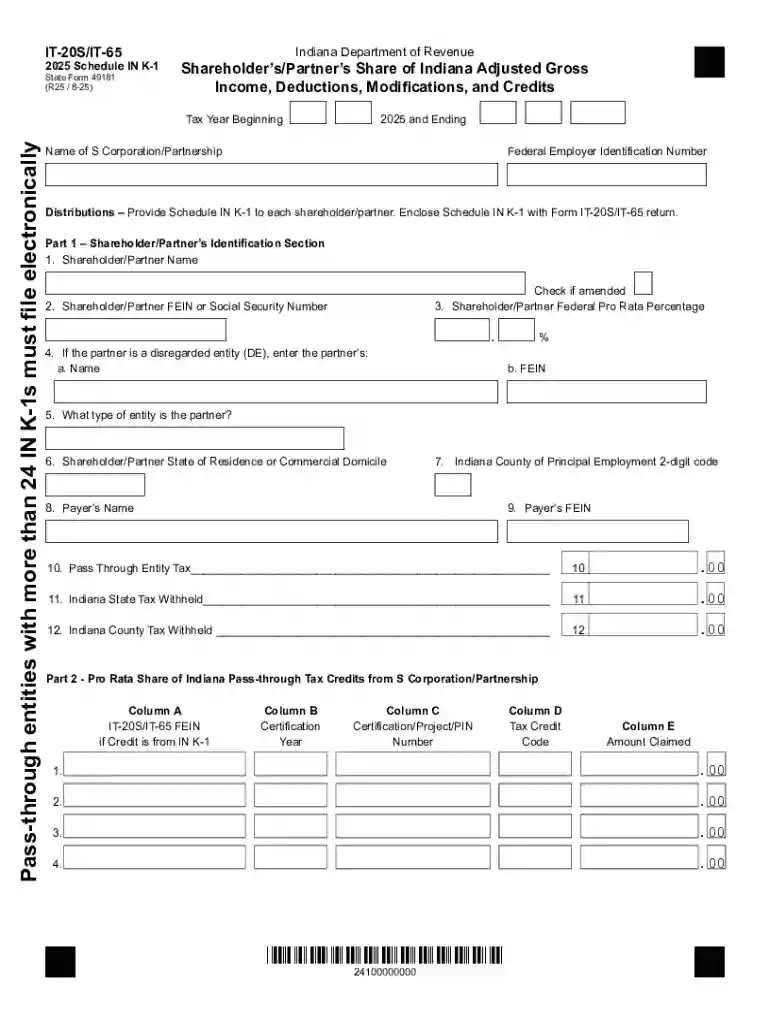
Instructions for Schedule IN K-1 - FTP Directory Listing Preview on Page 1

Here's how it works

01. Edit your form online
Type text, add images, blackout confidential details, add comments, highlights and more.

02. Sign it in a few clicks
Draw your signature, type it, upload its image, or use your mobile device as a signature pad.

03. Share your form with others
Send it via email, link, or fax. You can also download it, export it or print it out.

Definition and Meaning

The Instructions for Schedule IN K-1 - FTP Directory Listing serve as a user guide for completing the Schedule IN K-1 form associated with the Indiana Department of Revenue (DOR). This document is crucial for shareholders and partners of pass-through entities to report their share of Indiana adjusted gross income, deductions, modifications, and credits. The instructions provide detailed guidance to ensure accurate completion of the schedule.

Steps to Complete Schedule IN K-1

  1. Gather Necessary Information: Start by collecting documents that detail the partnership's or S corporation's total income, deductions, credits, and modifications relevant to your share.
  2. Understand Your Share Allocation: Determine how the partnership or corporation will distribute income, credits, and deductions among partners or shareholders.
  3. Complete the Form: Fill out the Schedule IN K-1 by following the line-by-line instructions provided. Ensure you accurately report figures in accordance with your ownership percentage.
  4. Review for Accuracy: Double-check all entries on the form to prevent errors that could result in compliance issues or penalties.
  5. Submit the Form: Include Schedule IN K-1 with the Indiana tax return. Each shareholder or partner should receive a copy for their records.

Important Terms Related to Schedule IN K-1

  • Pass-through Entity: A business entity like a partnership or S corporation that doesn't pay income taxes itself. Instead, income is divided among owners or shareholders.
  • Adjusted Gross Income: The total income of a shareholder or partner after adjustments, including deductions defined by the state.
  • Credits and Modifications: Specific adjustments and incentives provided under Indiana tax laws that may affect tax obligations.

State-Specific Rules for Schedule IN K-1

Indiana requires adherence to specific guidelines when reporting income and allocations on Schedule IN K-1. This ensures consistency and compliance across all state filings:

  • Income Attribution: Indiana requires income to be attributed based on business activities within the state.
  • Deductions: Only deductions permissible under state law can be used; these may differ from federal allowances.
  • Credit Limitations: Credits can only be claimed as prescribed by Indiana statutes. Familiarity with applicable statutes is essential for compliance.

Examples of Using Schedule IN K-1

Consider a company, XYZ LLC, located in Indiana. XYZ LLC has three partners, and their operations generate $300,000 in income. Based on individual ownership percentages, partner distributions, including income, deductions, and credits, are detailed on Schedule IN K-1. This form ensures each partner pays their fair share of state taxes.

Legal Use of Schedule IN K-1 Instructions

These instructions assist tax filers in ensuring compliance with Indiana's tax regulations. Using the guidelines helps to accurately prepare and submit Schedule IN K-1, minimizing the risk of legal penalties.

Key Elements of the Instructions

  • Line-by-line Guidance: Detailed instructions for filling out each section of Schedule IN K-1.
  • Examples and Scenarios: Specific examples illustrating how to handle diverse income sources and distribution scenarios.
  • Compliance Tips: Advice for avoiding common errors and ensuring smooth processing by the Indiana DOR.

IRS Guidelines for Schedule IN K-1

While Schedule IN K-1 is specific to Indiana, there are corresponding federal guidelines. Taxpayers must align their federal Form K-1 reporting with state filings, maintaining consistency and compliance at both levels.

Filing Deadlines and Important Dates

  • Annual Deadline: Typically coincides with the Indiana individual income tax filing deadline.
  • Extension Provisions: Extensions may be available, but these do not extend the deadline for tax payment. Penalties apply if taxes are unpaid by the original due date.

Required Documents

  • Financial Statements: For determining total income, deductions, and credits.
  • Previous Year’s Tax Returns: To ensure continuity and correctness in reporting.
  • Ownership Agreements: To verify proportionate distributions of income or credits among partners or shareholders.

Form Submission Methods

  • Online: E-filing is available and often recommended for expedited processing.
  • Mail: Traditional paper submission is an option, but electronic filing can reduce processing delays.

Penalties for Non-Compliance

Failing to complete or submit Schedule IN K-1 correctly can result in:

  • Fines and Penalties: Monetary penalties for late filing or underpayment.
  • Increased Scrutiny: Heightened risk of audits by the Indiana DOR.
  • Interest on Unpaid Taxes: Additional interest charges for taxes not paid by the due date.

Form Variants and Related Documents

While Schedule IN K-1 is the primary form, additional schedules or supplements may be required depending on the complexity of business operations or specific allocations. It is critical to ensure that all applicable forms accompany the primary submission for a comprehensive filing.

be ready to get more

Complete this form in 5 minutes or less

Get form

Got questions?

We have answers to the most popular questions from our customers. If you can't find an answer to your question, please contact us.
Contact us
If you received a copy of Schedule K-1 from a trust or estate, youll be reporting that income via Form 1041 instructions. And if youre a shareholder in an S Corp, youll be dealing with Form 1120-S instead of Form 1065but the concept for reporting is the same for your individual tax.Jun 20, 2025
Since your K-1 reports amounts in more than one of boxes 1, 2, or 3, the partnership/LLC is involved in more than one type of activity. You should treat each activity separately in TurboTax. Enter other rental activity amount, box 3, on a third K-1. This will allow TurboTax to properly track your loss carryovers.Sep 6, 2024
The entities that file Schedule K-1 forms are partnerships, S corporations, and trusts/estates, which issue them to their partners, shareholders, or beneficiaries to report their share of income, losses, and credits, while the recipients use this info on their personal tax returns. The business entity itself files the K-1s with the IRS as part of their tax return (Form 1065 for partnerships, 1120-S for S corps, or 1041 for trusts/estates). Who Files (The Entity): Business Partnerships: File Schedule K-1 (Form 1065) to report each partners share of profits, losses, deductions, and credits. S Corporations (S Corps): Issue Schedule K-1 (Form 1120-S) to shareholders for their portion of the companys pass-through income or losses. LLCs: If treated as a partnership or S corp for tax purposes, they must issue K-1s. Trusts and Estates: Fiduciaries file Schedule K-1 (Form 1041) for beneficiaries receiving distributed income. Who Receives (The Individual/Recipient): Partners: Owners of partnerships receive K-1s. Shareholders: Investors in S corporations receive K-1s. Beneficiaries: Individuals receiving income from a trust or estate get K-1s. Key Point: The K-1 is a pass-through form; the entity files it to inform the IRS and the owner/recipient, who then uses that data to complete their own individual tax return (Form 1040). For financial advice, consult a professional. About Form 1065, U.S. Return of Partnership Income - IRS.govJan 23, 2026 Schedule K-1 (Form 1065), Partners Share of Income, Deductions, Credits, etc. The partnership files a copy of SchedulIRS (.gov)Schedule K-1 Federal Tax Form: What Is It and Who Is It for? - InvestopediaTypes of Schedule K-1s. The K-1 forms used by the three entities (partnerships, S-corporations, and trusts) vary slightly in the wInvestopedia
How to read your Schedule K-1 Box 1: Interest incomeTaxable interest earned by the trust or estate. Box 2a: Total ordinary dividendsDividends distributed to you. Box 3: Net short-term capital gainsGains from investments held for one year or less. Feb 18, 2025
How do I Report Schedule K-1 (Form 1065) Box 13 Information? Direct Entry via the K-1 Section. Navigate to the K-1 section of the program and enter all required details directly. Entry Through the Associated Form. Go to the specific form where the K-1 information is reported (e.g., Form 1040 Schedule E, Schedule D, etc.)

Security and compliance

At DocHub, your data security is our priority. We follow HIPAA, SOC2, GDPR, and other standards, so you can work on your documents with confidence.
Learn more
ccpa2
pci-dss
gdpr-compliance
hipaa
soc-compliance

People also ask

Box 14 Self Employment Earnings (Losses) If there is a positive amount reported to you in this box, please report the amount as it is reported to you. This will be reduced appropriately by the program by any section 179 deduction you previously reported.
TurboTax Online Go to the K-1 screen under Wages Income. On the Schedules K-1 or Q page, select Yes. On the Did you receive any Schedules K-1? page, select Yes. Select Start next to the type of Schedule K-1 form you have, and enter your information.
0:00 0:38 In most cases pass through income or loss from a partnership LLC or SC corporation. Goes on scheduleMoreIn most cases pass through income or loss from a partnership LLC or SC corporation. Goes on schedule E line 28. However if the earnings were paid in the form of dividends.

Related links