






Definition and Purpose of the Tennessee Franchise and Excise Tax Return
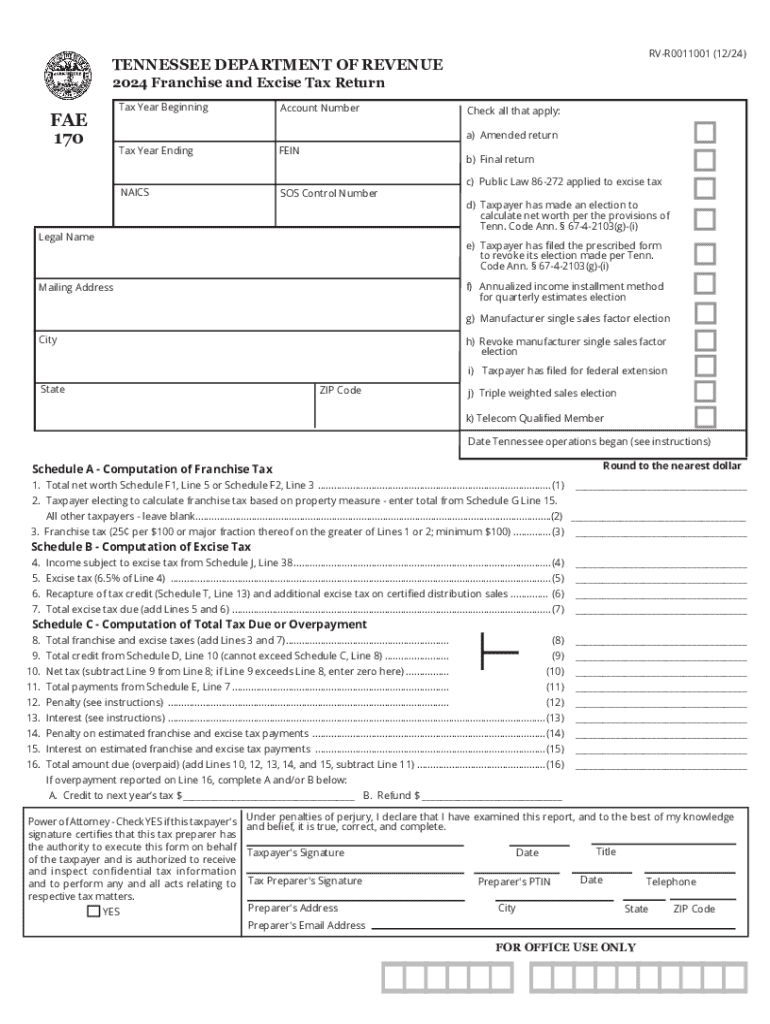
The Tennessee Franchise and Excise Tax Return, commonly referred to as the FAE 170 form, is a tax document used by business entities operating within Tennessee to report their franchise and excise taxes to the state’s Department of Revenue. Franchise tax is based on the greater of a corporation’s net worth or the value of its real and tangible personal property in the state. Excise tax is calculated on the net earnings of the entity. By using this form, businesses declare their financial status and ensure they meet their state tax obligations accurately and in a timely manner.
Key Elements of the Tennessee Franchise and Excise Tax Return
-
Tax Year Beginning and Ending: This section captures the specific accounting period for the business, ensuring the taxes are calculated for the correct fiscal year.
-
Account Number and FEIN: The form requires a unique Tennessee account number and the Federal Employer Identification Number (FEIN) to identify the business entity within state and federal systems.
-
SOS Control Number: This includes the entity's unique identifier from the Tennessee Secretary of State, essential for state records and compliance.
Steps to Complete the Tennessee Franchise and Excise Tax Return
-
Gather Required Information: Start by collecting financial statements, previous tax returns, and any documents indicating state-specific assets and income.
-
Determine Tax Year: Clearly define the fiscal period the return covers to prevent discrepancies. Align with the business’s accounting year.
-
Calculate Franchise Tax: Determine the greater of the entity's net worth or the value of its in-state tangible property.
-
Calculate Excise Tax: Compute the tax based on net earnings. Include all relevant deductions and exemptions applicable to the business.
-
Complete the Form: Enter all required details, ensuring accuracy in calculations and information input.
-
Review and Sign: Ensure all sections are completed correctly, double-check calculations, and obtain authorized signatures.
-
Submit as Required: File the form online through the Tennessee Department of Revenue’s website, or mail it if electronic filing is not used.
Legal Use and State-Specific Rules
The Tennessee Department of Revenue enforces specific regulations governing the Tennessee Franchise and Excise Tax Return. Only recognized business entities such as corporations, limited partnerships, limited liability companies (LLCs), and business trusts are required or permitted to file this form. Compliance with federal tax guidelines, notably the ESIGN Act for signatures, is mandatory.
-
Filing Frequency: Businesses must submit this form annually.
-
Record Keeping: Maintain backup documentation for all entries as records can be subject to state audits.
Filing Deadlines and Important Dates
-
Due Date: The form is generally due on the 15th day of the fourth month following the close of the corporation’s fiscal year. Extensions may be granted if requested before the original due date.
-
Extension Requests: While extensions for filing are permissible, they do not apply to tax payments tendered as taxes must be paid by the initial due date to avoid penalties.
Who Typically Uses the Tennessee Franchise and Excise Tax Return
The tax return is chiefly employed by businesses operating in Tennessee across various sectors. This includes domestic and foreign (out-of-state but operating in Tennessee) corporations, partnerships, LLCs, and other registered enterprises generating income within the state.


Business Entity Types and Taxpayer Scenarios
-
LLCs and Corporations: These entities are directly subject to the franchise tax on their operations within Tennessee.
-
Partnerships: Although generally not taxed, partnerships may file the return to account for any in-state financial activities.

Penalties for Non-Compliance with the Tax Return
Failing to file or pay taxes can result in penalties and interest accrued on the outstanding balance. Common penalties include:
-
Late Filing: A five percent penalty per month for delinquent filings.
-
Underpayment: Monthly interest on unpaid taxes.
-
Nonpayment: An additional penalty for failing to remit the due taxes on time.
Software Compatibility and Filing Methods
To streamline tax return preparation, various software systems are compatible, such as TurboTax and QuickBooks. These systems help compute taxes and verify entries for online submissions.
-
Online Submission: Preferred method via the Tennessee Department of Revenue’s portal.
-
Mail Submission: Alternatively, businesses can mail the completed forms if electronic filing is not feasible.
Important Terms Related to the Tax Form
Understanding specific terminology is crucial:
-
Net Worth: For franchise tax calculation, it includes net financial values minus liabilities.
-
Tangible Personal Property: Physical assets that are subject to assessment within Tennessee.
-
Excise Taxes: Taxes on regulatory activities and net profits rather than assets or holdings.
Examples of Using the Tennessee Franchise and Excise Tax Return
Consider an LLC engaged in both state and out-of-state operations. By employing a competent accounting team, it computes its Tennessee franchise tax based on a portion of net worth derived from in-state property. It also reports its excise tax calculated on in-state earnings after applicable deductions.
This comprehensive approach ensures all financial obligations are met efficiently, minimizing risks of state audits or penalties.