







Definition & Meaning
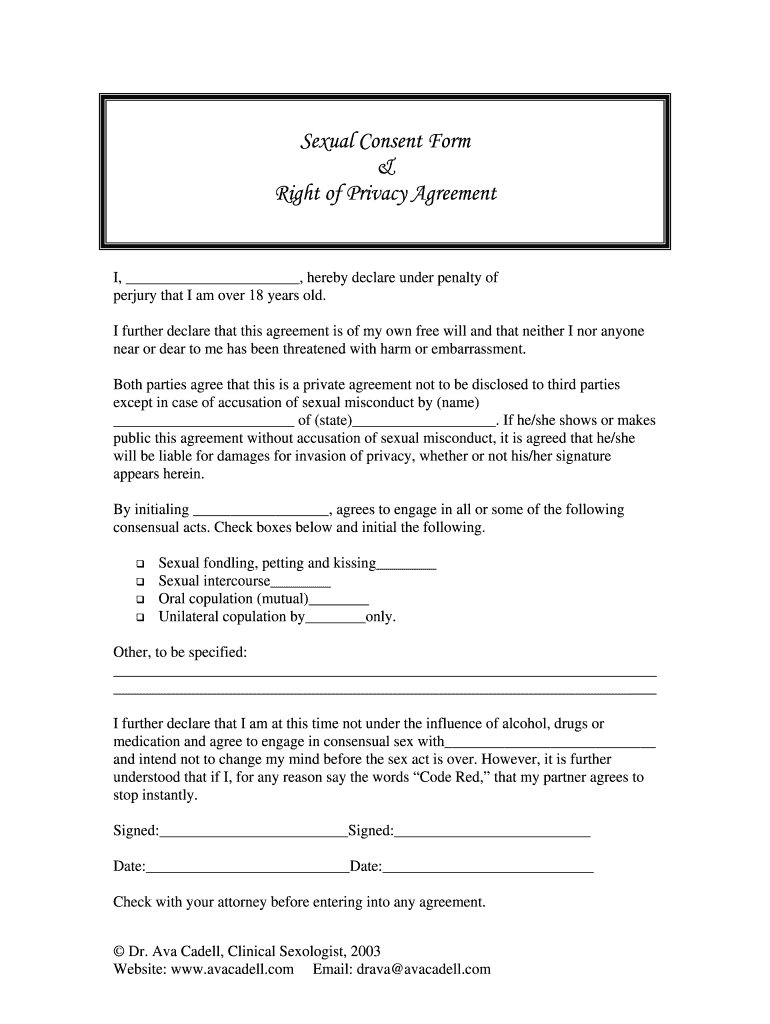
The consensual non consent form, often abbreviated as CNC, is a document used in specific contexts to establish boundaries and agreements for activities where explicit consent is given for circumstances that might resemble non-consent scenarios. This type of agreement is commonly employed in intimate relationships or scenarios that involve role-play activities where one party agrees to temporarily give control to another while setting clear boundaries and safe words. The CNC form is crucial for ensuring that all parties involved understand and agree to the terms, preserving mutual respect and safety.
Key Elements of the Consensual Non Consent Form
The consensual non consent form includes several critical components that ensure clarity and mutual understanding:
- Participant Information: Names, ages, and contact information of all parties involved.
- Agreed Activities: A detailed list of activities that parties consent to engage in, often including scenarios and specifics.
- Boundaries and Limits: Clear specifications of actions or behaviors that are off-limits, ensuring all parties understand what is unacceptable.
- Safe Words: Pre-agreed terms used to immediately halt an activity and re-establish consensual boundaries.
- Signatures: Signatures from all parties to validate that they have read, understood, and agreed to the terms stated in the form.
How to Use the Consensual Non Consent Form
Utilizing the CNC form involves several important steps to ensure it serves its purpose effectively:
- Discussion: Prior to filling out the form, parties should have an open and honest conversation about boundaries, desires, and expectations.
- Completion: Fill out the form together, detailing activities and setting clear boundaries.
- Review: Regularly review and adjust the form as needed, especially after sessions, to address any changes in consent or boundaries.
- Storage: Keep the form stored securely, maintaining both parties' privacy and the document's integrity.
Legal Use of the Consensual Non Consent Form
While the CNC form can offer protection and clarity within personal relationships, it must be understood that the legal enforcement of such documents is complex:
- Consent: The form serves as evidence of consent and mutual agreement, but it does not override laws on consent.
- Privacy: Participants should ensure that their privacy rights are protected, as the content may involve sensitive personal information.
- Consultation: It is advisable to consult a legal professional to understand the implications fully and ensure the form abides by relevant laws.
Who Typically Uses the Consensual Non Consent Form
The CNC form is predominantly used by individuals in the BDSM community or those practicing alternative forms of intimate relationships. Parties involved are typically:
- Partners: Engaging in scenes where power dynamics and role-playing are involved.
- Enthusiasts: Exploring controlled and consensual non-consent activities.
- Legal Advisors: Providing guidance on how to structure agreements for such activities.

Steps to Complete the Consensual Non Consent Form
Completing the CNC form requires careful attention to detail:
- Collect Participant Information: Gather relevant information about the parties involved.
- Discuss and List Activities: Negotiate and list all agreed activities and scenes.
- Define Boundaries: Clearly specify what activities are prohibited.
- Establish Safe Words: Agree upon and document safe words for stopping any activity instantly.
- Sign and Date the Form: Each participant should sign and date the form to confirm agreement.
Important Terms Related to the Consensual Non Consent Form
Understanding relevant terminology is essential for effectively using the CNC form:
- Safe Word: A predetermined word or phrase that, when spoken, immediately stops all activities.
- Scene: A planned interaction or series of activities within a BDSM context.
- Limit: Actions or behaviors that are strictly off-limits even within an agreed scenario.
- Role-play: Enacting a character or scenario for entertainment or exploration.
Example Scenarios of Using the Consensual Non Consent Form
Providing examples can clarify the CNC form's application:
- Role-Play: Two partners agree to a scenario involving a caregiver and dependent, with clear boundaries and safe words.
- D/s Relationships: A Dominant and submissive define physical and emotional boundaries, specifying which actions require additional consent.
- Exploration Sessions: Enthusiasts exploring new interactions use the form to pre-emptively outline hard limits and desired outcomes.
These comprehensive elements of the consensual non consent form, when followed and understood, ensure both safety and an enriching experience for all parties involved.




