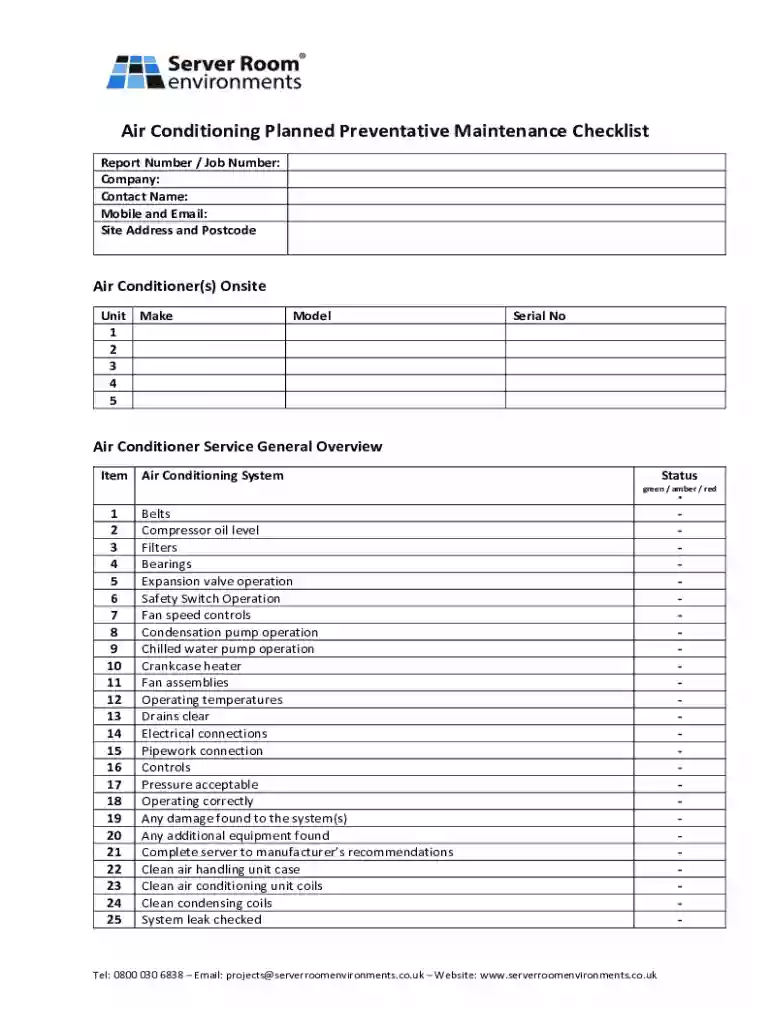
Air conditioning planned preventative maintenance checklist 2026

Get Form
air conditioning planned preventative maintenance checklist Preview on Page 1

Here's how it works

01. Edit your form online
Type text, add images, blackout confidential details, add comments, highlights and more.

02. Sign it in a few clicks
Draw your signature, type it, upload its image, or use your mobile device as a signature pad.

03. Share your form with others
Send it via email, link, or fax. You can also download it, export it or print it out.

Definition and Purpose

An "air conditioning planned preventative maintenance checklist" is a tool used to ensure regular upkeep and optimal performance of air conditioning units. This type of checklist facilitates the systematic inspection and maintenance of critical components, helping to prevent unexpected failures and extend the life of the equipment. It typically outlines specific tasks, including cleaning, checking refrigerant levels, inspecting electrical connections, and verifying thermostat functionality. This structured approach is crucial for maintaining energy efficiency, preventing costly repairs, and ensuring a comfortable indoor environment.

How to Use the Air Conditioning Planned Preventative Maintenance Checklist

Using this checklist involves a sequential process tailored to the needs of your specific air conditioning system. Typically, a trained technician or maintenance professional will:

  1. Review the Checklist: Before beginning, familiarize yourself with each listed task to understand the scope and tools required.
  2. Conduct Visual Inspections: Inspect visible components such as fans, belts, and filters for wear or damage.
  3. Perform Maintenance Tasks: Follow the checklist to carry out necessary actions, including tightening connections, cleaning coils, and lubricating moving parts.
  4. Record Findings and Actions: Document any issues identified and tasks completed for accountability and future reference.
  5. Schedule the Next Maintenance: Determine the next maintenance date based on the checklist recommendations and system's usage intensity.

Steps to Complete the Air Conditioning Planned Preventative Maintenance Checklist

  1. Preparation: Gather required tools and materials, such as cleaning supplies, replacement parts, and personal protective equipment.
  2. Turn Off the System: Safely shut down the air conditioning unit to prevent accidents during maintenance.
  3. Clean and Replace Filters: Remove and clean or replace air filters to enhance air quality and system efficiency.
  4. Inspect Electrical Connections: Check for loose wires or corrosion in the electrical components, tightening or cleaning as needed.
  5. Evaluate Refrigerant Levels: Ensure that refrigerant levels are within the recommended range to maintain cooling efficiency.
  6. Test Thermostat Functions: Verify that the thermostat is accurately measuring temperature and controlling the system.
  7. Reassemble and Test: Once all tasks are completed, restart the system to test its operation and check that all components are functioning correctly.

Key Elements of the Air Conditioning Planned Preventative Maintenance Checklist

  • Component Inspection: Detailed examination of coils, compressors, fans, and ducts.
  • Performance Testing: Assessment of system efficiency and operational effectiveness.
  • Safety Checks: Verification of safe operation, including emergency shut-offs.
  • Documentation: A record of each task performed, problems identified, and maintenance notes.

Why Conduct Planned Preventative Maintenance?

Regular maintenance through this checklist minimizes the risk of sudden breakdowns, reduces energy consumption, and lowers operating costs. It also ensures consistent comfort levels, extending equipment lifespan and preserving warranty coverage. Proactive maintenance helps in identifying potential issues before they escalate into major problems, guaranteeing system reliability.

Important Terms Related to Maintenance

Understanding key terms is essential for effective use of the checklist:

  • Refrigerant: The substance used for cooling inside the air conditioning unit.
  • Evaporator Coil: Absorbs heat from indoors and is critical for efficient cooling.
  • Condenser Unit: Releases absorbed heat outside, completing the heat exchange process.

Business Types that Benefit Most from This Checklist

Air conditioning maintenance checklists are particularly valuable for:

  • Commercial Buildings: Ensures customer and employee comfort, promoting a productive environment.
  • Hospitality Sector: Enhances guest experience by maintaining a pleasant indoor climate.
  • Healthcare Facilities: Prevents disruption in operations by ensuring reliable climate control.

State-Specific Rules and Compliance

In certain states, adherence to specific energy efficiency standards and environmental regulations is required. These rules may dictate how frequently maintenance should occur to align with emissions and energy consumption mandates. Compliance ensures that your systems not only operate efficiently but also meet legal requirements, avoiding potential fines or sanctions.

By integrating these key elements and practices, the checklist effectively supports the management and upkeep of air conditioning systems across various contexts and industries.

be ready to get more

Complete this form in 5 minutes or less

Get form

Got questions?

We have answers to the most popular questions from our customers. If you can't find an answer to your question, please contact us.
Contact us
5-Step AC Maintenance Routine for Homeowners Clean the Air Conditioner. One simple way to potentially save money and prolong the life of an AC system is to make sure the outdoor unit stays clean. Replace the Filter. Check for Leaks. Set the Thermostat. Schedule Annual Service by a Professional.
The AC $5,000 Rule is a guideline to decide if repairing your air conditioner is cost-effective: multiply the units age (in years) by the repair cost; if the total is over $5,000, replacement is generally the better financial choice, while under $5,000, repair might be worth it. However, its just a starting point, with other factors like the units overall age (typically 10-15 years), energy efficiency, and your budget also influencing the decision. This video provides a quick explanation of the $5,000 rule: 50sYarbrough Sons Heating, Cooling PlumbingYouTube Feb 8, 2026How the Rule Works Formula: Age of Unit (Years) Cost of Repair = Total. Result $5,000: Consider replacing the unit. Result
The HVAC 5000 Rule is a guideline to decide between repairing or replacing an air conditioner: multiply the units age by the repair cost; if the total exceeds $5,000, replacement is usually more economical, while below $5,000, repair might be the better option. This rule helps assess if an older, less efficient system is costing too much in ongoing repairs versus investing in a newer, more efficient model, though other factors like system life expectancy and energy savings also matter. How the Rule Works Calculate: Age of your HVAC system (in years) Estimated repair cost = Total. Compare: Total $5,000: Consider replacing the unit. Total
What products are eligible? Effective January 1, 2025, split system central air conditioners must meet SEER2 17.0 and EER2 12.0 to be eligible. Packaged central air conditioners must meet SEER2 16.0 and EER2 11.5 to be eligible.
The 3-minute rule for air conditioners is a safety guideline to wait at least three minutes after the unit shuts off before turning it back on, allowing internal refrigerant pressure to balance and protecting the expensive compressor from damage caused by restarting under high pressure, which can lead to overheating, electrical strain, or premature failure. Most modern thermostats have a built-in delay (often 3-5 minutes) for this reason, but manually overriding it or experiencing frequent short cycling indicates a potential problem. Why its important: Pressure Equalization: When the compressor stops, high-pressure refrigerant needs time to equalize with the low-pressure side; restarting too soon forces it to work against this pressure. Compressor Protection: Restarting under high pressure strains the compressor motor, potentially causing it to overheat, trip breakers, or suffer permanent damage, making it the most costly AC repair, note Cowboys Air Conditioning Heating, fasttrackheatingandcooling.com. System Lifespan: Following the rule reduces stress, preventing short cycling (turning on and off rapidly) and extending the units overall life, say Team Enoch and Maximum Climate Control. When to apply it: After turning the AC off at the thermostat. After a temporary power outage. If the unit stops cooling and you want to restart it. When to worry (and call a pro): If your AC consistently shuts off and turns back on within the 3-minute window (short cycling), its a sign of a system problem, not a user error. If you smell burning, hear loud buzzing, or the breaker trips repeatedly, stop restarting and call for service, according to KYC Air Conditioning. What Is the 3-Minute Rule for Air Conditioners and Why It Can Save What Exactly Is the 3-Minute Rule? The 3-minute rule is a simple but important guideline: wait at least three minutes after turninAltruistic AC, Heating PlumbingWhat Is the 3-Minute Rule for Air Conditioners? | Altruistic AC5 days ago The 3-minute rule means you should wait at least three minutes before turning your air conditioner back on after it shutAltruistic AC, Heating Plumbing

Security and compliance

At DocHub, your data security is our priority. We follow HIPAA, SOC2, GDPR, and other standards, so you can work on your documents with confidence.
Learn more
ccpa2
pci-dss
gdpr-compliance
hipaa
soc-compliance

People also ask

The AC 20-degree rule is a guideline that suggests setting your thermostat no more than 20 degrees cooler than the outside temperature to prevent overworking your air conditioner, improving efficiency, and extending its lifespan. If its 95F outside, you should set the thermostat to 75F or higher, not lower, because most units struggle to handle larger temperature differences, leading to constant running, higher bills, and potential damage. This rule helps your system manage both cooling and dehumidifying effectively. How it works System design: Standard AC units are built to cool about 20 degrees below the outdoor temperature. Increased workload: Setting it lower forces the compressor to work harder to remove heat and humidity, straining the system. Inefficiency: The unit runs constantly but may not DocHub your desired temperature, wasting energy and increasing costs. Benefits of following the rule Energy savings: Reduces energy consumption and utility bills. System longevity: Prevents premature wear and tear, extending the life of your AC. Better comfort: Maintains more consistent cooling and dehumidification. When it might not apply (and what to do) Modern/Oversized Units: Some high-efficiency or properly sized systems might handle a larger gap, but its still inefficient. Poor Insulation/Windows: If your home is poorly sealed, the AC struggles regardless, and youll need to manage heat sources (sunlight, appliances). What to do instead: Use fans, close blinds, clean filters, and consider professional maintenance. 20 degrees of cooling is the physical limit? : r/hvacadvice - RedditJul 20, 2021 I know what delta t is because i just finshed school in june and i also know that the 20 degree rule is the thermostatRReddit r/hvacadviceWhat Is The 20 Degree Rule?Huntsville Utilities
Best practices for AC temperature energy savings Keep your thermostat at 78F (26C) when youre home. Set your AC fan to the auto rather than the on setting. Follow the 4-by-4 rule when youre away: Raise your thermostat 4 degrees if youll be gone at least 4 hours.
The 7 key elements of preventive maintenance often refer to core activities like Inspection, Servicing, Calibration, Testing, Adjustment, Alignment, and sometimes Installation or Parts Replacement**, focusing on proactive tasks to prevent failures, while other models focus on program elements like Planning, Scheduling, Documentation, and Training for a complete strategy. Both interpretations aim to minimize downtime, extend asset life, and improve safety by addressing potential issues before they become costly breakdowns. Core Maintenance Activities (The What) These are the hands-on tasks performed on equipment: Inspection: Regular visual and physical checks to assess condition and identify early signs of wear. Servicing: Routine maintenance like cleaning, lubricating, and fluid checks. Calibration: Adjusting instruments or equipment to precise standards for accuracy. Testing: Verifying that equipment functions correctly and safely (e.g., electrical, pressure tests). Adjustment: Fine-tuning components for optimal performance. Alignment: Ensuring parts are correctly positioned relative to each other. Parts Replacement/Installation: Proactively replacing worn parts or installing new components. Programmatic Elements (The How) These elements build a successful PM system: Planning Scheduling: Developing tasks, resources, and timelines. Work Identification: Defining specific tasks for each asset. Work Execution: Carrying out the planned tasks. Material Management: Ensuring parts are available. Information Management/Documentation: Recording data for analysis. Training: Equipping staff with the right skills. Performance Management/Review: Analyzing data and improving the process. 7 Steps to an Effective Preventive Maintenance Program - City Facilities Management USMar 10, 2025City Facilities Management USWhy Preventive Maintenance Is Essential for Business SuccessMar 13, 2025 What are the 7 elements of preventive maintenance? The seven elements include: inspection, servicing, calibration, tesMicroMain

Related links