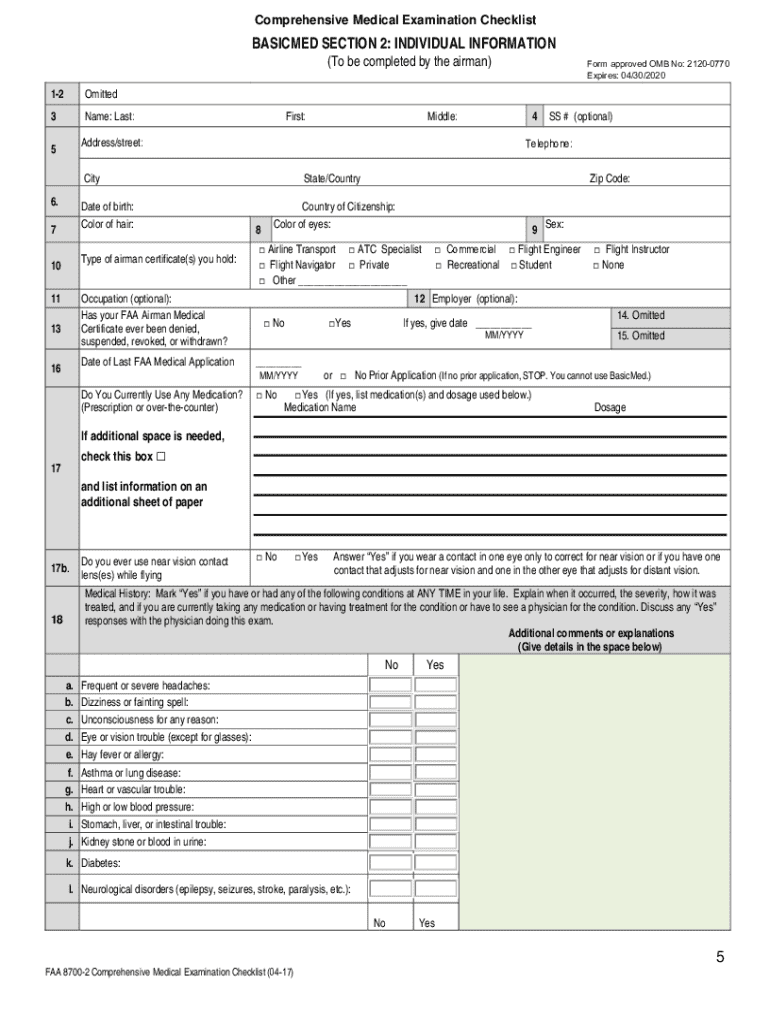





Comprehensive Medical Examination Checklist - faa 2026

Get Form
Comprehensive Medical Examination Checklist - faa Preview on Page 1

Here's how it works

01. Edit your form online
Type text, add images, blackout confidential details, add comments, highlights and more.
02. Sign it in a few clicks
Draw your signature, type it, upload its image, or use your mobile device as a signature pad.
03. Share your form with others
Send it via email, link, or fax. You can also download it, export it or print it out.

Definition and Importance of the Comprehensive Medical Examination Checklist - FAA

The Comprehensive Medical Examination Checklist - FAA serves as a vital document for individuals operating certain small aircraft within the United States. It ensures that pilots meet medical standards set forth by the Federal Aviation Administration (FAA), helping to maintain safety in aviation. This checklist guides both the pilot and the state-licensed physician through necessary medical evaluations. By following this checklist, pilots can verify their fitness to fly, thereby complying with federal aviation safety regulations.

Purpose and Utility

  • Safety Assurance: Ensures pilots are medically fit, reducing the risk of in-flight medical emergencies.
  • Standardized Process: Offers a consistent methodology for assessing pilot health, thus aiding both pilots and physicians in meeting legal and safety requirements.
  • Regulatory Compliance: Supports pilots in maintaining their eligibility to operate aircraft according to FAA rules.

Steps to Complete the Comprehensive Medical Examination Checklist - FAA

To effectively complete the checklist, follow these detailed steps:

  1. Schedule an Appointment: Arrange a meeting with a state-licensed physician familiar with FAA medical requirements.

  2. Initial Review: The physician examines the checklist instructions, ensuring a mutual understanding of the assessment criteria.

  3. Medical Examination: Conduct the comprehensive medical examination, addressing each health element specified in the checklist.

  4. Documentation: Carefully document all findings and ensure that the checklist is accurately filled out, addressing each section.

  5. Review Findings: Discuss the examination results with the physician, clarifying any potential health concerns or necessary follow-up actions.

  6. Submission: Upon completion and confirmation of all necessary fields, submit the checklist to the appropriate FAA office or retain for your records if specific submission is not required.

Important Tips

  • Thorough Preparation: Bring any existing medical records to the examination to expedite the process.
  • Checklist Familiarity: Review the checklist before the appointment to be aware of the specific requirements and tests.

Key Elements of the Checklist

Medical Evaluation Components

  • Medical History: A detailed review of the pilot's medical history, including any past or current conditions.

  • Vision Test: Ensuring visual acuity meets or exceeds FAA standards for safe aircraft operation.

  • Hearing Assessment: Verification of hearing ability, crucial for communication in-flight.

  • Cardiovascular Review: Assess the pilot's heart health to determine susceptibility to cardiovascular events.

  • Neurological Evaluation: Examination to rule out any neurological disorders that could impair pilot performance.

Documentation Requirements

  • Accurate Record-Keeping: Physicians must ensure each section of the checklist is completed with precise, honest data.

  • Signatures: Both the pilot and the physician must sign to validate the authenticity and accuracy of the information provided.

Who Typically Uses the Checklist

The primary users of the Comprehensive Medical Examination Checklist - FAA are:

  • Student Pilots: Verifying initial medical fitness to begin flight training.
  • Private Pilots: Ensuring continued compliance with FAA health standards for personal flying.
  • Recreational Pilots: Meeting reduced but still stringent medical criteria for hobby flying.
  • Aircraft Owners: Individuals owning small aircraft who occasionally pilot their craft.

decoration image ratings of Dochub

Associated Professionals

  • State-Licensed Physicians: Conduct the medical evaluation and provide expert insights into the pilot's health status.

  • Flight Instructors: May assist in understanding the checklist's role in flight training and licensure processes.

Legal Use and Implications

Utilization of the checklist within the legal framework is essential for all involved parties:

  • Compliance with FAA Standards: Essential for maintaining legal eligibility to operate aircraft within the United States.

  • Medical Privacy Considerations: Ensures that all medical information is handled in compliance with privacy laws and regulations.

Consequences of Non-Compliance

  • License Revocation: Failure to comply can result in suspension or revocation of the pilot's license.

  • Safety Risks: Ignoring checklist protocols can endanger the pilot, passengers, and others.

State-Specific Rules and Exceptions

While the FAA sets federal standards, some states may have additional regulations:

  • State Variations: Check for any state-specific medical requirements or documentation procedures that supplement federal guidelines.

Potential Exceptions

  • Medical Waivers: In certain circumstances, pilots may apply for medical waivers due to specific conditions that are typically disqualifying but manageable under specific situations.

Examples of Using the Checklist

Case Study: Recreational Pilot

A 55-year-old recreational pilot underwent the checklist due to a recent change in medication. The physician cleared him for flight after confirming the medication had no adverse effect on his cognitive or motor skills.

Professional Pilot Scenario

For a commercial pilot transitioning to private piloting for personal leisure, the checklist provides a reaffirmation of medical status, ensuring no existing occupational stressors negatively impact personal flying activities.

By thoroughly documenting and understanding these elements and applications of the Comprehensive Medical Examination Checklist - FAA, you can ensure both compliance and safety in aviation activities.

be ready to get more

Complete this form in 5 minutes or less

Get form

Got questions?

We have answers to the most popular questions from our customers. If you can't find an answer to your question, please contact us.
Contact us
An FAA medical examination requires about 30 minutes. Your doctor can perform the physical, and it requires several steps, including: Checking your eyesight and hearing. Performing a complete physical examination of your body including your head, torso, and extremities.May 15, 2024
Before Your FAA Medical Examination Avoid foods/beverages with caffeine, sodium or carbohydrates/sugar at least 8 hrs prior to the exam.
Being disqualified from piloting often stems from serious medical conditions (heart, mental health, substance abuse, seizures, severe vision/hearing issues), certain criminal records (especially for security-related offenses or serious felonies), or failing to meet language proficiency (English) and basic educational requirements, though some issues like certain medical conditions or minor offenses might be managed with time and control, potentially requiring special FAA waivers. Medical Disqualifications (FAA) Psychiatric Disorders: Psychosis, severe personality disorders, bipolar disorder, severe depression, or schizophrenia. Neurological Conditions: Epilepsy, unexplained loss of consciousness, or disturbance of nervous system function. Substance Abuse/Dependence: Current or past issues with drugs or alcohol. Cardiovascular Issues: Heart attacks, untreated coronary heart disease, or permanent pacemakers. Diabetes: Requiring or other hypoglycemic medications. Vision/Hearing: DocHub deficiencies, including color blindness, though some can be overcome with correction. Non-Medical Disqualifications Factors Language Education: Inability to read, speak, and understand English; lack of required education (high school diploma minimum). Criminal History: Security-related offenses (e.g., assaults on aircraft), major felonies, or issues showing lack of judgment or danger to others (TSA can deny). Age: Must meet minimum age requirements for licenses (e.g., 17 for private pilot). Training Skills: Failure to pass required exams, check rides, or lack of necessary flight hours. Weight: Can affect performance in some smaller aircraft, requiring weight loss. Key Takeaway Many conditions arent permanent bans but require evaluation, waivers, and proof of stability through regular reports, emphasizing pilot fitness for duty. What Disqualifies You from Being a Pilot?Jul 31, 2024Superior Flight SchoolWhat can stop me from becoming a pilotJul 17, 2023RReddit r/flying
Checking your eyesight and hearing. Performing a complete physical examination of your body including your head, torso, and extremities. Checking your vital signs including blood pressure, pulse, and respiration. Testing with an electrocardiogram (EKG) to detect any abnormalities in heart rhythm or other heart May 15, 2024
The FAA has provided a checklist that pilots and state-licensed physicians must use to complete the BasicMed examination called a Comprehensive Medical Examination Checklist (CMEC). At the start of the exam, you will ensure that the pilot has completed Part 2 of the checklist and will review their responses.

Security and compliance

At DocHub, your data security is our priority. We follow HIPAA, SOC2, GDPR, and other standards, so you can work on your documents with confidence.

Learn more
ccpa2
pci-dss
gdpr-compliance
hipaa
soc-compliance

People also ask

FAA medical exam disqualifying conditions include serious heart issues (heart attack, pacemaker, valve replacement), neurological disorders (epilepsy, unexplained loss of consciousness, stroke), severe mental health conditions (psychosis, bipolar disorder, severe personality disorder), substance dependence/abuse, and diabetes requiring or hypoglycemic medications, though many disqualifying conditions can still lead to certification via a Special Issuance Authorization if well-managed. Vision/hearing issues, severe hypertension, and certain kidney problems can also be disqualifying. Cardiovascular Conditions Angina pectoris (chest pain from coronary disease) Coronary heart disease (treated or symptomatic) Myocardial infarction (heart attack) Permanent cardiac pacemaker Cardiac valve replacement or heart transplant Neurological Conditions Epilepsy or seizure disorders Disturbance of consciousness (unexplained fainting, blackouts) Transient loss of nervous system function (without cause) Stroke (CVA) or Transient Ischemic Attack (TIA) Mental Health Conditions Psychosis Bipolar disorder Personality disorder (severe enough to manifest in overt acts) Metabolic Substance Use Diabetes mellitus requiring or hypoglycemic medications Substance abuse or dependence (alcohol/drugs) Other Potential Disqualifiers Vision: Severe vision impairment, certain color vision deficiencies (after new 2025 rules). Hearing: Inability to meet standards for normal conversation or voice tests. Kidney: Recent history of kidney stones (requires urologist report). Key Takeaway: Special Issuance Having one of these conditions doesnt always mean permanent disqualification; the Special Issuance (SI) program allows pilots to get certified by demonstrating stable, well-controlled conditions through detailed medical records and evaluations. What medical conditions does FAA consider disqualifying?Angina pectoris. Bipolar disease. Cardiac valve replacement. Coronary heart disease that has been treated or, if untreated, that hFederal Aviation Administration (.gov)FAA Medical Standards and Disqualifying ConditionsThe FAA requires automatic denial or deferral if a pilot has a history of any of the following conditions: 1️ Diabetes requiring hyRamos Law
WHAT IS THE 3P CHECKLIST? The 3P Checklist - Purpose, Partners, and Plan - guides groups through a process for effectively assembling coalitions.

Related links