




Instructions for Form CT-634 - Tax NY 2026

Get Form
Instructions for Form CT-634 - Tax NY Preview on Page 1

Here's how it works

01. Edit your form online
Type text, add images, blackout confidential details, add comments, highlights and more.
02. Sign it in a few clicks
Draw your signature, type it, upload its image, or use your mobile device as a signature pad.
03. Share your form with others
Send it via email, link, or fax. You can also download it, export it or print it out.

Definition and Purpose of Form CT-634

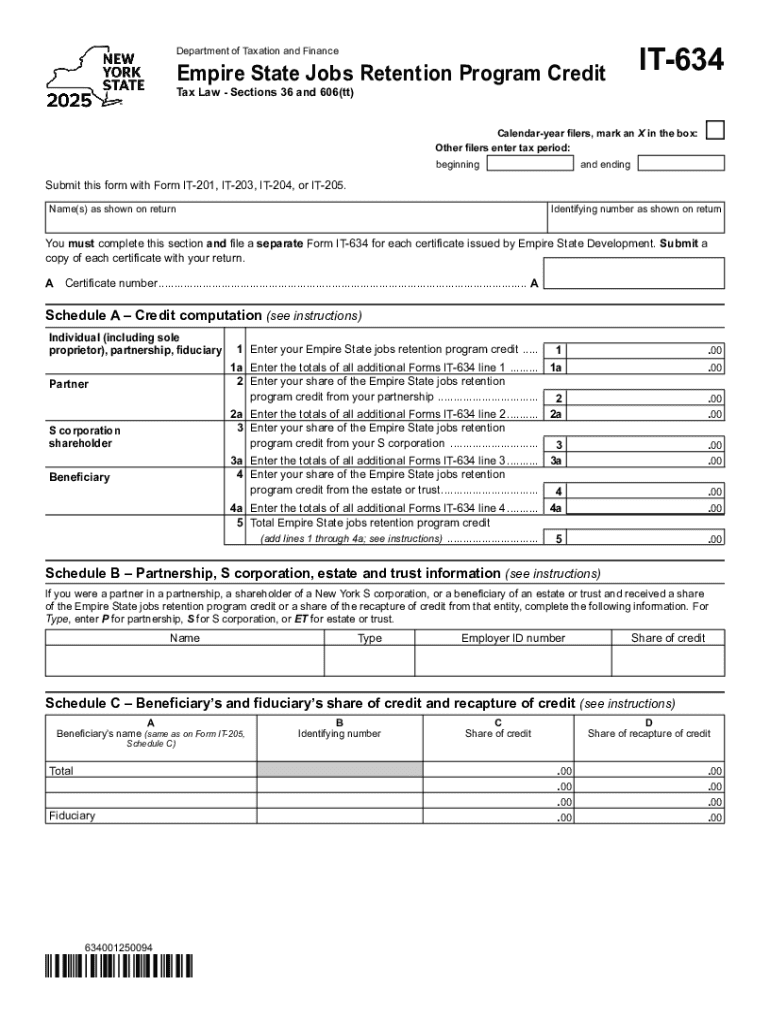
Form CT-634, known as the Empire State Jobs Retention Program Credit, is primarily used by businesses in New York to claim tax credits for retaining jobs within the state. This form is part of the New York State Department of Taxation and Finance’s efforts to incentivize businesses to maintain employment levels during economic challenges, ensuring job stability for residents.

Context and Background

  • Empire State Jobs Retention Program: Established to provide tax credits for businesses that retained jobs during periods of economic difficulty, especially in designated areas affected by natural disasters or economic downturns.
  • Sections 36 and 606(tt) of the Tax Law: These sections outline the legal framework and eligibility criteria for businesses claiming this tax credit, emphasizing the significance of retaining job numbers.

Target Audience

The primary users of this form are corporations or partnerships operating within New York State that meet specific eligibility requirements, including maintaining employment levels during eligible periods. This form is essential for businesses seeking to benefit from the state's tax incentive programs.

Steps to Complete Form CT-634

Completing Form CT-634 involves several detailed steps to ensure accuracy and compliance with the New York State tax laws.

  1. Assess Eligibility: Verify that your business qualifies for the Empire State Jobs Retention Credit by meeting all criteria outlined in sections 36 and 606(tt).

  2. Gather Necessary Information: Collect relevant documents and records, including employment data, financial reports, and prior tax filings that demonstrate job retention during the qualifying period.

  3. Fill Out Business Information: Enter general information about your business, including name, address, Employer Identification Number (EIN), and type of business entity (LLC, corporation, partnership).

  4. Calculate the Credit: Use the instructions provided to calculate the specific tax credit amount based on the number of retained employees and other qualifying factors. This requires detailed documentation of job numbers and related expenses.

  5. Review and Double-Check Data: Ensure all information entered is accurate and matches the supporting documentation to prevent delays or audits.

  6. Submit the Form: Depending on your preference, submit the completed form through the appropriate channel—electronically or via mail.

Practical Example

A New York-based manufacturing company with 100 employees qualifies for this program due to economic challenges posed by local natural disasters. By maintaining employment levels, the company is eligible to claim a significant tax credit, reducing their state tax liability.

Important Terms Related to Form CT-634

Understanding the terminology associated with Form CT-634 is crucial for correct completion and filing.

  • Retention Credit: A tax credit offered to businesses for retaining employees during eligible periods, aimed at reducing their state tax burden.
  • Qualifying Employee: An employee whose position was retained by the business during a predefined period, making them eligible under the program’s guidelines.
  • Eligible Period: The specific timeframe during which job retention qualifies for credit, typically tied to economic events or state designations.

Terminology Examples

  • Retention Agreement: A formal document outlining commitments to retain jobs in exchange for tax credits.
  • Credit Limitation: The maximum allowable credit a business can claim per eligible period, as outlined in sections 36 and 606(tt).

Submission Deadlines and Filing Procedures

Adhering to submission deadlines is critical to ensure eligibility for the Empire State Jobs Retention Credit.

  • Calendar Year Filers: Must mark an "X" in the relevant box to designate their tax year adherence.
  • Other Filers: Enter specific tax periods beginning and ending dates to ensure correct processing.

Key Dates and Deadlines

  • Annual Deadlines: Typically aligned with the state tax filing deadlines, but specific dates are provided each fiscal year by the Department of Taxation and Finance.

Software Compatibility for Form CT-634

Modern tax software can facilitate the completion and submission of Form CT-634, making the filing process more efficient.

  • Supportive Software: Known tax preparation tools like TurboTax and QuickBooks may offer functionalities for filing Form CT-634, integrating with your existing financial data for seamless submissions.
  • Importing Data: Use software to import relevant data from other accounting systems or past tax returns to minimize errors and save time.

Example Usage

A small business uses QuickBooks to track employee data and seamlessly exports this information to TurboTax, which assists in accurately calculating and filing for the Empire State Jobs Retention Credit online.

Eligibility Criteria and Business Types

Form CT-634 is designed to cater to specific business types that meet particular eligibility criteria.

  • Primary Eligibility: Businesses must have retained employees during a qualifying period, ensuring stable headcount despite economic challenges.
  • Business Types Benefiting: Manufacturing firms, service providers, and regional employers within disaster-designated areas.

decoration image ratings of Dochub

Detailed Criteria

  • Economic Impact Zones: Special eligibility for businesses in regions affected by significant economic changes or natural disasters.
  • Application Process: Businesses apply for certification before claiming credit, a necessary step outlined in the New York Tax Law.

Legal Implications and Compliance

Ensuring compliance with legal requirements is crucial when completing Form CT-634 to avoid penalties.

  • Disclosure Requirements: Full disclosure of employment data and related financial information is mandatory.
  • Penalties for Non-Compliance: Incomplete or inaccurate filings might result in fines or loss of eligibility for future credits.

Real-World Compliance Example

A retail business inadvertently omits significant employment data from their form submission, leading to a review and temporary suspension of their credit, illustrating the importance of thorough and accurate disclosures.

Form CT-634 Variations and Related Forms

Occasionally, variations or related forms may extend the functionality or adjust the applicability of Form CT-634.

  • Older Form Versions: While older versions are largely obsolete, understanding historical changes can be beneficial for long-standing businesses that have previously applied.
  • Alternative Forms: Business credit programs under different sections of the New York Tax Law provide complementary benefits, potentially useful for varying scenarios.

Form Utilization Example

A tech company also qualifies for a related credit program due to its strategic importance and job creation efforts in a rapidly developing industry region, supplementing their CT-634 filing.

be ready to get more

Complete this form in 5 minutes or less

Get form

Got questions?

We have answers to the most popular questions from our customers. If you can't find an answer to your question, please contact us.
Contact us
To fill out the New York State withholding form (IT-2104), provide personal details, select your filing status, use the accompanying worksheet to calculate allowances (claiming fewer for more tax withheld or more for less), check boxes for NYC/Yonkers residency, and sign and date the form before giving it to your employer to ensure correct state and local tax deductions. Step-by-Step Guide for Form IT-2104 Personal Information: Fill in your name, address, and Social Security Number at the top. Residency (NYC/Yonkers): Indicate if you live in New York City or Yonkers so your local taxes are also withheld. Filing Status: Check the box for your filing status (Single, Married, Head of Household, etc.). Allowances (The Worksheet): Use the worksheet in the instructions to determine your total allowances for NY State/Yonkers and NYC separately. More allowances mean less tax withheld; fewer allowances mean more tax withheld. If you have multiple jobs or your spouse works, youll need to adjust allowances (often claiming fewer) to avoid under-withholding. For nonwage income (like investments), you generally reduce allowances. Additional Withholding: If you want more tax taken out (e.g., to cover bonuses or if you underpaid last year), enter an extra dollar amount on lines 3, 4, or 5. Sign and Date: The form is not valid without your signature and the date. Submit: Give the completed form to your employers payroll department. Key Tips Use the Worksheet: Always complete the worksheet (usually in the instructions) to get accurate allowance numbers. Multiple Jobs: If you and your spouse both work, the higher-earning spouse should claim most allowances, and the lower-earning spouse should claim fewer (or zero). Update When Needed: Update your IT-2104 after major life changes or if youre consistently over/under-withholding. For financial advice, consult a professional. Instructions for Form IT-2104 Employees Withholding Allowance Dec 16, 2025 Overview. Form IT-2104 is completed by you, as an employee, and given to your employer to instruct them how much New YDepartment of Taxation and Finance (.gov)Form IT-2104 Employees Withholding Allowance Certificate Tax Year 2026Page 1. First name and middle initial. Last name. Your Social Security number. Permanent home address (number and street or rural Department of Taxation and Finance (.gov)
0:00 0:50 Live in New York City or Yoners. Make sure to check the right box so your city tax gets withheld tooMoreLive in New York City or Yoners. Make sure to check the right box so your city tax gets withheld too. And dont forget to sign and date the form its not valid without your signature.
For state taxes (and federal), the 0 or 1 allowance choice is largely outdated on the new W-4, but it still reflects a choice: Claiming 0 means more tax withheld for a bigger refund (or less owing), while claiming 1 (or more) means a smaller withholding for a larger paycheck, with the potential to owe taxes later, making it a personal budgeting decision. The key is to adjust withholdings so you get close to a zero refund/owing situation, not a huge one, by accurately reflecting your filing status, dependents, and extra income/deductions on the form. Claiming 0 (More Withholding) Get More Back: Youll get a larger refund at tax time. Less Take-Home: Your paychecks will be smaller. Best For: People who want a guaranteed refund or if you have multiple jobs (claim allowances at your main job). Claiming 1 (Less Withholding) Bigger Paychecks: You get more money in your pocket each payday. May Owe Taxes: You might owe money come tax time if you dont withhold enough. Best For: People who prefer a larger paycheck now and want to budget their own tax money throughout the year. Key Considerations Modern W-4: The IRS updated the federal W-4 (and most state forms follow) to use steps for dependents and other income/deductions, replacing the old allowance system, so youll fill out the form differently now. State vs. Federal: While the federal W-4 changed, some state forms (like New Yorks IT-2104 or Californias DE-4) still use allowance numbers, but the principle of more allowances = less withholding remains. Goal: Aim to have the right amount withheld so you neither owe a lot nor get a massive refund, which means youre essentially loaning the government your money interest-free. For financial advice, consult a professional. Should I claim 0 or 1 on a form w4 for tax withholding Nov 18, 2021 Consulting a financial advisor about your particular circumstances is best. According to the IRS Estimator, the perfecTurboTax SupportInstructions for Form IT-2104 Employees Withholding Allowance Dec 16, 2025 If you have more than one job. If you have more than one job, file a separate IT-2104 certificate with each of your emDepartment of Taxation and Finance (.gov)
How To Fill Out a W-4: Requirements for Employees Step 1: Provide Required Personal Information. Step 2: Report Eligible Job Income. Step 3: Review Dependent Tax Credits. Step 4: Add Additional Sources of Income. Step 5: Sign and Date Form W-4. Oct 30, 2025
To determine your NY state withholding, you need to fill out Form IT-2104, Employees Withholding Allowance Certificate with your employer, as it depends on your income, filing status, and local taxes (NYC/Yonkers), but generally, NY has progressive rates from 4% to 10.9%, plus potential NYC (3.078%-3.876%) or Yonkers surcharges, so use the official NY Tax Dept tables or a calculator for accuracy. Key Factors for NY Withholding: Progressive Rates: New Yorks income tax uses brackets, so higher income means a higher percentage is withheld (4% to 10.9%). Location Matters: New York City: Residents and workers pay an additional local income tax (approx. 3.078% to 3.876%). Yonkers: Residents and workers pay a separate Yonkers surcharge. Form IT-2104: This is crucial for telling your employer how much to withhold; dont rely solely on your federal W-4, as NY has different rules. Supplemental Wages: Bonuses and commissions have a flat supplemental rate (e.g., 11.70% for NY State, 4.25% for NYC). How to Determine Your Withholding: Get Form IT-2104: Contact your employer for this form, or download it from the NYS Department of Taxation. Calculate Allowances: Follow the instructions on Form IT-2104 for personal allowances and any additional amounts you want withheld. Use Official Resources: Refer to the NYS Department of Taxations Withholding Tax Tables (Publications NYS-50-T-NYS, NYS-50-T-NYC, NYS-50-T-Y) for the most accurate 2026 calculations. Check Online Calculators: Use reputable payroll or tax websites with NY calculators (like OnPay, SmartAsset, PaycheckCity) to estimate your paychecks. In short: Your withholding isnt a single number but a calculation based on your specific income and location, best determined by completing your IT-2104 form accurately for your employer. For financial advice, consult a professional. Withholding tax amount to deduct and withhold - Tax.NY.govDec 2, 2025 If the federal Form W-4 most recently submitted by an employee was for tax year 2019 or earlier, and the employee did nDepartment of Taxation and Finance (.gov)Free New York Payroll Calculator | 2026 NY Tax Rates - OnPayJan 1, 2026 New York State payroll taxes. Calculating taxes in New York is a little trickier than in other states. The state as a wOnPay

Security and compliance

At DocHub, your data security is our priority. We follow HIPAA, SOC2, GDPR, and other standards, so you can work on your documents with confidence.

Learn more
ccpa2
pci-dss
gdpr-compliance
hipaa
soc-compliance

People also ask

The Child Tax Credit (CTC) offers up to $2,200 per qualifying child (under 17 at year-end) for the 2025 tax year, partially refundable up to $1,700 (Additional Child Tax Credit) if income is low, with income phase-outs at $200,000 for single filers and $400,000 for married couples. To qualify, the child must meet relationship, age, residency, support, and citizenship tests, and have a valid SSN, while the taxpayer must claim them as a dependent and meet income requirements. Child Qualification Rules For a child to qualify, they must meet these tests: Age: Under age 17 at the end of the tax year (2025). Relationship: Your son, daughter, stepchild, eligible foster child, sibling, or a descendant (e.g., grandchild, niece, nephew). Support: Did not provide more than half of their own financial support. Residency: Lived with you for more than half the year (with exceptions). Citizenship: U.S. citizen, U.S. National, or U.S. resident alien. Social Security Number (SSN): Must have a valid SSN for employment. Dependent: Must be claimed as your dependent on your tax return. Joint Return: Cannot file a joint return, unless only to claim a refund. Taxpayer Income Rules Credit Amount: Up to $2,200 per child, with up to $1,700 potentially refundable as the Additional Child Tax Credit (ACTC) if you have little tax owed. Income Phase-Out: The credit starts to phase out for income over $200,000 (single) or $400,000 (married filing jointly). Earned Income: To get the refundable portion (ACTC), you need at least $2,500 in earned income. Key Takeaway The Child Tax Credit is a DocHub benefit, but strict rules on the childs age, relationship, and citizenship, plus your income level, determine eligibility for the full amount or any refundable portion. For financial advice, consult a professional. Child Tax Credit | Internal Revenue ServiceNov 18, 2025 Be your son, daughter, stepchild, eligible foster child, brother, sister, stepbrother, stepsister, half-brother, half-IRS (.gov)The child tax credit benefits eligible parents | Internal Revenue ServiceTo qualify for the child tax credit, taxpayers must: * Claim at least one child as a dependent on their tax return * List the chilIRS (.gov)

Related links