




01. Edit your form online
Type text, add images, blackout confidential details, add comments, highlights and more.

Type text, add images, blackout confidential details, add comments, highlights and more.

Draw your signature, type it, upload its image, or use your mobile device as a signature pad.

Send it via email, link, or fax. You can also download it, export it or print it out.
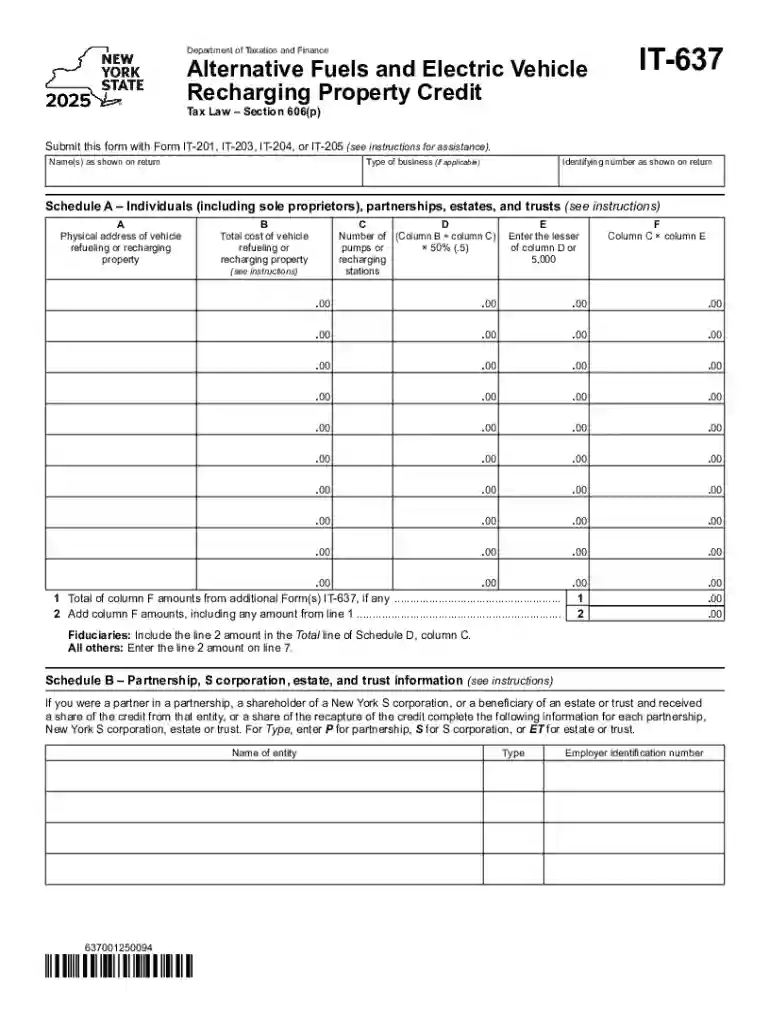
The Form IT-637, also known as the Alternative Fuels and Electric Vehicle Recharging Property Credit, is a form used by taxpayers in the United States to claim tax credits related to the installation of alternative fuel or electric vehicle recharging properties. The credit is designed to incentivize and support the adoption of cleaner and renewable energy sources by reducing the financial burden associated with infrastructure improvements for alternative fuels.
Eligibility for the Form IT-637 tax credit hinges on several factors. Primarily, individuals or businesses that install qualifying alternative fuel vehicle refueling stations or electric charging infrastructures can avail these credits. Additionally, specific criteria pertain to the type of equipment installed and its use. For instance, personal-use and commercial-use properties might be evaluated differently. It is essential to review the Tax Law Section 606(p) for a comprehensive understanding of eligibility requirements.


Gather Necessary Documentation: Make sure you have documentation of the costs incurred for the installation of the relevant infrastructure.
Download the Form: Obtain a copy of the Form IT-637 from the Department of Taxation and Finance website or through tax software that supports it.
Complete Part 1: Enter personal information, including your identification details.
Report Installation Details: Provide specific details about the equipment and installation on the form as required.
Calculate the Credit: Use the instructions provided within or with the form to properly compute your eligible credit.
Attach Supporting Documents: Attach evidence of installation costs, including invoices or contracts.
Submit Your Form: File with Forms IT-201, IT-203, IT-204, or IT-205 as appropriate, ensuring submission within the specified deadlines.
When filing Form IT-637, several documents support your credit claim:
The Form IT-637 is governed by state tax laws, particularly articulated in Section 606(p) of the Tax Law. Adherence to these statutory provisions is critical for ensuring compliance and avoiding penalties. The form must align with relevant IRS guidelines related to property credits, ensuring that the credits claimed are in accordance with federal and state laws governing environmental and energy-efficient measures.
While the form itself is standardized across the United States, there are state-specific regulations and additional incentives for electric vehicle and alternative fuel infrastructure. It is important to reference your state’s particular modifications or additional mandates that may apply to the tax credit.
Failure to accurately report or file Form IT-637 can result in penalties, including fines and the disallowance of the claimed tax credit. Incorrectly filing for credits that taxpayers are not eligible for or neglecting to report accurately could invite audits and potential legal consequences. Therefore, careful preparation and substantiation of claims are necessary.
Understanding the depth and specifics of Form IT-637's application, legal obligations, and benefits can facilitate maximizing available credits while ensuring compliance with all regulatory mandates.
We've got more versions of the Form IT-637 Alternative Fuels and Electric Vehicle form. Select the right Form IT-637 Alternative Fuels and Electric Vehicle version from the list and start editing it straight away!
At DocHub, your data security is our priority. We follow HIPAA, SOC2, GDPR, and other standards, so you can work on your documents with confidence.






Dec 12, 2025 You may claim this credit if you invest in qualifying alternative fuels vehicle refueling property or electric vehicle recharging property.Read more
Apr 10, 2009 fuels only. See Form 637 for other persons who. Removal from refinery. The removal of gaso- must register and for more information about.Read more
Apr 27, 2017 Alternative fuel is any liquid other than gas oil, fuel oil, or any product taxable under section 4081. You are liable for tax on alternativeRead more


