






Definition & Meaning
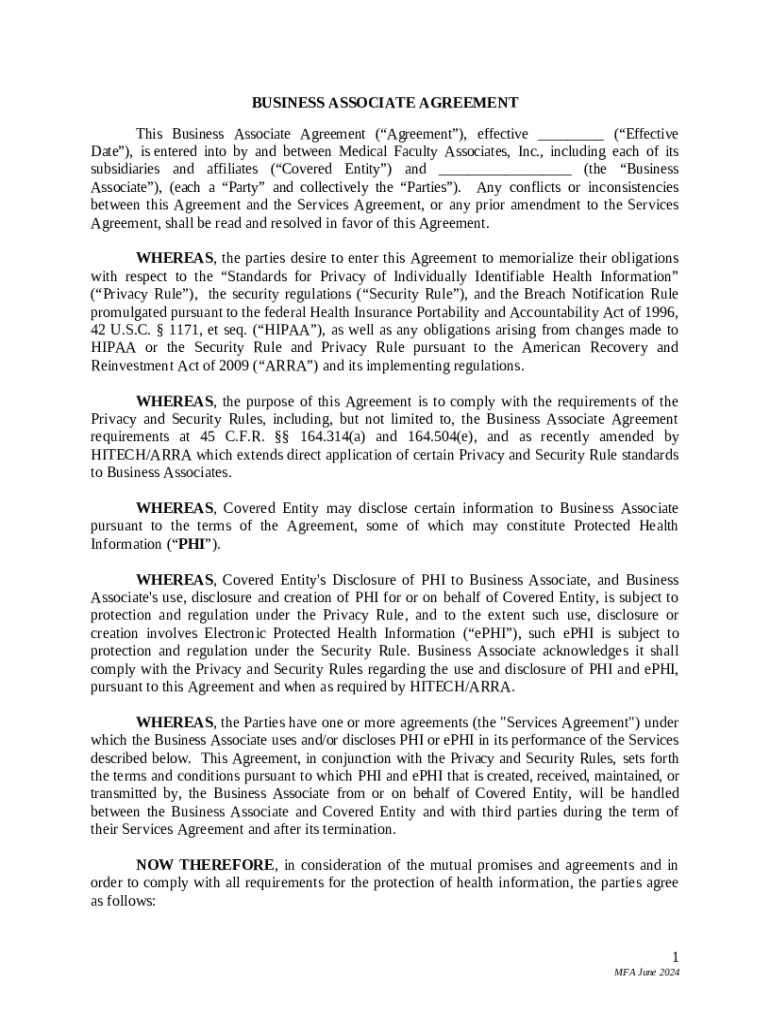
A "Business Associate Agreement" (BAA) is a legally binding document that outlines the responsibilities, obligations, and compliance criteria for business associates who handle Protected Health Information (PHI) on behalf of covered entities. The BAA is pivotal in ensuring that all parties adhere to the Health Insurance Portability and Accountability Act (HIPAA), safeguarding PHI from unauthorized access, use, or disclosure. It lays down the framework for how PHI should be handled, alongside delineating the consequences of non-compliance. Specific definitions and meanings within the agreement can significantly affect the legal and operational dimensions of the partnering entities, making it crucial that all parties understand the precise uses and applications of each term.
- Covered Entities: Typically include health plans, health care clearinghouses, and health care providers who transmit health information electronically.
- Business Associates: Any entity or individual performing activities for or on behalf of a covered entity that involves access to PHI.
Steps to Complete the Business Associate Agreement
Completing a BAA involves a series of methodical steps to ensure legal compliance and mutual understanding between parties. Here is a comprehensive guide:
- Identification of Parties: Clearly define who the covered entity and the business associate are, along with full legal names and contact details.
- Outline Obligations: Specify the responsibilities that each party carries with respect to the protection and management of PHI.
- Detail Permitted and Required Uses: Identify what PHI can be used for, any restrictions on use, and requirements for confidentiality.
- Security Measures: Both parties must articulate specific security measures to protect PHI, including encryption and access controls.
- Breach Notification Processes: Describe the notification procedures and timelines for any PHI breaches.
- Termination Clauses: Establish conditions under which the BAA can be terminated and obligations post-termination.
- Mutual Agreement on Terms: Both parties must review and agree to the terms through signatures, making the agreement legally binding.
Key Elements of the Business Associate Agreement
Certain elements are fundamental to a BAA, serving as the backbone for ensuring compliance:
-
Scope of Work: The BAA should specify exactly what services the business associate will provide and any PHI they will handle.
-
Use and Disclosure Limitations: Define the permissible and necessary uses of PHI, ensuring they align with the covered entity's objectives and policies.
-
Data Safeguards: All parties must adhere to federal and state requirements for safeguarding PHI, such as through administrative, physical, and technical protections.
-
Breach Protocols: Define the steps and responsibilities if PHI is compromised, including timelines and communication methods.
-
Subcontractor Compliance: Ensure that any subcontractors also adhere to BAA terms to protect PHI at all levels of service provision.
Legal Use of the Business Associate Agreement
The BAA operates within a rigorous legal framework, maintaining compliance with federal regulations such as HIPAA:
-
HIPAA Compliance: Ensures business associates handle PHI in compliance with HIPAA standards, reducing risks of legal exposure.
-
Liability and Indemnification: Outlines liability for breaches or violations, and indemnification clauses to protect covered entities.
-
Compliance with Federal and State Laws: Requires staying current with evolving legal statutes and adjusting agreements accordingly.
-
Audit Rights: May include provisions for auditing the business associate’s procedures and policies for handling PHI.
-
Confidentiality Obligations: Extends confidentiality provisions even after the agreement’s termination, underscoring the ongoing nature of compliance.
Examples of Using the Business Associate Agreement
Real-world applications of BAAs underscore their importance in safeguarding PHI across a range of business interactions:
- Healthcare IT Providers: Offering cloud services to health entities must sign a BAA to ensure they manage PHI according to HIPAA requirements.
- Billing Companies: Working with PHI for claims processes necessitates a BAA to delineate data handling and privacy practices.
- Telemedicine Platforms: These platforms must engage in BAAs to manage patient information securely and compliantly.
In each of these scenarios, the BAA serves as the pivotal document ensuring that PHI remains protected and that both parties have clear, legally enforceable guidelines to follow.
Important Terms Related to Business Associate Agreement
Understanding key terminology is essential for grasping a BAA’s implications:
- Protected Health Information (PHI): Information relating to the past, present, or future physical or mental health of an individual that is held by a covered entity or business associate.
- Electronic Protected Health Information (ePHI): PHI that is stored or transmitted electronically.
- Minimum Necessary Standard: Requirement that stipulates making reasonable efforts to disclose only the minimum necessary PHI for a particular task.
- Data Encryption: The process of converting information into a secure format that is inaccessible without proper decryption tools.
Understanding these terms can aid significantly in ensuring all parties clearly comprehend their roles and responsibilities concerning PHI.
Who Typically Uses the Business Associate Agreement
A diverse range of entities utilize BAAs to maintain compliance and protect PHI:
- Healthcare Providers: Hospitals, clinics, and individual practitioners engage business associates for various services—ranging from billing to record management.
- Software as a Service (SaaS) Providers: Providing platforms for managing patient information necessitates a BAA for legal and data protection compliance.
- Legal and Consulting Firms: When these entities access and utilize PHI in the pursuit of their professional services, they must adhere to BAA requirements to curtail potential data breaches.
Each user of a BAA benefits from the structure it provides, reinforcing mutual responsibilities and legal compliance in handling sensitive information.


State-Specific Rules for the Business Associate Agreement
While BAAs are predominantly guided by federal law, state laws can introduce additional priorities:
- California: Additional privacy obligations through the California Consumer Privacy Act (CCPA) affecting health data outside of HIPAA.
- Texas: Implements more rigorous standards under the Texas Medical Privacy Act, which may necessitate additional BAA provisions.
- New York: Enforces the New York SHIELD Act, possibly requiring adjustments to BAAs regarding data security practices.
Navigating these state-specific nuances ensures that business associates and covered entities remain compliant across different jurisdictions, avoiding penalties and maintaining data integrity.