



01. Edit your form online
Type text, add images, blackout confidential details, add comments, highlights and more.

Type text, add images, blackout confidential details, add comments, highlights and more.

Draw your signature, type it, upload its image, or use your mobile device as a signature pad.

Send it via email, link, or fax. You can also download it, export it or print it out.
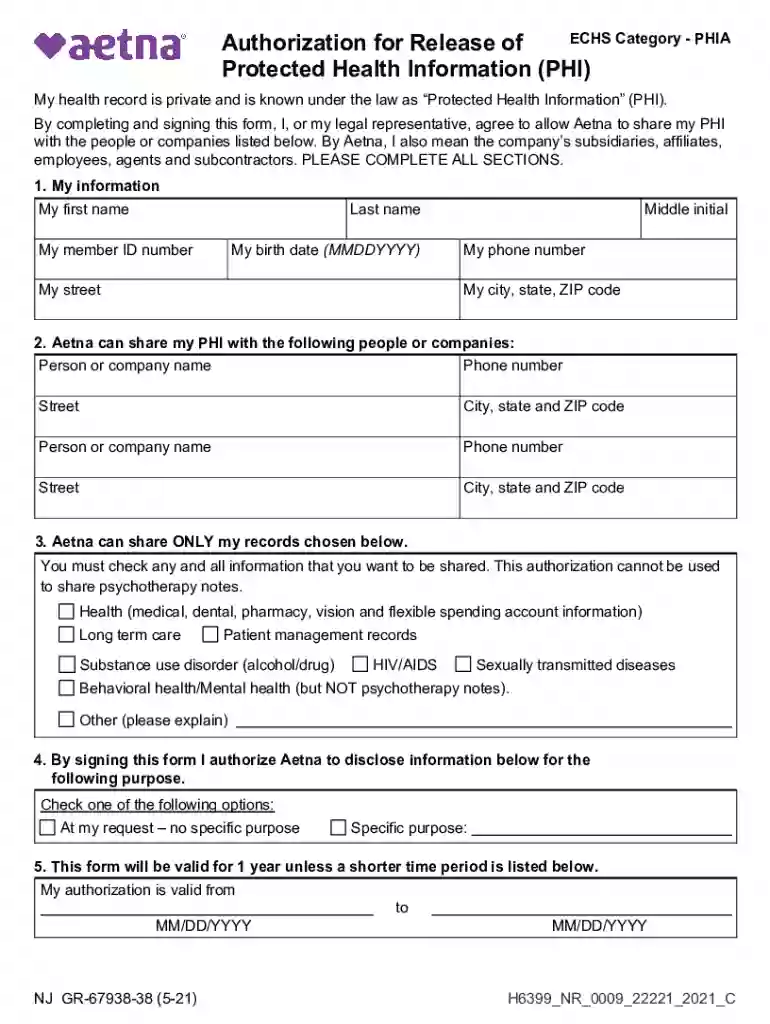
Authorization for Release of Protected Health Information (PHI) is a formal document required by Aetna to give permission for the disclosure of an individual's health records. This legal form ensures that personal health information is shared with specified parties, complying with HIPAA regulations. The form specifies what information can be released, to whom, and for what purpose, maintaining the privacy and security of sensitive health data.
To use the Aetna Authorization for Release of PHI, identify the specific health information you want to disclose. Follow these steps:
Completing the form involves the following procedure:
Ensure accuracy in each section to avoid processing delays.
Using this form ensures legal compliance with HIPAA and provides:
This form is commonly used by:

The form comprises critical parts necessary for a valid authorization:
This form is legally binding and adheres to HIPAA regulations, ensuring patient privacy is maintained. The form outlines explicit consent from the patient, demonstrating voluntary agreement to share health information. It is used in compliance with federal and state laws to prevent unauthorized disclosure of protected health information.
Some states may have additional regulations or requirements that affect the use of this form. For example:
Consult state-specific guidelines to ensure compliance with local laws regarding health information release.
At DocHub, your data security is our priority. We follow HIPAA, SOC2, GDPR, and other standards, so you can work on your documents with confidence.




By completing and signing this form, I, or my legal representative, agree to allow Aetna to share my PHI with the people or companies listed below. By Aetna, IRead more
It may cover chronic diseases, behavioral health conditions and alcohol or drug abuse. It may cover communicable diseases, sexually transmitted diseasesRead more
Dec 31, 2020 Health care providers must include in their NPPs a statement about an individuals right to restrict disclosures of protected health informationRead more


